
doubao.com
King's Pawn Opening
Opening Insights: Chess Openings Series
Hi everyone, I am Jason.
Recently, I will publish a series of blogs about chess openings (Opening Insights: Chess Openings Series), including 5 commonly used openings.
The King's Pawn Game is a classic opening system in chess. It starts with White playing 1.e4, that is, advancing the pawn in front of the king two squares forward.Look it: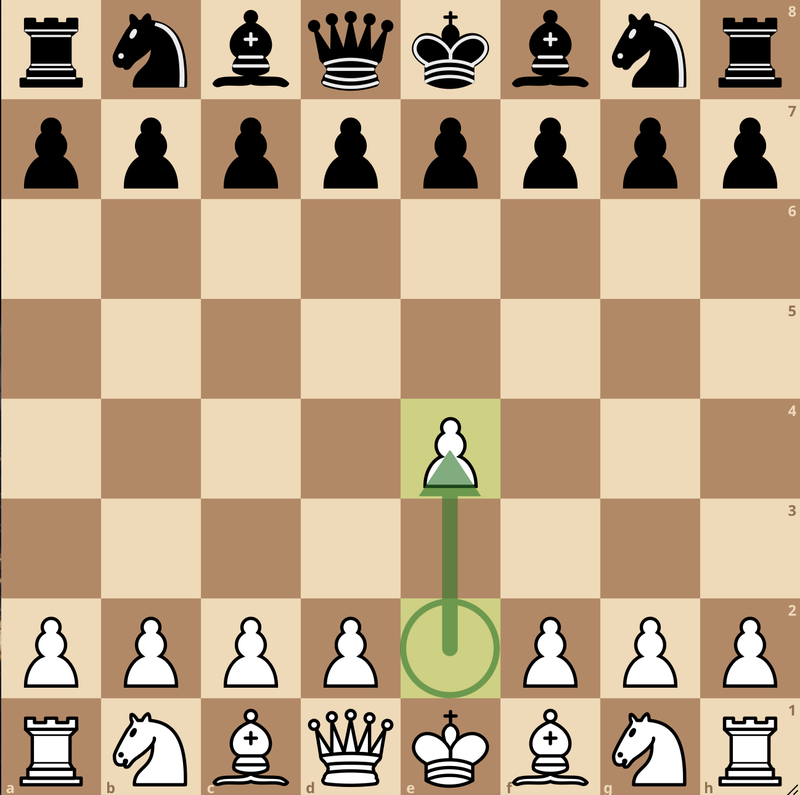
Characteristic
Quick development of pieces:
The move e4 can control key squares such as f5 and d5, opening up diagonal lines for the queen on d1 and the bishop on f1 to develop, which is conducive to the quick development of pieces for launching a rapid attack.
Open position:
The King's Pawn Opening makes the position open, likely to trigger intense battles, and is suitable for players who like to attack and open up the position quickly.
Complex variations:
Due to its long history, it has been extensively analyzed, giving rise to numerous variations. The black side has various response methods. As long as either side makes a wrong move in the attack or defense, it may lead to an unfavorable situation.
History and Status:
In the 18th and 19th centuries, the King's Pawn Opening was considered the only first move in the opening, with a profound historical heritage. Anatoly Karpov, a chess king, also chose the King's Pawn Opening as his only opening option in the early stage of his career. Today, it remains a very popular opening method in chess, deeply loved by many chess players, and a large number of wonderful games start with this opening.
Common Variations:
Italian Game
Basic Move Sequence:
1 .e4 e5
2 .Nf3 Nc6
3 .Bc4 (White places the bishop on c4, aiming at the weak square f7 of Black, which is a characteristic move of the Italian Game)
Core Idea
White rapidly develops the pieces on the kingside (Knight on f3, Bishop on c4), directly exerting pressure on the weak square f7 of Black's kingside, while controlling the key central squares (d5, f5). The goal is to launch an early offensive on the kingside. Black needs to balance defense and the fight for the center, avoiding the breakthrough of the f7 square.
The Ruy López Opening (also known as the "Luis López Opening")
Basic Move Sequence
1 .e4 e5
2 .Nf3 Nc6
3 .Bb5 (The white bishop on b5 aims diagonally at the black knight on c6, indirectly threatening the pawn on e5. At the same time, it pins the black knight on c6 and the pawn on a7, which is the core symbol of the Ruy López Opening)
Core Idea
Instead of directly attacking f7, White gradually exerts pressure on the center by pinning the black pieces in the center (the knight on c6 protects the pawn on e5), restricting Black's piece development, and creating conditions for subsequent central consolidation (such as advancing d4) or kingside attacks. Black needs to break the pin and seize the initiative in the center. It is an opening with a strong strategic depth.
The King's Gambit
Basic move sequence
1 .e4 e5 2 .f4 (White sacrifices the f-pawn to gain control of the center and offensive speed. It is one of the most aggressive variations in the King's Pawn Opening)
Core idea
By sacrificing the f-pawn (2.f4), White opens the f-file and the f1-a6 diagonal, quickly activating the pieces on the kingside (such as Bc4, Nf3), creating an early offensive on the kingside. White takes advantage of the defensive loopholes on the kingside after Black accepts the sacrificed pawn (such as the weakening of the f7-pawn) to launch an attack. Black needs to choose between "accepting the sacrificed pawn" or "declining the sacrificed pawn", which determines the direction of the game.
Sicilian Defense
Basic Move Sequence
1 .e4 c5 (Instead of directly responding symmetrically with e5, Black advances c5, indirectly competing for the center. This is one of the most popular defenses for Black against 1.e4)
Core Idea
Black controls the d4 square (White's ideal central pawn advance point) with the c5 pawn, plans to consolidate the center with d6 subsequently, and then develops pieces like Nc6 and Nf6, gradually advancing the c-pawn to c4 and launching a counterattack on the queenside. White, on the other hand, needs to advance d4 (usually 2.Nf3 Nc6 3.d4 cxd4 4.Nxd4) to compete for the center, forming branches such as the "Open Sicilian" or the "Closed Sicilian". The two sides engage in a long - term game in the confrontation between the center and the flanks.
The King's Pawn Opening and the Player's Style:
The open and aggressive characteristics of the King's Pawn Opening make it more favored by attacking players. Such players usually have a bold, decisive, and adventurous style. They like to take the initiative and seek winning opportunities through complex situations. For example, some players known for their sharp attacks, such as Alekhine, often use the King's Pawn Opening. They take advantage of its open nature to quickly develop their pieces and launch fierce attacks on the black's position. However, this doesn't mean that steady players won't use the King's Pawn Opening. They can choose some relatively stable variations, such as certain variations in the Ruy Lopez Opening, to control the situation and steadily accumulate advantages.
Okay, that is all!
My Next Blog: Queen's Pawn Game!!!
https://lichess.org/@/Chejason/blog/the-queens-pawn-opening-the-solid-strategic-foundation-in-chess/TPgGE9lb


