
How to Train Chess Tactics: A Step-by-Step System
 In the previous article, we discussed how to evaluate your own play and identify the specific weaknesses that are holding you back. If you haven’t read it yet, I recommend starting there.
RU версия: https://lichess.org/@/Ferstep/blog/-/lvfmoSEk
EN version: https://lichess.org/@/Ferstep/blog/chess-diagnosis-find-your-biggest-weaknesses/8bd1XHlb
One of the most common conclusions after such an assessment is that you need to improve your tactical vision. At this point, many players begin solving dozens of tactical puzzles every day, hoping to see quick improvements in their games. In practice, however, this often does not happen.
The problem usually lies not in the number of puzzles solved, but in the quality of the training itself. In this article, we will break down a step-by-step system that can turn tactical puzzle solving into an effective tool for chess improvement, rather than simply a way to increase your puzzle rating.
Why Train Chess Tactics?
Chess tactics are about finding a concrete sequence of moves that leads to an immediate advantage: winning material, delivering checkmate, reaching a winning endgame, or gaining a decisive positional advantage. Unlike strategy, which answers the question, “What plan should I choose?”, tactics answers, “How can I take advantage of this opportunity right now?”
Almost every tactical combination is based on familiar tactical motifs such as pins, forks, discovered attacks, deflections, overloading, removing the defender, and many others.
For most players below roughly the 2000–2200 level, tactics have the biggest impact on practical results. The reason is simple: far more games are decided by a single tactical oversight than by subtle strategic mistakes. You may play the opening well and reach a comfortable position, but one tactical mistake can throw away all the work you've done. On the other hand, finding the right tactical idea at the critical moment can save a difficult position—or even win the game outright.
Regular tactical training develops several important chess skills at the same time.First and foremost, tactical training improves your calculation skills—the ability to accurately calculate variations without making mistakes. At the same time, it strengthens your pattern recognition, allowing you to spot many tactical ideas almost instantly. Over time, it also develops disciplined thinking: the habit of checking your opponent's threats, looking for forcing moves, and evaluating the consequences of every candidate move.
All of these skills carry over directly into your tournament games, making your play more accurate, confident, and consistent.
Common Mistakes in Self-Training
 Most chess players solve tactical puzzles on a regular basis, yet not all of them make significant progress. The reason is simple: they repeat the same mistakes over and over, turning tactical training into entertainment rather than a tool for improvement.
Playing for the puzzle rating. Many players begin to treat their puzzle rating as the ultimate goal. As a result, they focus on gaining rating points instead of carefully analyzing each position. A high puzzle rating alone does not guarantee that you'll spot tactical opportunities in your own games.
Guessing the first move. This is one of the most common mistakes. Players find the obvious first move, play it, and immediately check the solution. However, solving a tactical puzzle means calculating the entire variation to the end. If you can't explain why every move in the combination works, you haven't truly solved the puzzle.
Solving only easy puzzles. Easy puzzles are useful for warming up and reinforcing tactical patterns, but if they never challenge you, your improvement will eventually stall. To keep progressing, you need puzzles that force you to calculate deeply and occasionally expose weaknesses in your thinking.
Constantly switching between platforms. Lichess today, Chess.com tomorrow, then a mobile app or a tactics book. This lack of consistency makes your training fragmented and your progress much slower. It's far more effective to choose one primary training resource and use it systematically over a long period.
Lack of a System. This is perhaps the most common mistake of all. Many players solve tactical puzzles whenever they happen to have a few free minutes, with no clear plan, no consistent routine, and no review of their mistakes. While this approach may be enjoyable, it rarely leads to lasting improvement.
What really matters is consistency, training with appropriately challenging puzzles, and carefully analyzing the positions you get wrong. These are the key elements of effective tactical training—and they form the foundation of the system we'll explore in the following sections.
Where Should You Train Chess Tactics?
Every training platform has its own strengths and weaknesses, so the best choice depends on your training goals—not on which platform is the most popular.
Lichess is an excellent free option for regular tactical training. It allows you to solve mixed puzzles, focus on specific tactical motifs, and even train using positions from your own games. Its biggest strengths are its extensive puzzle database, clean interface, and the fact that nearly all features are available for free. The main drawback is that the puzzle format can encourage guessing the first move instead of calculating the entire variation. Lichess is ideal for daily practice, warm-ups, and reinforcing tactical patterns.
ChessTempo is better suited for structured, long-term improvement. It allows you to create custom puzzle sets, adjust the difficulty, and systematically revisit puzzles you previously missed. Its main disadvantages are a less intuitive interface and a steeper learning curve due to the number of available settings. ChessTempo is an excellent choice if you want to follow a long-term training plan, track your progress, and regularly review challenging puzzles.
Chess.com offers a polished interface, themed puzzle collections, Puzzle Rush, and several time-based training modes. It is particularly effective for developing fast pattern recognition and fitting short training sessions into your day. However, many advanced features require a subscription, and constantly solving puzzles against the clock can encourage superficial calculation instead of deep analysis. Chess.com is best suited for warm-ups, speed training, and maintaining motivation.
Books remain one of the best tools for developing calculation skills, strategic thinking, and disciplined analysis. Because you can't instantly reveal the solution, you're forced to calculate every variation yourself before checking the answer. This closely resembles the thinking process required in a real game. The main drawbacks are the lack of built-in statistics and the need to track your progress manually.
Books are especially valuable for deep, focused training, tournament preparation, and improving your ability to calculate variations entirely in your head.
The most effective approach is to choose one online platform for your daily tactical training and complement it with a good tactics book for more serious, in-depth study.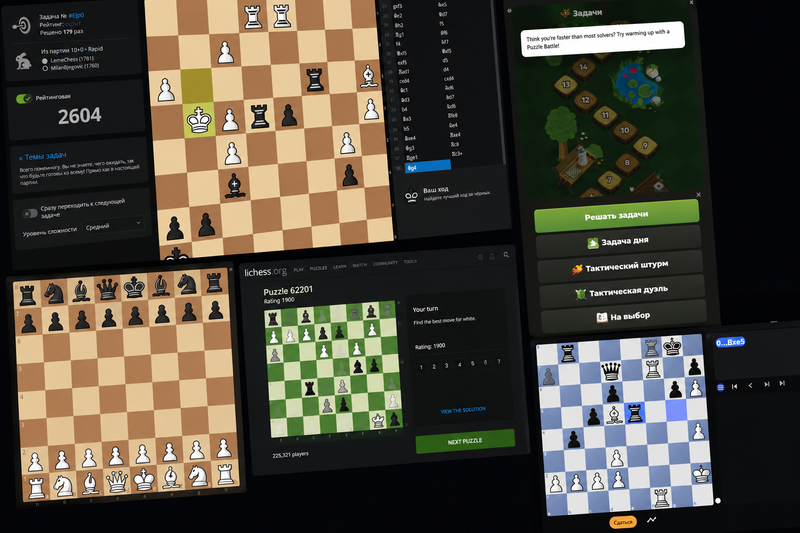
How to Choose the Right Puzzle Difficulty?
One of the most common mistakes in tactical training is choosing the wrong puzzle difficulty. If the puzzles are too easy, your improvement quickly plateaus. You'll simply recognize familiar patterns without having to calculate different variations. This type of practice is useful as a warm-up, but it does little to strengthen your calculation skills.
The opposite extreme is choosing puzzles that are too difficult. If you can't solve a puzzle even after several minutes of careful thought, the session often turns into aimless guessing. This is mentally exhausting, reduces motivation, and prevents you from developing good calculation habits.
The ideal difficulty level is one that challenges you while remaining within reach. A typical puzzle should take between one and five minutes to solve, and you should find the correct solution in roughly 60–80% of your attempts. If you're solving almost every puzzle without mistakes, it's time to increase the difficulty. If you're failing most of them, lower it slightly until you reach a more productive level.
The key is to focus on the quality of your thinking rather than the puzzle rating itself. Every training session should challenge your calculation, but you should still be able to work out the solution on your own through careful analysis. That is where the greatest improvement happens.
The Correct Step-by-Step Method for Solving Tactical Puzzles
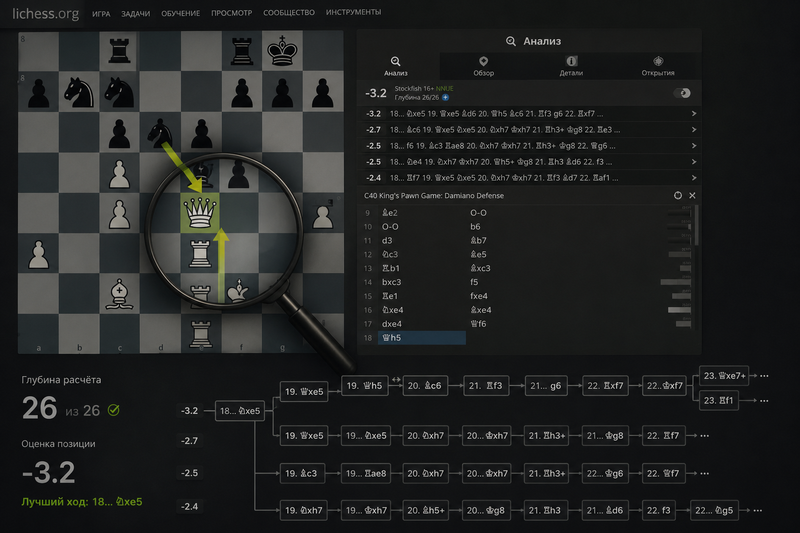
The main rule is simple: do not play the first move immediately, even if it looks obvious. The goal is not to guess the beginning of the combination, but to calculate it fully and make sure it works against your opponent’s best defense.
1. Evaluate the position. Start by checking the material balance, king safety, and piece activity. Look for undefended or overloaded pieces, back-rank weaknesses, open files, loose coordination, and possible mating threats. You should also note whose move it is and what your opponent is threatening. This initial assessment helps explain why a tactical opportunity may exist.
2. Look for forcing moves. Begin with moves that restrict your opponent’s choices: checks, captures, and direct threats. They are usually considered in that order. However, do not automatically choose the first check you see. Identify several candidate moves and compare them. Sometimes a quiet move that creates a powerful threat is more accurate than an immediate attack.
3. Calculate the variations. For each candidate move, find your opponent’s strongest reply and continue calculating until you reach a clear outcome: checkmate, a material gain, or a favorable endgame. Try to work out the entire line in your head without moving the pieces. It is important to visualize not only the tactical idea itself, but also the final position after the combination is complete.
4. Check your opponent’s defensive resources. Imagine that a strong player is defending the position. Can they capture the attacking piece, block the attack, trade off a key piece, move the king to safety, or create a counter-threat? Do not stop at the most obvious reply—look for the most difficult and unpleasant defense. Most tactical mistakes happen because one defensive resource was overlooked.
5. Only then play the first move. Before entering your solution, mentally review the entire variation from beginning to end. Make sure you have not confused the move order and that you have calculated all the main defensive responses. You should only make the move once you can explain not just the first move, but the full sequence. This is what helps transfer your puzzle-solving skills into real games.
How Much Time Should You Spend on a Single Puzzle?
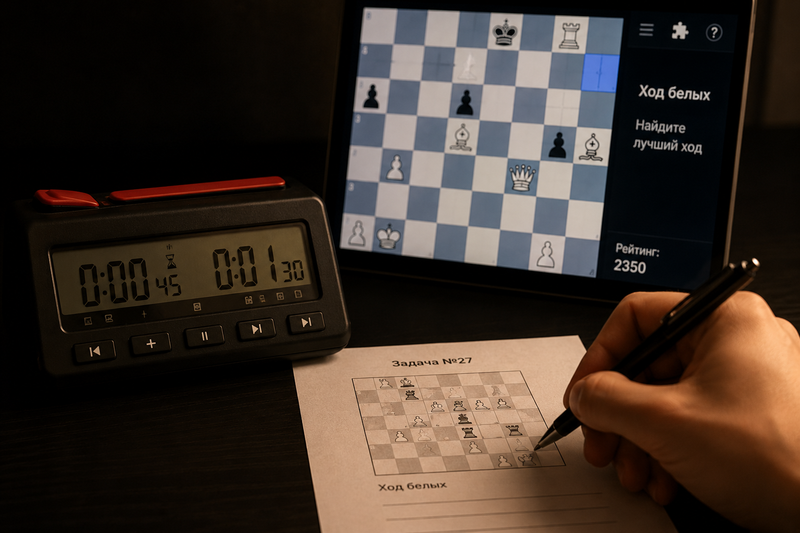 There is no universal answer—it depends entirely on the goal of your training session. If you're reviewing familiar tactical patterns or warming up before a game, decisions should be made quickly, usually within 10–30 seconds. The objective is not deep calculation, but improving the speed of your pattern recognition.
If your goal is to improve your calculation skills, there is no reason to rush. Spending 5–15 minutes on a challenging but solvable puzzle is often the most effective approach. During that time, you should identify several candidate moves, examine your opponent's defensive resources, and calculate the critical variations to the end. This type of training develops the calculation skills that transfer directly to real games.
At the same time, avoid spending too long on a single position. If, after 10–15 minutes, you are no closer to the solution or keep repeating the same unsuccessful lines, it is usually better to check the answer. Afterward, don't simply move on to the next puzzle. Take the time to understand why the combination worked and identify exactly where your calculation went wrong.
Remember one simple principle: the goal of tactical training is not to solve every puzzle at any cost, but to develop correct thinking habits. A careful analysis of one failed attempt is often far more valuable than solving ten easy puzzles without much thought.
Should You Analyze Your Mistakes?
Yes—and this is often the most important part of the entire training session. Many players get a puzzle wrong, glance at the solution, and immediately move on to the next one. As a result, they never understand why they made the mistake, and a few days later they repeat exactly the same error. This is where much of the potential improvement is lost.
After every incorrect solution, first try to find the correct idea on your own before revealing the answer. If you still can't find it, study the entire solution carefully. Don't just memorize the correct move—figure out why your own calculation failed. Did you overlook a tactical motif? Did you stop calculating too early? Did you fail to consider your opponent's strongest defensive resource? Or did you simply play the first move too quickly? The more accurately you identify the cause of the mistake, the less likely you are to repeat it.
It is also worth revisiting puzzles you previously got wrong. Don't do it immediately after seeing the solution. Instead, come back a few days or even a few weeks later, when you no longer remember the exact line. This type of spaced repetition reinforces tactical patterns and makes them much easier to recognize in future games. For that reason, reviewing your mistakes is often more valuable than solving a large number of brand-new puzzles.
How Can You Apply Tactical Training to Real Games?
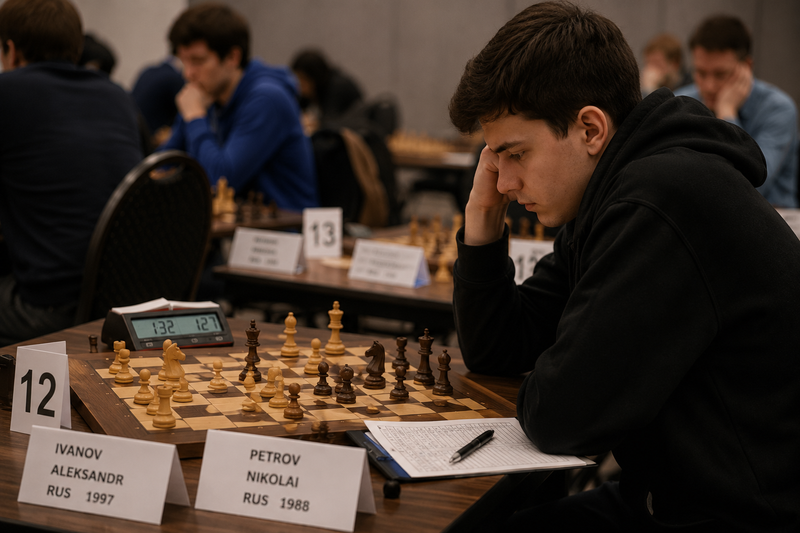
A high puzzle rating does not automatically make you a stronger player. When solving puzzles, you already know that a tactical solution exists, so you begin searching for it immediately. In a real game, however, there is no such hint—you must first recognize that a tactical opportunity is present.
To improve your tactical awareness during games, develop the habit of asking yourself a few simple questions before every important move: Are there any checks, captures, or threats for either side? Are any pieces undefended, pinned, or overloaded? Is either king vulnerable? This quick mental checklist takes only a few seconds, but it greatly increases your chances of spotting tactical opportunities.
Another valuable habit is to look for your opponent's threats before thinking about your own plans. This simple routine helps eliminate many tactical oversights. After each game, analyze every tactical opportunity you missed and look for similar puzzles to solve afterward. Connecting your puzzle training with your own games is one of the most effective ways to transfer tactical skills into practical play.
How Can You Tell If Your Training Is Working?
The clearest sign of progress is not a higher puzzle rating, but an improvement in your actual games. If you train regularly and use the right methods, you should gradually make fewer blunders, spot combinations more quickly, and calculate variations with greater confidence and accuracy. Over time, tactical opportunities will become easier to recognize, and the overall quality of your decisions will improve.
This is why it is useful to return periodically to the game-analysis method described in the first article of this series. By comparing your results from month to month, you can track whether you are making fewer tactical mistakes, playing more accurately, and achieving better results. This gives you a much more objective picture of your progress and helps you adjust your training plan when necessary.
Effective tactical training is not about the number of puzzles you solve, but about the quality of your work on each position. Spending 20–30 minutes every day carefully calculating variations and analyzing your mistakes is far more valuable than occasional training marathons lasting several hours.
It is just as important to analyze your own games regularly, because they reveal exactly which tactical patterns and ideas you are still missing. Puzzle solving and game analysis should go hand in hand. Only by combining both will you turn tactical knowledge into confident, accurate decisions at the board.
Thank you for reading! I hope this article has given you a clearer idea of where real chess improvement begins.
If you'd like to follow my work, you can find me here:
🎥 Twitch — Daily live streams with tournament commentary, game analysis, and Q&A sessions.
twitch.tv/ferstep_
📢 Telegram — Stream announcements, new articles, training resources, and project updates.
Telegram channel
♟️ Online Chess Coaching — If you're interested in personalized game analysis, individual coaching, and a structured training plan, you can learn more here.
Chess Place
See you on the stream, on Telegram, or across the board. Good luck with your training!
You may also like
 Ferstep
Как тренировать тактику: пошаговая система
Одна из самых частых рекомендаций после диагностики — улучшить тактическое зрение Ferstep
How to Analyze Your Own Chess Games: A Step-by-Step Guide
"Don't limit your analysis to lost games." Ferstep