
How to Analyze Your Own Chess Games: A Step-by-Step Guide
Why Playing Games Isn’t Enough to Improve
Playing games alone does not guarantee improvement. That is why, in the chapter on analysis, I recommended analyzing your own games to identify your weaknesses. You can play hundreds of games while repeating the same mistakes without even realizing it. Real improvement begins after the game, when you revisit the critical positions and use them to diagnose your decision-making. Why did you choose that move? Which variations did you overlook? At what point did one of your recurring weaknesses appear and cause you to lose control of the game? This type of analysis turns a single mistake into more than just a lesson—it reveals a recurring weakness that you can deliberately work on and eliminate in future games.
Which Games Are Worth Analyzing?
Don't limit your analysis to lost games. Mistakes are often easier to spot after a loss, but even a win can contain inaccuracies and poor decisions that your opponent simply failed to punish. It's also important to consider the time control. Bullet is rarely suitable for in-depth analysis because success often depends more on reaction speed and pattern recognition than on the quality of your decisions. Blitz is somewhat more useful, but time pressure can still distort your decision-making. Rapid and classical games provide the greatest value because they reveal your thinking process and strategic mistakes much more clearly. Focus on games where you hesitated, spent too much time on critical decisions, or let a winning position slip, and aim to analyze two or three such games each week.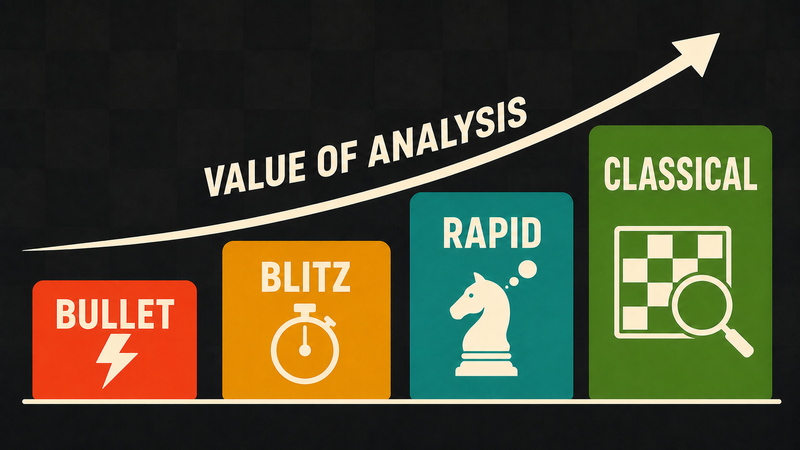
When Is the Best Time to Analyze a Game?
Immediately after the game, write down your thoughts, emotions, and any moments where you felt uncertain. These details fade quickly and are easy to forget. However, don't begin analyzing the game immediately. Take a short break first so that the result no longer influences your evaluation of the position. Ideally, perform a full analysis later that day or the following day, while your thought process is still fresh in your memory.
Step 1. Reconstruct Your Thought Process Without an Engine
Review the game for the first time without using a chess engine or seeking outside advice. Your goal is not to find the perfect moves, but to reconstruct your thought process as accurately as possible.
Go through the game slowly from beginning to end, pausing at every moment when you felt uncertain or spent a significant amount of time calculating. Write down how you evaluated the position, what concerned you, which plan you chose, and which variations you considered.
Pay particular attention to moves you played automatically, emotionally, or under time pressure. Do not judge your decisions solely by the final result. A good move may have been played for the wrong reasons, while a sound plan may have failed because of a single mistake later in the game.
For each critical moment, answer four questions:
What was I trying to achieve?
What response did I expect from my opponent?
What did I overlook?
Why did I make this particular decision?
These notes will preserve an accurate picture of your thinking. When you use the engine later, you will be able to compare not only your moves, but also your reasoning with the actual demands of the position.
Step 2. Identify the Critical Moments
A critical moment is a position in which a decision significantly affects the course of the game. Look not only for obvious blunders, but also for turning points where several reasonable continuations were available, the character of the position changed, or a precise plan was required.
Pay particular attention to the transition from the opening to the middlegame, the beginning of an attack, exchanges of key pieces, changes in the pawn structure, and the transition into an endgame. Also mark positions where you spent a long time thinking, played without a clear idea, or suddenly changed your plan.
In most cases, identifying three to five critical moments per game is enough. If you mark every inaccuracy, the analysis will turn into a simple list of mistakes and fail to reveal what matters most: which decisions best expose the strengths and weaknesses of your thought process.
Step 3. Find the Best Moves on Your Own
Return to each critical moment and reassess the position as if you were playing it during the game. Evaluate the material balance, king safety, piece activity, coordination, pawn structure, and weak squares. Then decide what the position demands most: static play or dynamic action.
Ask yourself whether the position calls for prophylaxis, regrouping, a pawn break, the exchange of a poorly placed piece, or concrete forcing play. Identify two or three candidate moves, beginning with checks, captures, and direct threats. For each candidate, calculate your opponent’s strongest reply and continue the variation until you reach a position you can evaluate clearly.
Compare the resulting positions in terms of material, initiative, and piece activity, then choose the most promising line. Record not only the variation itself, but also the idea behind it. Even if you fail to find the best move, a later review will help reveal the source of the error: an inaccurate evaluation, a missed candidate move, or a calculation mistake.
Step 4. Use the Engine Properly
Only use the engine after analyzing the position on your own. Start by comparing your move and the candidate moves you identified with Stockfish’s top choice, but do not focus only on the numerical evaluation. A difference between +0.4 and +0.8 rarely explains the practical nature of a mistake. What matters more is understanding why the engine prefers a different plan.
Follow the engine line until the underlying idea becomes clear. It may involve gaining a tempo, exploiting a tactical motif, preventing counterplay, improving a piece, or entering a favorable endgame. Then enter your own candidate move and let the engine show the strongest response. This will help you identify the true source of the error: a missed reply, an incorrect evaluation of the resulting position, or insufficient calculation depth.
Do not check every move. Focus instead on specific critical moments and major swings in the evaluation. If an engine line seems unrealistic or too difficult to understand, look for a more natural continuation with a similar evaluation.
At the end, summarize the lesson in words rather than as a sequence of moves. Ask yourself which feature of the position you should have noticed and which thinking habit would help you handle a similar situation better in the future.
Step 5. Classify Your Mistakes
After reviewing the position with the engine, identify not only the cost of the mistake, but also its underlying cause. A tactical mistake occurs when you miss a tactical motif, a forcing sequence, or an intermediate move. A calculation mistake means you identified the correct candidate move but failed to calculate the variation accurately or deeply enough.
A positional mistake stems from an incorrect evaluation of the pawn structure, weak squares, piece activity, or the overall nature of the position. An opening mistake usually reflects either insufficient opening knowledge or a lack of understanding of the typical plans in the position. An endgame mistake indicates a gap in your knowledge of theoretical endgames or the techniques required to convert or hold them.
Classify time management mistakes separately, such as moving too quickly in a critical position or spending excessive time on a straightforward decision. Finally, identify mental discipline mistakes—failing to check your opponent's threats, playing automatically, or allowing emotions to influence your decisions after losing concentration.
Assign each mistake to one primary category. After analyzing 10–15 games, recurring patterns will reveal your systemic weaknesses and show you exactly what to prioritize in your training.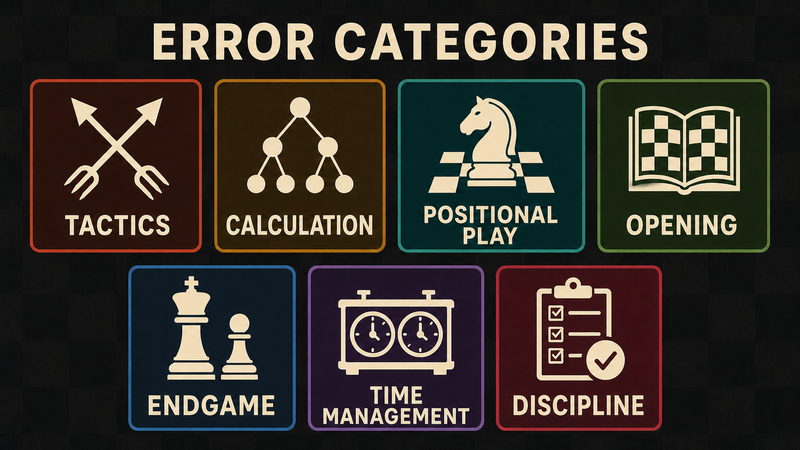
Step 6. Turn Your Analysis into Training
An analysis is only complete once its conclusions have been turned into concrete training tasks. Save the key positions to Lichess and solve them again after some time. A tactical mistake should lead to solving puzzles based on the same motif. An opening mistake should prompt you to review the variation and the typical plans. A positional mistake should lead you to study similar games by strong players, while an endgame mistake should be followed by reviewing the relevant theory and practicing the position against the engine.
If the problem lies in your thinking process, formulate a simple rule for yourself: always check your opponent's threats, look for forcing continuations, or compare at least two candidate moves before making a decision.
Don't try to fix everything at once. After each game, choose one or two key lessons. Then, after analyzing 10–15 games, update your training plan based on the recurring patterns in your mistakes.
This is when game analysis stops being a review of engine lines and becomes a deliberate process of improvement.
Practical Example: Analyzing a Critical Position
Common Mistakes When Analyzing Games
The biggest mistake is opening the game immediately after it ends and mindlessly clicking through the engine's top lines. You'll see the best moves, but you won't understand the flaws in your thinking that led to the mistakes.
The second mistake is analyzing only your losses while ignoring your wins, where your opponent simply failed to punish your inaccuracies. It's equally unproductive to examine every single move. Your attention becomes scattered, and the truly critical moments are buried among minor inaccuracies.
Don't become obsessed with Stockfish's evaluation or search depth. Instead, focus on understanding the chess idea behind the engine's recommendation. Likewise, don't explain away recurring mistakes by blaming time pressure, emotions, or bad luck.
Most importantly, don't end your analysis by simply reviewing the engine lines. Without a written conclusion and a concrete training task, the analysis is unlikely to have any lasting impact on your future play.
A Quick Post-Game Checklist
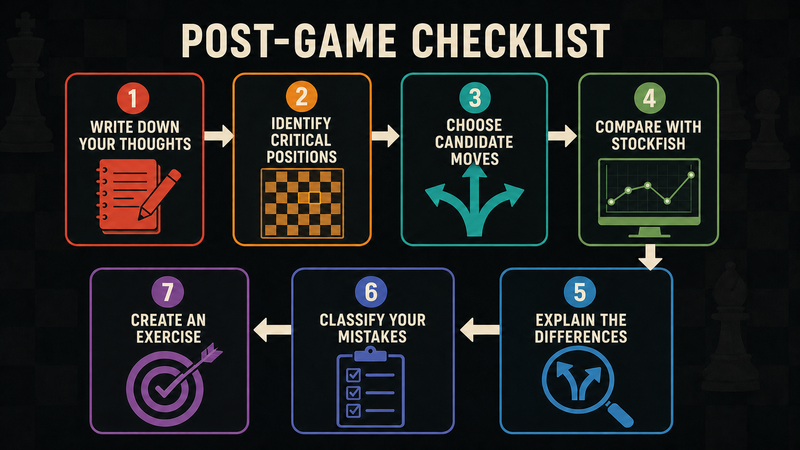
After every game, follow these seven steps:
- Write down where you had doubts and what you expected to happen.
- Without using an engine, identify 3–5 critical positions.
- For each position, find several candidate moves and choose the best one.
- Run Stockfish and compare its recommendations with your own analysis.
- Explain, in your own words, the reason for each difference.
- Classify your mistakes into one of the following categories: tactics, calculation, evaluation, opening, endgame, time management, or thinking discipline.
- Summarize one or two key lessons and turn them into concrete training tasks for the coming weeks.
Conclusion
Thank you for reading! I hope this article has given you a clearer idea of where real chess improvement begins.
If you'd like to follow my work, you can find me here:
🎥 Twitch — Daily live streams with tournament commentary, game analysis, and Q&A sessions.
twitch.tv/ferstep_
📢 Telegram — Stream announcements, new articles, training resources, and project updates.
Telegram channel
♟️ Online Chess Coaching — If you're interested in personalized game analysis, individual coaching, and a structured training plan, you can learn more here.
Chess Place
See you on the stream, on Telegram, or across the board. Good luck with your training!
You may also like
 Ferstep
How to Train Chess Tactics: A Step-by-Step System
One of the most common conclusions after such an assessment is that you need to improve your tactica… Ferstep
Как тренировать тактику: пошаговая система
Одна из самых частых рекомендаций после диагностики — улучшить тактическое зрение Ferstep
Как правильно анализировать свои партии: пошаговая система
"Анализировать нужно не только поражения" TheMagnusAura
General Plans of Common Pawn Structures (Part 1)
''The pawns are the soul of chess'' - Philidor flash3s
How you should create and execute your middlegame plans
The process of selecting and achieving your post-opening ideas Chuckmeister3D