
How I became mediocre in Puzzle Storm over 2+ years: Part 1 of 2
For two years I've focused on learning Puzzle Storm, not chess. Here's what didn't work for me! Part 2 will cover what did.Update: See part 2 here.
Introduction
These two blog posts are about how I developed my Puzzle Storm ability to a mediocre level. (I define mediocre as doing 3 puzzle storms per day, and having an average daily best of 25.) In the end, I was able to achieve my goal, but what I thought would take a few months ended up taking me more than two years!
This isn't a How To guide, since I'm not sure what I did was particularly effective. But maybe others may find my thoughts on different training methods interesting or helpful, if only for examples on what not to do.
In this blog post, I'll cover some training methods that I had high hopes for, but was disappointed in. In part 2 of this series, I'll cover what I thought worked best for me.
Background
I'm close to 50 years old and started to learn chess a couple years ago. I learned how the pieces moved as a kid, but didn't play except for a few casual games with friends or family.
At first, I thought chess was about strategy and deep thinking, but I quickly learned that, for beginners, chess is about basic tactics and board vision. Strategy is pointless if you drop pieces! I wanted to get to a basic tactical level first. Also I was inspired by Neal Bruce (see for instance here, where he appears on the Perpetual Chess Podcast), a middle-aged beginner who spend four years learning tactics, before moving on to other aspects of chess.
Why Puzzle Storm?
Puzzle Storm seems to be a decent measure of tactical ability. Unlike the Lichess or Chess.com puzzle ratings, it takes time into account. For instance, suppose I raise my Lichess puzzle rating from 1800 to 1900. How do I know if I'm actually getting better, or if I'm just thinking longer?
But isn't Puzzle Storm is a waste of time?
Many think that Puzzle Storm is almost totally unrelated to chess---any practicing or discussion of Puzzle Storm is useless. For example:
The inconvenient truth is that Puzzle Rush works wonderfully to sharpen up your basic tactical instincts but usually has little to do with tactics or, especially, calculation. The first thirty-something positions usually feature solutions that are simply too primitive to be called ‘tactical motifs’, while the scarce time left on the clock remaining for the ones coming up next does not allow the process of finding the proper solution to be called ‘empirical’ in any way – it is more like guessing as compared to concrete verification of the elected move[s]. This is also why Puzzle Rush should serve merely as yet another way to have fun with chess, or maybe as a pre-training warm-up at best. And if my students insist on using it once in a while, I say sure, just do not consider the time spent doing so as ‘training’.
-- GM Wojciech Moranda, as quoted in Perpetual Chess Improvement
First, even if it is totally unrelated to chess, so what? I'm not going to become a professional at either---all of this is just a fun diversion anyway. Puzzle Storm has the practical benefits of being available at any time, quick to complete, and providing an unambiguous numerical score.
Second, I think everything GM Moranda said is true, and also applies to Puzzle Storm. But what about my case, where I could never even get past the first thirty puzzles he mentions? What if I was stumped by puzzles that are "too primitive to be called 'tactical motifs'"? Being an intermediate chess player does require some base level of board vision and tactical recognition, which would imply at least some mediocre level at Puzzle Storm.
Empirically, strong chess players I've asked personally to try Puzzle Storm have all been able to get 30+, so presumably puzzle storm tests abilities necessary for chess also. Reddit user oaaees has also found a strong correlation between blitz rating and puzzle storm max score.
What didn't work for me
Here are some training methods that didn't seem to work for me as well as I hoped. I don't think any of these are obviously stupid (otherwise I wouldn't have tried them), and it's possible they would be great for some people.
Just doing Puzzle Storm
Shouldn't just playing a lot of Puzzle Storm be the best way to train Puzzle Storm? For instance, many believe that playing in classical tournaments is the best way to improve your performance in classical tournaments.
To improve at something, it is generally best to do that thing. However, for me, a few times a day is enough. Paradoxically, I think doing a lot of Puzzle Storm might actually hurt your Puzzle Storm! I'll try to explain why in part #2 of this blog post.
This blog post recounts someone's experiment doing Puzzle Storm for a year. They improved quickly in the first couple weeks, and then plateaued.
Quick puzzles on Chessable
Alex Crompton is an adult improver who wrote about learning chess as an adult. He has a blog post about it and also appeared on a Perpetual Chess podcast. I think he has some valuable insights, so I'd like to recommend his thoughts, even though this is the "what didn't work" section.
One of his main ideas is that people should drill quick puzzles on Chessable to pick up basic pattern recognition. For instance, he recommends an 8 or 10 second timer, after which the puzzle is considered failed. At first, I thought this method was sure to bring me basic tactical fluency. Tactics (and Puzzle Storm) is about learning a certain number of basic patterns, right? And spaced repetition is the most efficient way to learn these patterns, thus this method should be great.
My problem was that I just wasn't smart enough to recognize patterns quickly. I could recognize some patterns quickly, but as I learned new patterns, I would forget or get slower with the old patterns. I felt my brain only had so much space in it, so adding one puzzle would push another one out! For instance, he endorses the Learn Chess the Right Way series by Susan Polgar. I agree it's an excellent series, but there's more than 3000 variations in the series. I've been working on that series for years, and must have done every puzzle in it a dozen times (and some puzzles 30+ times I think), but to this day there's lots of them I can't do in 20 seconds, much less 8 seconds.
de la Maza methods (Woodpecker)
I also tried a few techniques from Michael de la Maza's Rapid Chess Improvement book. Like Alex Crompton, he's an adult chess improver who made rapid gains and wrote about his training methods.
One training technique he recommends is picking a set of 1000 puzzles, and then drilling them with increasing frequency, until eventually you can correctly answer all 1000 in a single day. This is also sometimes called the Woodpecker Method. I tried a slightly watered-down version, where I could do 600 puzzles in one day (I didn't think I had the time or stamina for the full 1000).
I indeed found that I did recognize them faster and faster, and it was satisfying to be so quick at so many puzzles. It was also motivating to have a concrete, achievable goal to train for. However, when I stopped drilling those particular positions, I quickly lost my facility with them. And my familiarity with those positions didn't seem to extend very far to novel chess positions.
I also tried a couple of de la Maza's other techniques, like his "Knight Flight" drill. I physically got a board out, and moved a knight from a1 to b1 in the quickest way possible. Then I repeated that for the other 4031 combinations of two squares. I felt like I was in a training montage of a martial arts movie, but I'm not sure it helped my chess much.
Honorable mentions
Here are some types of practice that I think would be helpful to chess generally, but were disappointing for Puzzle Storm.
Playing rated classical games
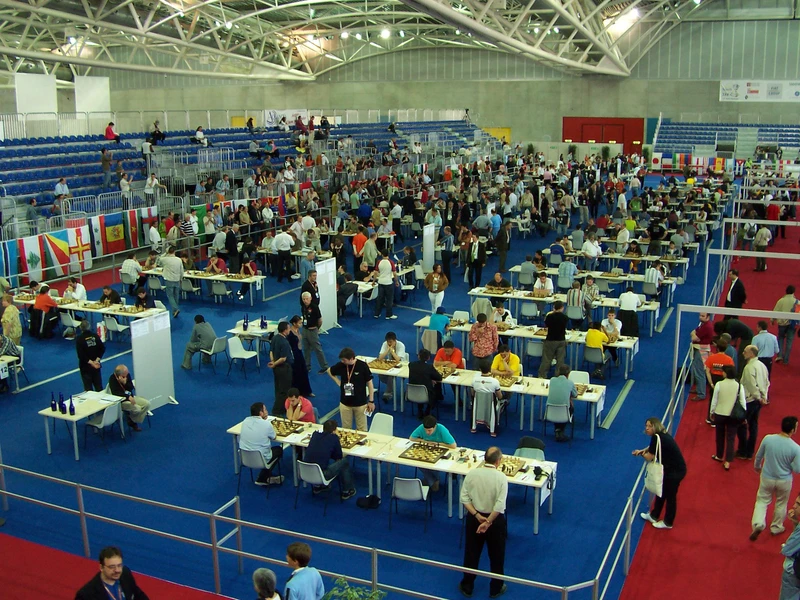
Most people say that playing rated classic games (and analyzing them) are the best thing for improving chess. But actual chess has many more angles than Puzzle Storm (openings, time management, endgames, positional considerations, etc.), so I don't think studying chess in general is the most time-efficient way to improve at Puzzle Storm.
I played more than a dozen rated games. They definitely didn't hurt, but I didn't notice any direct effect on my Puzzle Storm scores.
Also, even when I ran into simple tactics over-the-board, it was no guarantee I would apply them to Puzzle Storm. For instance, I remember quite well one game I lost by placing two pieces two files apart, so that my opponent could fork them with a pawn. I still remember the opening of that game, a bit about what my opponent looked like and how he spoke, and where I played the game. However, I still missed Puzzle Storms pawn forks after that.
Harder Lichess or chess.com puzzles
Lichess and chess.com have a great library of puzzles. Like playing rated games, I think practicing these would have helped me eventually, but solving harder puzzles didn't seem to really focus on what I needed for Puzzle Storm, since I tended to take my time understanding the positions first instead of honing my simple tactics vision. If I adjusted the difficulty so I was practicing easy puzzles, my experience was similar to just doing Puzzle Storm or doing easy puzzles on Chessable.
But, there may be a sweet spot (about 1800 level Lichess puzzles for me, what you get by selecting "Easier" difficulty), that balances getting bogged down by calculation with speeding through too-easy puzzles.
Stay tuned
This post highlighted the training methods I was disappointed with. Part 2 will cover the methods that I thought were most helpful and why.
You may also like
 CM HGabor
How titled players lie to you
This post is a word of warning for the average club player. As the chess world is becoming increasin… FM CheckRaiseMate
A Strategic Rule I've Never Seen Before
How do you choose which piece to use for defense? ChessMonitor_Stats
Where do Grandmasters play Chess? - Lichess vs. Chess.com
This is the first large-scale analysis of Grandmaster activity across Chess.com and Lichess from 200… Graque
How I became mediocre in Puzzle Storm over 2+ years: Part 2 of 2
In the previous post, I mentioned what didn't work. Here's what seemed to work for me! Graque
Remove blindspots with move counting game
Are you having trouble "seeing" certain moves that are right in front of you? Perhaps this mini-game… somethingpretentious