
my screenshot
How I became mediocre in Puzzle Storm over 2+ years: Part 2 of 2
In the previous post, I mentioned what didn't work. Here's what seemed to work for me!Quick Background
See part 1 of this post for more details. I'm about 50 years old, and I set an idiosyncratic quest for myself a couple years ago: to become mediocre at Puzzle Storm (defined as average daily best score of 25). My progress was much slower than I had hoped, but I finally achieved my goal! Earlier I wrote about what didn't work; now let's discuss what seemed most helpful and why.
I hope this blog post will be helpful to some beginning players looking to improve, especially adults who may be frustrated with their progress.
Paradox of speed
The whole point of Puzzle Storm is speed---I wanted to get faster at doing easy things. Ironically, I found slowing down was the key to speeding up.
Correct muscle memory
Let's use piano practice as an example. This video lays out some basic principles on how to practice.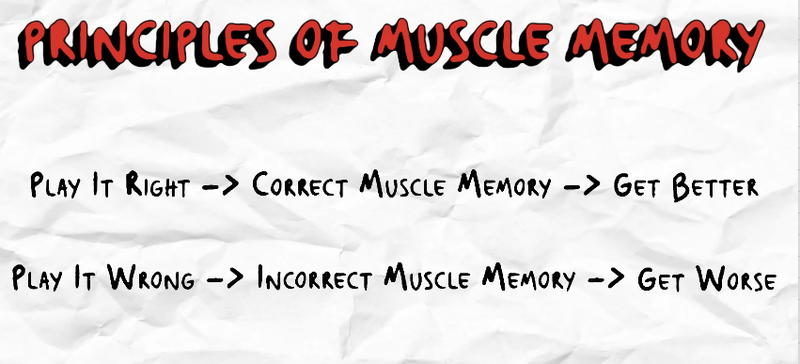
The simple steps are:
- Play the piece slowly and correctly
- Gradually increase the speed
If you start playing too fast, your progress will plateau, because you start learning bad habits. As "Piano Sauce" says, playing right builds up good muscle memory, and playing wrong builds up bad muscle memory. Over time, the cumulative difference between good practice and bad practice can be astounding.
Playing fast but inaccurately builds bad muscle memory
So what is correct muscle memory for doing easy chess puzzles? This is where rehearsed piano and chess diverge. When playing piano, you may want to play the same notes with the same timing, every time. But in chess, you continually face positions you've never seen before.
However, there is something that's the same every time in chess: the procedure to understand the basics of the position, which at least includes noting checks and captures for both sides. Building correct chess muscle memory for easy puzzles would mean practicing a procedure over and over that includes seeing all the checks and captures on the board. (Threats are sometimes mentioned also as another type of forcing move, but at my level, most puzzles can be solved with checks and captures. When I got a puzzle wrong, usually it was because I didn't see a check or capture.)
This is how doing Puzzle Storm, or fast puzzles on Chessable, or the Woodpecker Method can actually hurt your chess! Suppose you do a hundred easy puzzles, and get each one of them right in 2 seconds. Great for you! But, were you practicing correctly? Perhaps you weren't actually seeing all the checks and captures, but you were only seeing the checks and captures for your side, or you were only seeing the most obvious moves.
When you play the piano inaccurately, you can hear it immediately. But if your board vision is inaccurate (you overlook a check or a capture), most of the time it won't matter, and often it may help you, because you play faster!
Insidiously, fast practice that feels successful can still instill bad habits, and cause you to plateau: you may be fast at easy puzzles but fail on slightly harder or less familiar puzzles. Hence Puzzle Storm can hurt your Puzzle Storm!
Disgruntlement theory of board blindness
Here's another story of how practicing fast can hurt you, even if you get the correct answer.
Let's follow Daniel Kahneman and distinguish between two modes of thinking:
- System 1: fast, intuitive, unconscious, operates in parallel (multiple tasks simultaneously)
- System 2: slow, logical, conscious, operates serially (one task at a time)
Clearly System 1 is crucial to Puzzle Storm (and chess in general), so we want to improve that. It's tricky though, because we have no conscious access to what System 1 is doing. Suppose you look at a chess board, and fail to see right away that one of your pieces is hanging. Your System 1 failed you, but you have no idea how or why.
To use an analogy, System 1 is like your team of workers that you send off to analyze a position. They work in parallel, each thinking about a different part or aspect of the board. If you have good board vision, when you see a chess position, your crack team of workers rushes out, analyzes every piece and square, and immediately surfaces the most important facts to your conscious mind. If you have bad board vision (board blindness), then your lazy team meanders off, and comes back with some thoughts, but perhaps someone dropped the ball somewhere, and they don't tell you about your hanging piece.
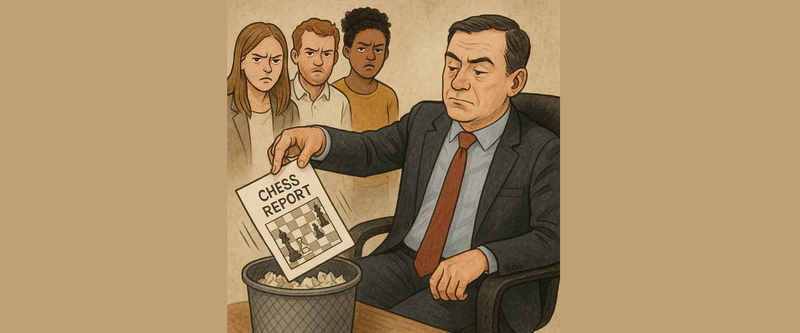
But whose fault is that? If you move before noticing all the forcing moves, then you're like a boss who routinely trashes your workers' reports without even reading them. Your team is going to get disgruntled, and stop producing accurate reports. For instance, suppose you have a tendency to miss pawn pushes. Maybe that's because you never wait for the guy on your team in charge of examining pawn pushes to look at all of them. He'll eventually learn no one is listening to him and quit working.
Keep in mind that all of this is happening unconsciously, and what you notice is just the tip of the iceberg. If you miss one pawn push, your brain has probably not analyzed a dozen others without your realizing it, but only one pawn push ended up being important. You need to make sure to thank and encourage your mental team regularly, because most of the work they do won't be relevant in a given position!
What worked #1: Move counting
For me, getting mediocre at Puzzle Storm was less about learning tactical patterns, and more about building reasonable board vision. In the previous section, I argued that building basic board vision is mostly about acquiring the habit of finding the checks and captures in a position.
Unsurprisingly, a good way to build the habit of finding all the checks and captures in positions is to repeatedly find checks and captures in positions! And the most straightforward way to practice this is with move counting:
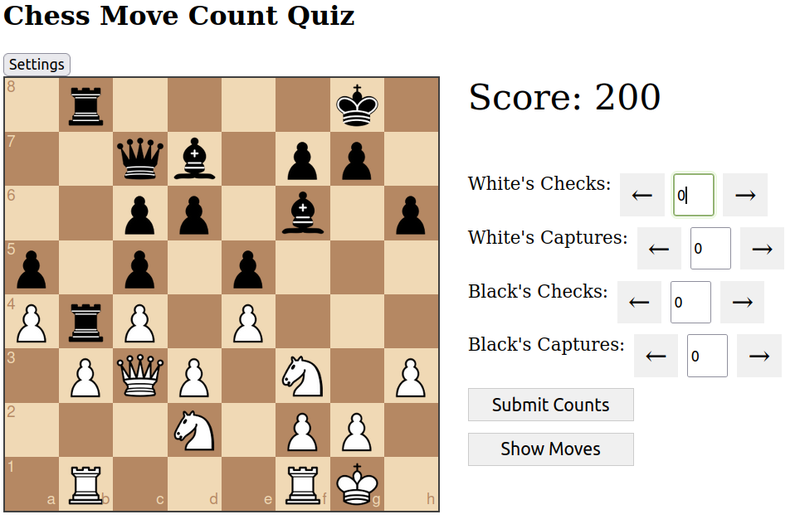
I wrote a simple app to help me practice. It's free and open source. I wrote a few previous blog posts about it here, here, and here.
What worked #2: Custom Chessable course
Move counting is good, but it doesn't direct my practice to focus on the areas where I'm weakest. Accuracy is very important in Puzzle Storm because of streak bonuses, so it's important not to blank on any easy puzzle. I would review my slow and missed puzzles after every Puzzle Storm, but I'm not the quickest learner and needed to see the same thing multiple times before I learned it.

Chessable is very good for this. Every day, I picked at least three Puzzle Storm puzzles that I either missed or took too long on, and recorded their puzzle IDs (by copying and pasting from their URLs). I accumulated these and then, by adapting a script I found on Reddit (thanks to labbeast89), periodically imported them into a custom Chessable course, which I would review daily. My course eventually grew to over 4000 variations!
In part 1 I said that quick puzzles on Chessable were disappointing. For my custom course, I set no time limit. I also customized the Chessable repetition schedule so I would quickly only see the puzzles every month or longer. I would be guaranteed to see the puzzle 8+ times, but I wouldn't be tempted to instantly recognize any particular puzzle.
What worked #3: Coaching
Finally, it really helped to have a coach. For the last 6 months of my quest, I was lucky to work with Dan Heisman, perhaps the most distinguished chess coach in the US for intermediate players and adult improvers. He seemed bemused at the idea of getting better at Puzzle Storm, but he never directly told me it was stupid goal, and he provided lots of helpful insights.
For instance, Dan may be the author most responsible for popularizing the concept of "board vision", so it's no wonder that he helped me realize that board vision is different from tactical pattern acquisition, and that my main problem was the former.
Coaches can also provide more general judgments. At my age, my overall chess potential is only going downhill. So when I plateaued and didn't make measurable progress for months, I wondered if I had reached my peak and if it was time to give up. Dan said that it was possible, but unlikely, based on his experience with other adult improvers. Because Dan has taught hundreds and hundreds of students over the years, I believed him. As it turned out, he was right.
Conclusion
I think the Puzzle Storm training that was most effective for me focused on patience, building good habits, and board vision. This is almost the opposite of what I originally thought would work (working on speed and memorizing patterns).
My experience may not generalize to others (especially readers who are much younger and/or better at chess than me), but I hope you at least found this interesting. Thanks for reading!
You may also like
 CM HGabor
How titled players lie to you
This post is a word of warning for the average club player. As the chess world is becoming increasin… Graque
How I became mediocre in Puzzle Storm over 2+ years: Part 1 of 2
For two years I've focused on learning Puzzle Storm, not chess. Here's what didn't work for me! Part… Graque