
M Walusza; L Ootes
Fixing the FIDE Women's Grand Prix roster
It needs more opportunity.FIDE recently announced the new qualification rules for the next Women’s Grand Prix series set to take place in 2026-27. The Women’s Grand Prix is essentially the closest thing we have to a formal women’s professional chess tour. It features almost all of the top players.
For the most part, not much has changed since the last series. It’s still 20 players. It’s still 6 round-robin tournaments. Everyone plays exactly 3 tournaments. Most of the qualifiers (except for the wild cards) are just the top-rated players. Did FIDE get it right in keeping this system?
Let’s talk about who should be in the Women’s Grand Prix, who actually will be, and what FIDE could do to get more players who deserve it into the series.
Who should qualify
I’ve broken down who should be in the Women’s Grand Prix into five main groups.
First off, all of the Top 16 in FIDE rating should make it. This is because all of these players are either (1) good enough to deserve their rating, or (2) if not, it’s the perfect opportunity for the real top players to farm them for rating or for the top norm-seekers to boost their GM norm chances.
Next, the top 10 non-GMs (i.e. IMs and WGMs) should qualify. The Women’s Grand Prix is (or at least should be) the perfect opportunity for women to earn GM norms in women’s tournaments. But that only works if you actually have norm-seekers in the series. The top IMs/WGMs should overlap at least somewhat with the Top 16 overall, so I wouldn’t choose all these spots just based on rating. Rather, it would be good to use other events as qualifiers or choose some as wild cards based on who has had recent success or is actually pursuing the GM title.
 Alina Kashlinskaya, who has 2 GM norms and has reached 2500, is the kind of player who should definitely be in the Grand Prix to support her pursuit of the GM title. Credit: Lennart Ootes.
The next most important group that should qualify are the top juniors. There are currently no juniors in the Top 16. You have to provide some sort of pathway to get there, and that should really be the Women’s Grand Prix. I would want at least 10 juniors in the series. Like the top IMs/WGMs, this could be a mix of rating spots, qualifiers, and wild cards.
 Anna Shukhman and Afruza Khamdamova are two of the most promising juniors, both of whom I would want to see in the Women’s Grand Prix sooner rather than later. Credit: Michal Walusza.
Those three groups are the most important to me. But that still doesn’t cover everyone. GMs outside the Top 16 should also have a few qualifying spots so as not to penalize them for already having the GM title. Also, part of the reason to include more GMs is it helps with norm chances.
And lastly, the tournament hosts deserve one or even more than one wild card at their own events minimum provided they’re above a certain rating.
Hypothetical lineup
Put all those groups together and we get a Women’s Grand Prix roster that looks something like this:
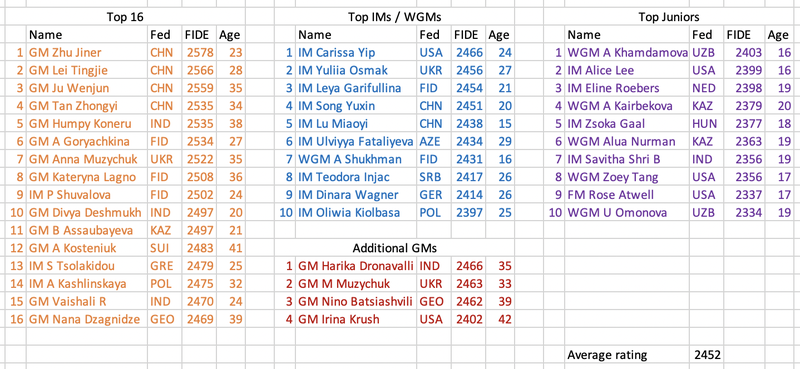
For simplicity, I mostly chose the top-rated players in Groups 2, 3, and 4 since there were no explicit qualifiers. I also left out potential host wild cards since we don’t know who would be hosting. All in all, it’s a list of 40 players. The actual Women’s Grand Prix roster is only going to have 20 players (and only 14 before including host wild cards), so more than half of these players are not going to make the real roster. Which ones get left out?
Who actually qualifies
FIDE allocates 10 of the 20 spots directly from qualifiers. Two spots go to the participants of the last Women’s World Championship match. Two spots go to the top two in the previous Women’s Grand Prix series. Three spots go to the medallists in the World Cup. Three spots go to the medallists in the Grand Swiss.
For the remaining 10 spots, the only change for this series is one spot goes to the top player in the Women’s FIDE Circuit who isn’t already qualified. After that, three spots are rating spots. Lastly, the final six spots are wild cards, one for each of the six event hosts. Overall, that leaves a Women’s Grand Prix roster that looks like this:
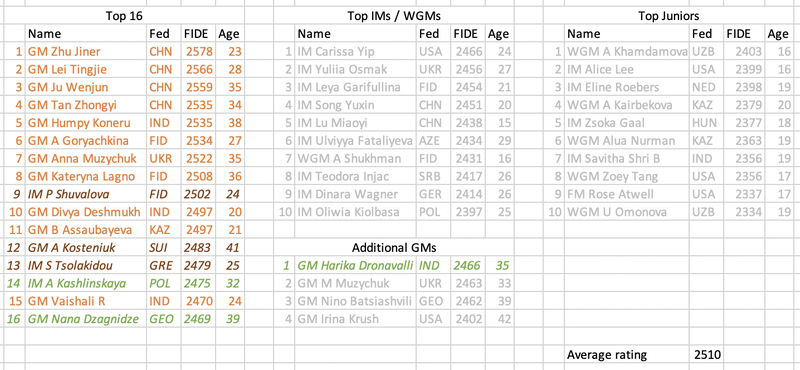
The players in orange are the 11 already qualified. The 3 in dark orange are the current leaders for the rating spots (decided in April). The players in green are currently not qualified, but I think they have a decent chance to get in either as host wild cards or to replace someone who declines to participate. (That still leaves 3 wild cards that depend on who hosts, which is still not known.) The players greyed out won’t be in the series unless they get a host wild card or steal one of the rating spots.
[CORRECTION: If any replacements are needed, they will be taken from the Women's FIDE Circuit leaderboard. There will not be additional rating qualifiers as was done before. With that change, Alina Kashlinskaya should be greyed out, and Song Yuxin should be in green.]
As you can see, even though FIDE has a variety of qualifying criteria, in practice, most of the spots just go to the Top 16. This year, essentially all of the spots go to the Top 16. No norm-seekers in the mid-2400s and below are included, and no juniors at all. Those are two groups that it’s important for FIDE to support if they want to boost women’s chess, and yet if you’re in one of those two groups, you’re almost completely reliant on your country being able to sponsor an event if you want to get into the Grand Prix.
What FIDE can do to improve things
Having a base roster of 40 is very different from 14. There is no way just having a series of round-robin tournaments could accommodate that many. Instead, FIDE would need to have at least a few of the tournaments use a Swiss format. They could split the series into a few Swiss tournaments and a few round-robins (using the Swiss tournaments to help decide who qualifies for the round-robins), or they could just do all Swiss tournaments. Swiss tournaments would allow hosts to have more than one wild card. It would also allow players on the rise to get into the Grand Prix later on even if they didn’t meet the criteria at the start. FIDE actually did use a Swiss format for the entire open Grand Prix (which Hou Yifan participated in) back in 2017.
If FIDE doesn’t have the money or the players don’t want that, they should change the qualification methods. Currently, all of the spots are open to everyone, regardless of title or age. If they want more norm-seekers in the Grand Prix, they should have qualification spots specifically for non-GMs. If they want juniors in the Grand Prix, they should have qualification spots specifically for juniors. If FIDE doesn’t do that, they’re not going to get the players the Grand Prix is supposed to support to actually play in the Grand Prix.
FIDE did attempt to improve things this year by changing one of the rating spots to a qualification spot based on the Women’s FIDE Circuit. However, that didn’t actually change anything because Anna Muzychuk got the spot and she would have got one of the rating spots anyway. If they really wanted to “reward recent performance over established rating” as they said, they should have awarded the Circuit spot after the rating spots were allocated. Then, it would have gone to 20-year-old IM Song Yuxin, who definitely deserves to be in the Grand Prix after her QF at the World Cup and T-3rd place in the Grand Swiss. Now, unless China sponsors a Grand Prix leg, she’ll probably be left out.
[CORRECTION: FIDE changed how replacements are determined so that instead of having additional rating qualifiers, any replacements needed would be taken from the Women's FIDE Circuit leaderboard. If any replacements are needed, Song Yuxin would be the first to get a spot, followed by Harika Dronavalli, Alexandra Kosteniuk, and Afruza Khamdamova. This is a good change by FIDE, as it would determine a Circuit spot after the allocation of the rating spots, as I suggested above. Nonetheless, there is no guarantee any replacements will be needed.]
 Song Yuxin is currently one of the most notable omissions from the expected 2026-27 FIDE Women’s Grand Prix roster. Credit: Michal Walusza.
If all of that somehow didn’t convince you that FIDE should open up the Grand Prix to a wider range of players, keep in mind: The winner of the whole Grand Prix series last year was Zhu Jiner, and she didn’t even qualify for that series. She only got in as a late replacement after Lei Tingjie was denied a visa for India and decided to withdraw from the whole series. That’s right: If not for the India visa department, we wouldn’t have had the eventual Grand Prix series champion in the series at all. And that’s just one player. Imagine what other players left out could do if we just gave them a chance.
The FIDE Women’s Grand Prix is the backbone of women’s professional chess today. It’s nice that it serves the top established players, but it would be even better if it also provided more opportunity to the second tier and to the future stars looking to break into the world elite.
For daily coverage of women's chess, follow Women's Chess Coverage on Twitter. For more posts, check out Women's Chess Coverage on Substack, where you'll be able to catch every post before it goes up on lichess, plus extra posts and related content!
You may also like
 CM HGabor
How titled players lie to you
This post is a word of warning for the average club player. As the chess world is becoming increasin… ChessMonitor_Stats
Where do Grandmasters play Chess? - Lichess vs. Chess.com
This is the first large-scale analysis of Grandmaster activity across Chess.com and Lichess from 200… OnTheQueenside
The Entire History of Women's Chess in Eight Tournaments (Part 1)
The beginnings of women's chess! OnTheQueenside
Entire History of Women's Chess in Eight Tournaments (Part 2)
The present awaits! OnTheQueenside