
Credit: Harry Benson
Fischer vs Karpov: The Match That Never Was
Explore one of the Greatest Potential Rivalries in the History of Chess
Bobby Fischer and Anatoly Karpov are two of the greatest legends of the game. They had a potential rivalry spanning 2 years from 1975-1977.
Table of Contents:
- First Meeting: November 1972
- Candidates Matches: June 1973 - May 1974
- FIDE Congress and Nice Olympiad: June 1974
- Candidates Final: September - November 1974
- Match Planning: November 1974 - March 1975
- FIDE Congress: March 1975
- World Championship Declaration: April 1975
- World Championship Negotiations: July 1976 - 1977
First Meeting: November 1972
In 1959, Bobby Fischer was the new rising prodigy and was playing in his first Candidates tournament at the age of 16. Anatoly Karpov remembered following the tournament and knowing about Fischer as an eight year old boy: "Of course I knew his name and his games when I was very young, because I followed the Candidates Tournament in Yugoslavia.".
Eleven years later, World Champion Boris Spassky was preparing for the 1972 World Championship against Fischer. He asked to play some training games with Karpov, who was the most promising upcoming talent in the Soviet Union and was considered to have a similar style to Fischer. For the game, Karpov played White. Spassky played the Ruy Lopez. Karpov got a winning position, but went for tactics instead of consolidating the position and then lost. Spassky then decided to stop playing after this one game.
During the match, Karpov was preparing for the World Chess Olympiad with Keres, Korchnoi, Petrosian, and Tal. It was proposed that Karpov should go to see the match to gain experience but a sports leader from the Ministry of Sport rejected this. Karpov recalled that it was because "they didn’t see a great future for me for the world championship". Describing the Fischer-Spassky match, Karpov reflected: "We could see it was a very big fight. Very emotional.".
Fischer won the 1972 World Championship against Spassky. Karpov was asked how long Fischer would reign:
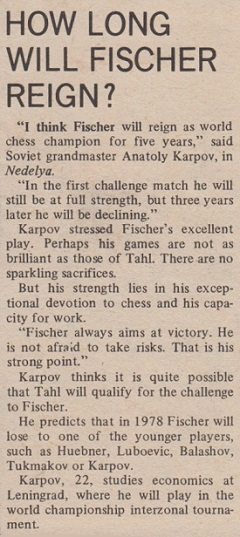 Soviet Weekly, p.15, 2nd June 1973: Source: Edward Winter
Now World Champion Bobby Fischer was traveling the world, looking for a place to hold a rematch with Spassky, who won the 1973 USSR Championship. During November 1973, Fischer was hosted in the Philippines by President Marcos who opened the 1st Philippines International Chess Tournament. After that Fischer went to Toyko and then to Mexico City.
 Bobby Fischer, Lubomir Kavalek, Florencio Campomanes, November 1973. Credit: Irena Kavalek, Life at Play, Source: https://www.zenonchessediciones.com
The first time Karpov met Fischer was at the Church's Fried Chicken Tournament in San Antonio, November 1972. The tournament was sponsored by Church's Texas Chicken, a fast food chain to advertise their fried chicken in the current chess boom. Karpov, Petrosian and Portisch shared first place. The organizers invited Fischer and Spassky to play but they declined. Fischer showed up at the tournament to meet the players, having been invited by Mr. Church. Karpov said "he looked very nice and friendly".
Had you met Fischer before you became the challenger?
Yes, I met Fischer when he became world champion, three months later.
Where was this?
This was in San Antonio. There was this organizer, Mr. Church, invited Fischer for the closing ceremony on the last day, so Fischer arrived. This was my first meeting with Fischer. He knew all the others [players]. He had played with them before, but we had never met. Fischer came five minutes before the round, so he shook hands with everybody, every participant. Then he disappeared and so he didn’t stay for the closing ceremony. I didn’t see him anymore, only this one minute.
What was your impression of him at that time?
He looked very nice and friendly, so I had a good impression. I think it was nice to invite him as a special guest for the tournament, a great tournament.
Anatoly Karpov, Interview, 2009
Tigran Petrosian wrote about the tournament in his article: 'The Taste of 'Fried Chicken'. He stated that "In the literal and metaphorical senses, the Fried Chicken tasted good."
-It is hard to say how strong Mr Church's "love of chess" is, and how long "fried chicken" will remain on the world chess menu; but although the San Antonio tournament was not the greatest chess contest in the history of America, as its organizers had wanted it to be, it was still a notable enough event and would have done credit to any European country with more stable and longer established chess traditions.
-The association with "fried chicken" cast its shadow over the organization of the contest - the chessboards were arranged on restaurant tables, covered with white tablecloths.
-Our own Anatoly Karpov made a specially good showing in the tournament. It is not without reason that people both in our country and abroad see a great future for this young and talented Grandmaster. He made an excellent impression on me, both as a chessplayer and as a person.
-Why was Fischer not participating? To this question, the American master George Koltanowski, who was one of the initiators of the Fried Chicken event, gave me an answer that was part joking, part serious: "Since there was a danger that Bobby might demand the whole of Mr Church's business as his fee, we decided not to invite him."
-To conclude my brief remarks, I cannot help mentioning that Fischer put in an appearance for a few hours in San Antonio. He flew in on a private plane and conducted himself like a VIP guest who condescended to honour the tournament with his presence. On account of this, the start of the round was postponed by 15 minutes. Fischer overstayed his time. All this while, the FIDE President Max Euwe was waiting for him at the entrance from the street, in spite of the murky weather. These days Fischer is late not only for his own games, but for other people's too...
Tigran Petrosian, The Taste of 'Fried Chicken', 1972
https://www.youtube.com/watch?v=bUb7IdFIE4c
The FIDE Congress at Helsinki, Finland took place in September 1973. A Congress is where delegates representing each country vote on pressing matters.
Being World Champion meant becoming a statutory member of the Central Committee automatically.
Fischer sent a cable to the gathering outlining his proposals for the World Championship:
Regret my absence. Regarding World Championship, Cramer proposal has much merit. Urge adoption of 10 wins to decide match, draws not counting, champion to retain title if nine wins to nine...
Champion and Challenger should decide on site without restrictions. Strong mechanism needed to safeguard their right to select site without coercion or intervention of third parties or other restrictions, such as requiring a bid from neutral party...
If players cannot agree on site, FIDE should decide, considering the amount of money, organizational ability, and playing conditions...
Bobby Fischer, Cablegram Excerpts, September 1973
Candidates Matches: June 1973 - May 1974
Karpov qualified to the Candidates Matches by sharing first place at the Leningrad Interzonal in June 1973. Karpov said that he didn't think he would become the challenger in this cycle. During January-February 1974, Karpov defeated Polugaevsky 5.5-2.5. Now he was up against Spassky for their match in April-May.
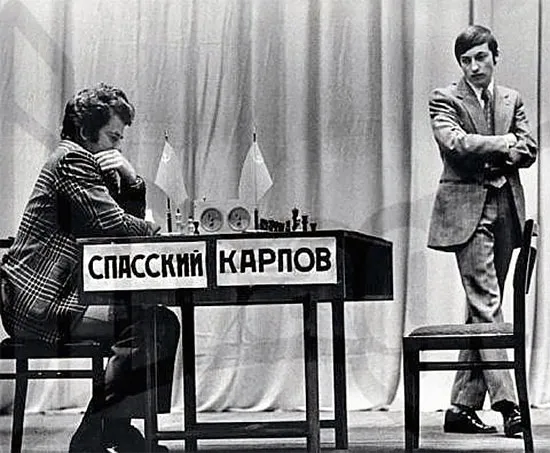 Credit: https://unoscacchista.com
Karpov defeated Spassky 7-4. Spassky said that he played better against Karpov then he had against Fischer in the 1972 match. Karpov now faces Korchnoi in the Finals to challenge Fischer.
FIDE Congress and Nice Olympiad: June 1974
At the Nice, France Olympiad in June 1974, the FIDE Congress assembled to discuss and vote on the match conditions. Fischer wanted an unlimited match, winner being first to ten wins with draws not counting. He also wanted the Champion to retain the title if the score reached 9-9. This meant that the challenger may have to win by 2 extra points to get the title. This is because in a situation where the score is 8-8, if the champion scores another win then they reach 9 points which allows them to retain the title. The challenger would have to win two more games to reach a 10-8 score.
Fischer sent a cable to the Congress from Pasadena, California:
Now I speak of a very important matter. Official world championship occurs only once in three years. Temporary form, or team preparation, or luck should not be permitted to determine results. World champion should be world's best player, and long match is necessary to reach a just result with nearly absolute certainty. For this reason I propose that match be won by first player to win ten games, with no limit on total number played.
Provision for drawn match with score nine wins to nine with champion retaining title and prize fund split equally is consistent with longstanding tradition of small advantage for champion. Yet those who have long enjoyed this advantage now wish to abolish it. Propaganda emanating from a certain country has falsely implied that I am seeking unprecedented advantage. These critics say that it is unfair to require a two-point margin of ten wins to eight in order for challenger to win the match, yet only in this way can champion's advantage be fairly preserved when there is no limit on total games.
And critics deliberate overlook that champion also needs two-point margin of ten wins to eight in order to win match. Mr. Cramer can demonstrate the historical record, but for example, Alekhine needed at least a margin of six wins to four to become world champion, whereas Capablanca needed only five wins to retain his title, draws not counting, throughout my career I have always insisted on optimal conditions for my participation in chess competitions. I will not compromise on this principle for the 1975 World Championship Match. Best Wishes.
Bobby Fischer, June 21st 3:16 pm, Cable
In the Olympiad, Karpov played on Board 1 for the Soviet team scoring 12/14 and winning the gold medal for best individual performance. The Soviet team (Karpov, Korchnoi, Spassky, Petrosian, Tal, Kuzmin) won the Olympiad with 46 points, ahead of Yugoslavia with 37.5 and the United States with 36.5. Fischer didn't play because his request for a separate building to play his games was declined. Karpov spoke at the FIDE Congress on behalf of himself and Korchnoi:
We played in the chess Olympiads in Nice, so this was not only important for chess but also for chess politics. If you remember, Fischer sent an ultimatum to the congress that was taking place in Nice during the Olympiads. I remember in this congress that I made a speech on behalf of myself and Korchnoi, because at that moment we were the two who could play Fischer. I was talking on behalf of two, so we discussed the things we should sell [stress]. Korchnoi asked me to talk because it was known that when he became emotional or nervous, he would say much more than he should. At that time we were friends.
Anatoly Karpov, Interview, 2009
The FIDE delegates voted against Fischer's proposal for an unlimited match. They voted for a 36 game limit, where the winner is the one who first scores 10 wins (without Fischer's 9-9 condition). If the match goes to 36 games, then the winner is the one with the best score with draws counting. 18-18 means that the Champion retains the title.
 Chess Life and Review, October 1974
Fischer then stated that he is resiging his FIDE World Chess Champion Title since his conditions weren't accepted:
Cablegram of June 27 7:19 pm to Dr. M. Euwe, FIDE President:
As I made clear in my in telegram to the FIDE Delegates. The match conditions I proposed were non-negotiable. Mr. Cramer informs me that the rules of the winner being the first player to win ten games, draws not counting, unlimited number of games and if nine wins to nine unlimited number of games match is drawn with champion retaining title and prize fund split equally were rejected by the FIDE delegates. By so doing FIDE has decided against my participation in the 1975 World Championship. I therefore resign my FIDE World Chess Champion Title.
Sincerely, Bobby Fischer.
According to a federation official who asked not to be identified, the American Olympiad team immediately asked the federation today to reconsider its new rules with a view to getting Mr. Fischer to reconsider his resignation.
There was speculation in Nice tonight that his [Fischer's] move could have been carefully calculated to provoke the American team's intervention with the federation and ultimately a federation reversal.
New York Times, Fischer Renounces His Chess Title in Rules Dispute, June 29th, 1974
Your professionalism, competitive spirit, and outstanding skill have thrilled all during the year you fought to attain world championship. FIDE General Assembly asks that you reconsider possibility of defending title under regulations adopted here. Only by such a defense can you demonstrate to the world your true and high qualities.
Regards, FIDE General Assembly, June 30th 1974.
Fred Cramer was one of the Vice-Presidents of FIDE (Zone 5), and a former President of United States Chess Federation from 1960-63. He was a representative for Fischer during the 1972 World Championship. Cramer attacked FIDE for not agreeing to Fischer's unlimited match condition, calling FIDE a "conspicuous and colossal failure".
Fischer stated that he resigned from title of the World Champion, but FIDE didn't do anything because according to their rules there is no provision for resigning the title, so Fischer was still the World Champion. The gears of Championship logistics kept on grinding as Fred Cramer stated that Mexico Chess Federation was collecting funds for a 1 million dollar bid for a Mexico City Match. Rimini, Italy was another potential spot with the Italian Chess Federation aiming for a 500,000 dollar bid.
Grandmaster Reactions:
Robert Byrne: “absolutely stark‐naked cheating... I think it's fear—Bobby would rather retire undefeated than risk the possibility of losing.”
Bent Larsen: "“A five‐month match would be horrible for everybody involved —players, officials, journalists, readers, spectators — everybody,... The advance of chess does not depend on one person. If he does not want to play he is free to stay away from chess competition and everybody is free to fantasize about his reasons.”
Svetozar Gligoric: “I would consider competing with Fischer under any circumstances, for it favors the popularization of the noble game.”
Gordon T. Thompson, Fischer Defends Demand On Rules, New York Times, October 7th, 1974
Candidates Final: September - November 1974
Anatoly Karpov and Victor Korchnoi played the finals between September-November 1974 to decide who would challenge Fischer for the title.
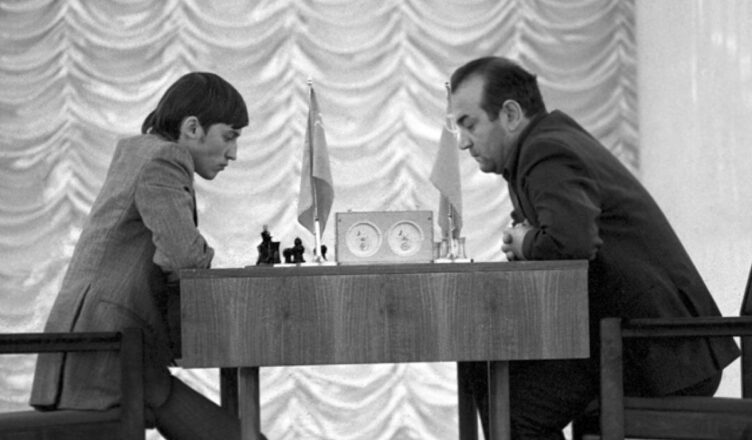 Credit: Dmitry Donskoy / RIA Novosti
Karpov defeated Korchnoi 12.5-11.5 to become the World Champion Challenger.
Karpov said that Korchnoi supported Fischer after Korchnoi lost the match, despite the fact that Korchnoi agreed with him previously to stand against Fischer's conditions, resulting in Karpov making a speech at the Nice Olympiad on behalf of themselves.
So I mentioned it to the delegates to the congress, but then when I beat Korchnoi, he gave an interview and changed his position completely. He said absolutely a different thing and so this was very unpleasant for me. The congress in Nice didn’t accept Fischer’s demands, and I must say this was not realistic, what he wanted.
Anatoly Karpov, Interview, 2009
Match Planning: November 1974 - March 1975
Bobby Fischer responded to Larry Evans' comments in the April edition of Chess Life and Review, where Evans stated that Fischer's conditions were not fair:
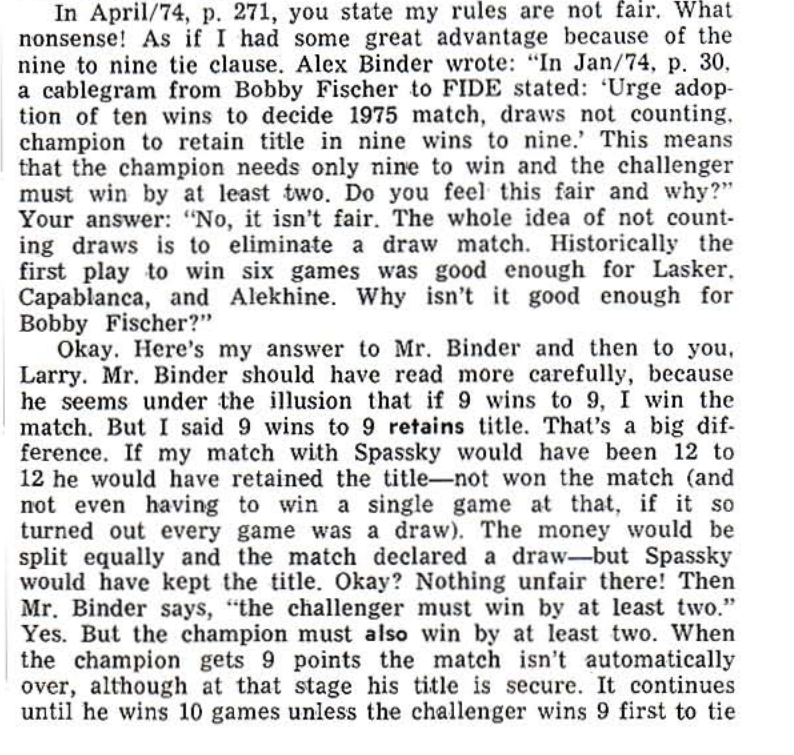 Bobby Fischer, Letter to Larry Evans, Chess Life and Review, November 1974
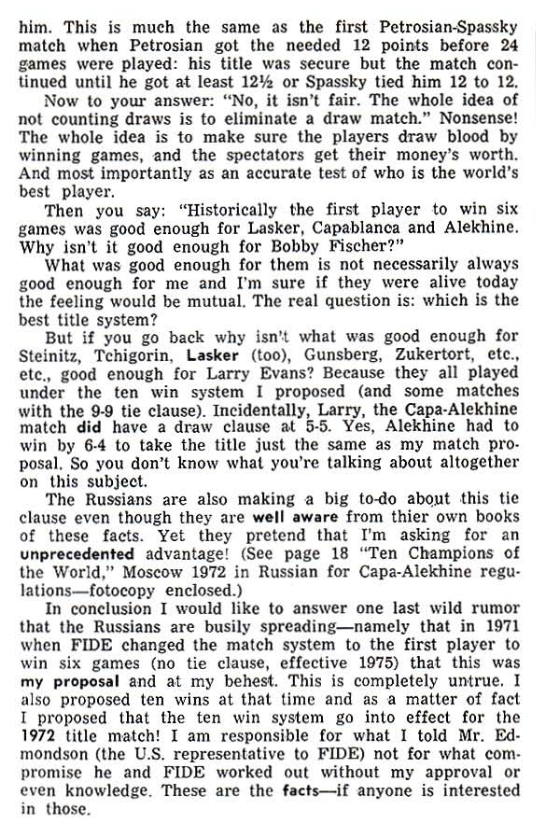 Bobby Fischer, Letter to Larry Evans, Chess Life and Review, November 1974
 Larry Evans, Response to Bobby Fischer, Chess Life and Review, November 1974
Fischer played a secret training match Lubomir Kavalek in December 1974 to help prepare for the match, and also worked with Bernard Zuckerman on openings. Ed Edmondson was the Executive Director of the United States Chess Federation. He helped Fischer during the 1972 match negotiations by acting as his representative. He met with the FIDE Bureau in Penang, Malaysia on December 15th to discuss the match terms. Edmonson argued that Fischer's terms should be accepted on the claim that the 9-9 scenario would be a 'million to one' chance, and that Karpov beat Korchnoi by one point so a declaration of Karpov as World Champion without playing Fischer could not be accepted. The FIDE Bureau voted against changing the Nice Congress Regulations by 5-4. FIDE President Max Euwe then said that he hopes that the Soviet Chess Federation announces that Karpov would accept Fischer's conditions as this would be a 'grand gesture' demonstrating 'sportsmanship'.
Only three countries bidded for the match:
| Country | Bid |
|---|---|
| Philippines, Manila | $5,000,000 |
| Italy, Milan | $426,250 |
| Mexico, Mexico City | $387,500 |
FIDE Congress: March 1975
From March 18th-20th, 1975 another FIDE Congress in Bergen, Netherlands was held, having been called by 35 national federations. There were three days of discussion and the delegates debated over the 9-9 draw clause with some saying that it's the only way to have the Champion retain the title in the event of a draw, and others saying that it gave the Champion a large advantage. In the end the Congress voted to accept Fischer's condition to have an unlimited match by 37-33. However, the FIDE delegates voted against Fischer's 9-9 clause by 35-32.
Fischer now had until April 1st to agree to play the match with these conditions or he would be forfeited.
Karpov shared his thoughts:
Well, the match with Fischer may not in fact take place. But all the same I will make very thorough preparations. Whatever happens this work will not be in vain. The study of Fischer's games will most likely enable me to improve and enrich my play.
Q: But are you nevertheless nervous?
What point is there in being nervous now? I had reason to be worried when the extraordinary congress had not yet been held, and I thought that absolutely all of Fischer's demands might be adopted there. If this had happened, I decided with myself, I would then simply not have had the moral right to play the match. But when I learned that the congress had not proceeding at Fischer's bidding, I calmed down instantly. It was then clear that either the match would take place, or else I was immediately Champion of the World. What was there to worry about?
Anatoly Karpov, Interview, thechesspedia.net
When the deadline passed, FIDE President Max Euwe extended it till April 3rd, saying that maybe the telegram was sent but got delayed.
There was no response from Fischer.
World Championship Declaration: April 1975
Anatoly Karpov became the 12th World Champion on April 3rd, 1975.
Karpov found out from a journalist while he was playing tennis at a training camp:
What was your feeling at that moment?
Two feelings, first, OK, I was happy that I had been declared the new world champion, but second I was not very happy that I couldn’t play Fischer.
Were you angry at Fischer for not playing?
No, it’s difficult to say. Like I said I had two feelings. If I hadn’t become world champion, I would have been angry. But I played very well during the whole cycle. I played the best Interzonal tournament of all the matches, so when I recalled all the matches, I felt I deserved it. But I didn’t expect that Fischer would leave chess forever. I thought OK, I became world champion and we can negotiate and we can play.
Anatoly Karpov, Interview, 2009
An Informal sounding of opinion in one government office disclosed that the first reaction was also that Mr. Karpov and the Soviet Union had lost a lot of Western currency because there will be no $5‐million purse to share. How much of the purse Mr. Karpov would have been allowed to keep was never disclosed, but some chess fans estimate that it would have been well below 50 per cent, with most of the money going to the Soviet Chess Federation.
Writing in Izvestia, Aleksandr Roshal, a chess coach, said that possibly Mr. Fischer was not prepared for the match, even if all his conditions had been met.
“He was forgiven so much because it seemed to many people that he had such a tremendous talent and the character of a real fighter,” the coach wrote, “but he has disappointed millions of chess fans.”
Robert D. McFadden, Fischer Loses Chess Title To Russian, 23, by Default, New York Times, April 4th 1975
Fischer's representative Ed Edmondson attacked Karpov:
 The Times Herald, (Port Huron, MI), April 7th 1975
Russian Chess Magazine 64 wrote an article:
Editor of the American chess magazine Chess Life Bert Hochberg called Fischer's refusal "above all an invaluable loss for himself". He noted that the Fischer-Karpov match was awaited all over the world with great interest. A TASS correspondent tried to track down Fischer through American grandmasters living in California, but Fischer disappeared. However, according to the executive director of the US Chess Federation, E. Edmondson, Fischer is alive and well, since a few days ago he talked to him.
"During the period of holding the highest title, Fischer did not enrich the world chess school, but introduced disagreements into the chess world that are far from sports," Dutch grandmaster I. Donner defined the behavior of the American chess player in an article in the newspaper De Volkskrant. "Fischer didn't want to understand that you can't be a chess player without an opponent, that you need opponents to remain a champion. But this requires at least a semblance of readiness to agree with others."
"The probability of Fischer's success was ruled out," Argentine grandmaster Miguel Najdorf said in Buenos Aires. "His refusal means that he is extremely illogical. Although he is a very strong chess player, I suppose that even if it were accepted that at 9-9 he would remain the World Champion, Fischer would still find an excuse not to play." (TASS).
---
Unlike Lombardy, who considers it completely useless to analyze the motives of Fischer's behavior, most other authors who study his work and psychology still risk setting themselves such a task. Recently, many books, articles and other studies have been written about Fischer in the West. Some of them are sustained in the spirit of unrestrained praise and obsequiousness. Others are excessively enthusiastic admirers of "the former champion to prepare; not only to applaud his every word and deed (or silence and inaction), not only to give him an indulgence for past and future "somersaults", but also to elevate him to the rank of a kind of chess deity, whose dignity does not allow him to condescend to compete with ordinary mortals.
So, a sports columnist for an American newspaper! "Des Moines Register" Foreman Jacobson proposed to proclaim Fischer for life... non-playing champion, although he is still very far from retirement age, as you know. "With his outstanding success, Bobby fully deserved to have the chess crown forever retained for him, regardless of whether he intends to continue playing or not," the reporter said. "As for Karpov, he should have been declared vice-champion and obliged to defend this title once every three years."
64 Magazine, 15, 11-17th April 1975
Karpov gave an interview on April 11th with Soviet Sport. He stated "Now I am already World Champion, and I want talks only with a view to a new match. If Fischer agrees, I'm ready to play him under fixed conditions that we will both stipulate".
FIDE President Max Euwe corronated Karpov as World Champion at a ceremony in the Hall of Columns in Moscow on April 24th to the applause of 1,000 people who were in attendance, including FIDE officials, Soviet chess figures and national federation members. Karpov made a speech thanking his supporters and got bequeathed the World Champion wreath.
 64 Magazine, 18, 30th April-7th March 1975.
The next day Karpov held a press conference:
I have made everything for the match with Fischer to take place, I have taken extreme measures, met almost all his demands. I agreed with the venue he proposed, with the candidature of the chief arbiter who appointed according to the wish of the American grandmaster. At last I was ready to play the match up to 10 wins with no games limit. I consider the last term absolutely unacceptable. Statstics shows that Fischer (so do I) loses lately not more than one-two games a year. One can imagine how long out match would have lasted. It would have been a marathon-exhausting contest as a result of which the chess world could have lost two leading grandmasters. However, I was ready to play such a match.
---
The Executive Director of the US Chess Federation Mr. Edmondson made up a term for me "a paper champion". I think that this term is more appropriate for Fischer who since the match with Spassky in 1972 has not been participating anywhere for 3 years and really is a "paper king". At the same time the whole chess world was watching the challengers' match with much attention and there were no claims towards me or my play. As for Fischer we will hope that he will not leave chess, that he will show his outstanding skills, his talent.Anatoly Karpov, Press Conference, April 25th, 1975, thechesspedia.net
Was that a bit disappointing for you after Fischer's demands were not met and the match did not take place? Was it bittersweet to be world champion without a match?
No, I prepared for the match, I was ready to play, but of course I could not force Fischer to play. If he didn't appear, he didn't appear. I wanted to play and to defeat Bobby. It was my personal aim to win that match, but the leaders of my country didn't like the idea. They said, you are world champion, why to take the risk to play Fischer, you are world champion, what else do you want? I said, I want to play the strongest player of the time, I want to beat him, I have chances. And then they asked, are you sure you can win? I said, I have good chances, but it's a sport, how can you be sure that you'll win?
That's why I had problems to negotiate. They said, if you guarantee [a win]. I said, are you crazy? I cannot guarantee I'll win, but I have good chances to beat Fischer.
Anatoly Karpov, Tania Sachdev Interview, 2020
World Championship Negotiations: July 1976 - 1977
Florencio Campomanes (future FIDE President), was at the time a FIDE Vice President of Asia and was friends with Fischer. Karpov was traveling to Toyko and Campomanes said he would join him because he hadn't seen Japan in a long time. Yasuji Matsumoto, chairman of the Japanese Chess Federation also went with them. When they arrived in the hotel Campomanes said that he had a surprise for Karpov: "Suddenly, Campomanes went out and one minute later he came with Fischer, so this was a big surprise, of course.". They greeted each other and then had dinner and discussed the match. They hung out together from 7pm-1am. The meeting took place coincidentally on the same day Korchnoi left the USSR.
Yes, they took place approximately at the time when Korchnoi declared his intentions not to return to USSR?
In one day, hour, maybe, in the same minute even. I remember it very clearly: I met Fischer on 26th July 1976.
And you didn't tell anyone where you were going?
Of course not - our talks were secret. They began at 7 p.m. in Tokyo, and at 10 a.m. in Amsterdam, Korchnoi entered a police station and asked for asylum. There are nine hours between Tokyo and Amsterdam time zones, so it all happened simultaneously. The Soviet minister of sports could as well circle the date with a black marker twice, and leave a note: exactly at noon (Moscow time) Korchnoi defected in Amsterdam, and Karpov met Fischer in Tokyo.
---
How did Fischer speak with you? On equal terms, or was he looking down upon you?Absolutely normally. He never allowed himself any arrogance when speaking about chess professionals, and, no matter what Bobby thought of me personally, he respected me as a fellow grandmaster. Since Tokyo, we have actually met numerous times, even in 1976.
Anatoly Karpov, Dmitry Gordon Interview, 2007
We greeted each other and shook hands, and then he started to talk. I think Matsumoto presided at this meeting and said why don’t we all go have dinner together. It was unbelievable, because the Hilton is a big hotel, but as I remember we got to the restaurant at 7:00 in the evening and there were no other people [there]. I was especially amazed that we had a table for four with no other people. We had a very quiet dinner; it was maybe like two hours.
We discussed the possibility of playing a match, so of course we realized if we would have met before, we would have played in ‘75, a match. But, I think Fischer wasn’t ready to play, psychologically. He could not even tell himself he wasn’t ready. Yet, under pressure from Campomanes, he forced Fischer to come. When Fischer was with Campomanes, he [said he] was ready to play, but when he was alone and probably for himself he was saying, “No, no, I’m not going to play.” I think this was his problem.
Anatoly Karpov, Interview, 2009
After the talks we set out for a stroll around Tokyo. I was afraid that autograph hounds would harass us, but, to my amazement, not one person approached us. Here were two of the best chessplayers in modern times, whose photographs practically never left the front page, walking down the street – you’d think at least someone would have noticed. Later I understood that such a thing is possible in only one place on earth: Tokyo.
One photograph – the only one in which Fischer and I are together – was taken. The chairman of the Japanese Chess Federation, Matsumoto, ingratiated himself with Fischer, who disliked journalists even more than their articles, and took our picture “for his family album”. A few days later the shot was sold to Agence France-Presse, who in turn distributed it worldwide.
Karpov on Karpov, p.161-162, 1991, Source: Edward Winter
Karpov hadn't told the Soviets that he would be meeting with Fischer. After Karpov returned, the KGB opened a file on him after rumors in Moscow that he was planning on selling the title to Fischer. "They even tried to prosecute me, compiled some dossiers, but eventually all calmed down.", Karpov remembered. Karpov then told the Soviet officials that he would be meeting with Fischer again. He reflected: "After all these years, I can't understand only one thing: why I wasn't forbidden to go abroad for such an unsanctioned action."
Karpov met with Fischer one month later in August 1976 during the Las Torneo del Vino tournament in Spain. Karpov won the tournament with 7/9. During the tournament, Fischer and Karpov had some food in a small restaurant. Afterwards when they walked down the street, they were recognized and they were attacked by a mob of fans who wanted autographs. Then Fischer and Karpov ran away in haste from the crowd. Karpov reflected: "We had to flee in the truest sense of the word!" They continued their discussion at the hotel.
After the tournament finished, Campomanes called Karpov and said can he and Fischer come over to visit again. Karpov said sure, and said he was staying at the Barajas Airport Hotel because his flight would leave in the next morning. They then talked for two hours.
They met again in 1977 in Washington D.C.. After discussions of the match terms, Fischer agreed to play. Fischer, Karpov and Campomanes then went to the Philippine Consulate to get a typist to type out the terms of the match so that they could sign the papers. Only the name of the match had to be sorted. Fischer then said that the match should be called 'The Absolute World Championship for Professionals'. Karpov said that this would never be accepted by Soviet Officials: "At that time the idea of sports professionals was not well accepted either in the Olympic movement or in the USSR".
That was the last time they ever met.
It is hard to describe the feeling I experienced, when I realized that there would be no match with Fischer. I felt a sense of loss ... Some kind of a vacuum opened up in my life. It did not cause me pain, but a great deal of time passed before I was able to overcome that feeling of regret. I realized that the most vivid thing that could have happened in my life would not take place.
Anatoly Karpov, Russians vs Fischer, Dmitry Plisetsky and Sergey Voronkov, p.424
Fischer also negotiated matches with Korchnoi and Gligoric afterwards in 1978-79 but they never happened. Fischer would never play chess again until his 1992 rematch with Spassky. Negotiating and preparing for matches was possibly a way of making himself feel like he was continuing chess, without the risk of losing. Or maybe he just got anxiety whenever he had to make a big decision.
Later in the 90's, Karpov visited Budapest, Hungary. He was there to visit the famous Gellert thermal baths. On his last day at 7 o'clock Karpov decided to chill at the sauna before his flight back to Moscow at 11. After swimming at the pool, Karpov rested on the wide steps. He was recognized by someone who said: "Did you know you are sitting in the same place Fischer usually sits? You might still run into him. Will you be here long?". Karpov replied: "An hour or so". The Hungarian then revealed: "Bobby comes at 11:30. I see him regularly...".
In the 2000's, Karpov and Fischer tried to negotiate a match through Lothar Schmid, who was the arbiter for the 1972 World Championship. The last thing Karpov conveyed to Fischer was that they could play a Fischer Random match. But Fischer never responded.
---
Sources:
Anatoly Karpov. Chessgames.com
Anatoly Karpov Article. Edward Winter
Karpov vs Fischer, thechesspedia.net
Karpov-Fischer, Dana Mackenzie Blog
Dis-covering Bobby Fischer: Bobby Fischer's life in 1970s after the championship match, Ruhubelent Blog
Tigran Petrosian, The Taste of 'Fried Chicken', 1972
Chess Life and Review, January 1974
New York Times, Fischer Renounces His Chess Title in Rules Dispute, June 29th, 1974
Gordon T. Thompson, Fischer Defends Demand On Rules, New York Times, October 7th, 1974
Chess Life and Review, November 1974
Chess Life and Review, February 1975
Robert D. McFadden, Fischer Loses Chess Title To Russian, 23, by Default, New York Times, April 4th 1975
The Times Herald, (Port Huron, MI), April 7th 1975
64 Magazine, 15, 11-17th April 1975
64 Magazine, 18, 30th April-7th March 1975
Anatoly Karpov, Dmitry Gordon Interview, 2007
Anatoly Karpov, Interview, 2009
Anatoly Karpov, Sport Express Interview, 2015
Anatoly Karpov, Tania Sachdev Interview, 2020
You may also like
 RuyLopez1000
The History of Chess Geometry
The Wonderland of the Impossible. ChessMonitor_Stats
Where do Grandmasters play Chess? - Lichess vs. Chess.com
This is the first large-scale analysis of Grandmaster activity across Chess.com and Lichess from 200… RuyLopez1000
Personal Thoughts on Study Making
My thoughts. RuyLopez1000
Bishop vs Knight Forever and Ever
The Bishop's Corner. FM MathiCasa
Chess Football: A Fun and Creative Variant
Where chess pieces become "players" and the traditional chessboard turns into a soccer field GM Avetik_ChessMood