
Stories Behind the Moves: 22.Nxd7.
In 1971, Bobby Fischer played a famous move.
The move was 22.Nxd7 against Petrosian in the 1971 Candidates Match, Game 7.
Bobby Fischer beat Tigran Petrosian 6.5-2.5 in the 1971 Candidates Match. Fischer then became World Champion after defeating Boris Spassky.
Chess Life and Review stated that Game 7 was the game that broke Petrosian's spirit and that Petrosian did not think that he could lose such a position. Previously during the adjournment of Game 6, Petrosian got up from his bed and analyzed the position in the middle of the night as he realized there wasn't an easy draw as he and his seconds assumed. After they all analyzed, they still couldn't find a clear draw. Fischer went on to win the game. Then came Game 7, which is now seen as one of Fischer's best games as he manoeuvred Petrosian into zugzwang by move 30. Petrosian was known as the toughest defender in chess and the hardest player to beat. Fischer then won Games 8 and 9, to make a four game win streak. The last time Petrosian had lost that many games in a row was in the 1949 Soviet Championship.
You take the blue pill, the story ends, you wake up in your bed and believe whatever you want to believe. You take the red pill, you stay in Wonderland, and I show you how deep the rabbit hole goes. - Morpheus.
And ye shall know the truth and the truth shall make you free. - John 8:32.
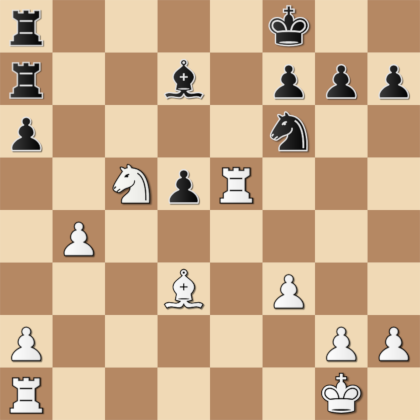
A brilliant decision, masterfully transforming one type of advantage into another. It should be borne in mind that at that time such exchanges of a powerful knight for a passive bishop were most unusual, and Petrosian was obviously hoping for the 'obvious' 22. a4 Bc6 23. Rc1 Nd7 24. Nxd7+ Bxd7 with possibilities of a defence. However, Fischer was in his element here: he always valued bishops higher than knights, and he especially liked play with his light-squared bishop. He very skillfully created positions where the superiority of bishop over knight could manifest itself, ... and in the realisation of such a superiority he had no equal: here he operated like a chess automaton.
Garry Kasparov, My Great Predecessors, Part 4, p. 428
Very characteristic of the creativity of today's Fischer. He often resorts to the possibility of transforming one type of advantage into another. Thus in the present position too, he readily parts with his strong knight, exchanging it for what is in general a bad bishop, and obtains a position of a qualitatively different type in which White's bishop will dominate over the knight.
L. A. Polugaevsky, '64' (No 43, 1971), Translated by Douglas Griffin
This exchange, which wins the game, was completely overlooked by the press room group of grandmaster analysts. Najdorf, in fact, criticized it(!), suggesting instead the incomparably weaker 22 P.QR4 (a4). Now, in addition to his potential outside passed pawn, Bobby has a Bishop vastly superior to the Knight and his Rooks will possess the only open file.
Robert Byrne, Chess Life & Review, February 1972, p.85
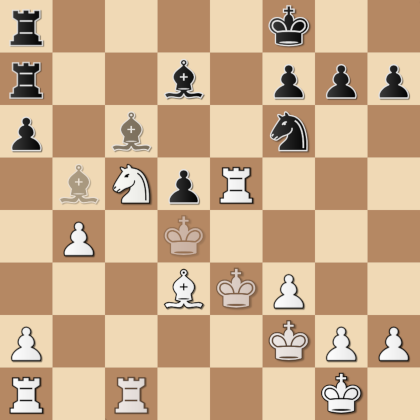
This image shows some ideas. Firstly let us see the thought process behind Nxd7:
- Petrosian is stuck defending the a pawn with his rooks. It is attacked by Fischer's knight and bishop.
- Petrosian played Bc8-d7 with the idea of Bb5 to trade off the attacking d3 bishop.
- This needs to be stopped as it would stop pressure on a6.
- There are only two moves that stop this, Nxd7 and a4.
- After Nxd7, there is the threat of Rc1 and then Bxa6. This is because of the back rank. Rxa6 would lead to Rc8 followed by checkmate.
- So this would have to be defended with Rd6.
- This allows Rc7 with the threat of Re7, doubling rooks.
- So Nd7 has to be played.
- Now Black's pieces are tied up.
- Tied up pieces = zugzwang = we can bring the King to d4 easily and dominate.
Fischer probably looked at Nxd7 first as it is a forcing move and saw that it was winning, so why go for 22.a4 when there is a clear win. Fischer preferred bishop versus knight endgames, like his famous Game 4 against Taimanov. In the previous game 6 against Petrosian, Fischer exchanged his knight for Petrosian's bishop. This was commented on as Fischer technically was left with a bad bishop:
So Fischer went for his style.
The move Nxd7 echoed through out the ages. At least it did... At least until the engines came along with their platinum bit-coded arrogance. They annihilated our classics. Made a mockery of our champions. It would be like finding out that the Mona Lisa had a mustard stain, that Stonehenge had a missing stone, that the Eiffel Tower wasn't a tower, that the Big Ben wasn't big, and that the Leaning Tower of Pizza wasn't actually made out of pizza.
---
One stormy night, an article was published on ChessBase. The article was called 'Solution of the endgame riddle: Was Fischer's 22.Nxd7 winning?'
It was published as part of their 'Is this famous position winning' series.
Commentators would analyze positions in that series with engines.
They concluded that Nxd7 was a blunder, turning a winning position to a drawn position.
Furthermore the article said that Fischer's play in the endgame was 'far from perfect' and that the win was blundered to a draw multiple times.
The news was a principle variation stuffed bombshell, courtesy of a possessed pack of anonymous button pushers, buddy Stockfish and Co.
I say that in jest. Users would analyse games with engines and share their analysis for the fun question of finding out if positions were winning or not. This is fine.
Fischer and Petrosian didn't see the idea of 23. d4 to activate the knight after 23. Rc1. This was probably because they were focused on the a6 pawn. And they didn't see the idea of Nb6 and d4 later, which led to four consecutive errors in the game according to the engine. This was probably because they were focused on Fischer's King activating. Petrosian was demoralized and Fischer was confident.
There has been discussion on whether 22. Nxd7 should be taught in textbooks as a way to play. What do you think?
Analysis below:
Tigran Petrosian annotations in Petrosian's Legacy (from Ruhubelent blog).
Anish Giri: This Nxd7 game, so that's the funny part - double exclaim Nd7. It's a big question actually whether it's a double exclaim or not. It's one of those, it was such a revolutionary concept and it's still good but actually there is a better move here than Nd7.
Might be a4, I mean you can put on the engine I don't recall, I'm almost sure that there was a better move here.Sagar Shah: But like Knight d7 everyone just told Fischer is a noob like you know like all the...
Anish Giri: That was like the opposite, so first they thought he was a noob. Look they were here (gestures with hand) he took it here the engines take it here and by accident they were right - but not fully.
Nd7 also wins. I think Nd7 is like 1.2, 1.1 and there's a move with 1.9 - something like this. I have a, my friend at least has analyzed this. But yeah Nd7, that it can be good is a revolutionary thought. Actually the more I think about it, like it makes it practically very easy to convert, so practically I still love it.
I must say that if you would give it to me and I would be blank here, I wouldn't know anything - I think I could have come to Nd7 being the best move here. It looks the best to me now also, but I know that it's not the best by computer.
Anish Giri, Sagar Shah Interview, ChessBase India
---
So yet another famous game has been put though the mangle.
This is akin to running a word processor over an Agatha Christie novel. It may find a spelling or grammatical error, it may even give the villain a loophole where they could have escaped but it will never change the last page.
Fischer won, just enjoy the story. There is no 'Riddle' only the fact that a computer will never be able to really solve one.
Sally Simpson, Chessgames.com message board
Share your thoughts on this game and Fischer's famous move 22.Nxd7 in the comment section.
You may also like
 A8086555
The engine said black is winning I said no
In the world of chess, the emergence of engines is undoubtedly the key to the rapid development of t… RuyLopez1000
The Candidates Qualification System
Thoughts on the Candidates Qualification System RuyLopez1000
Did the Soviets Collude in the 1953 Candidates Tournament?
I Investigate The Claims By Looking At The Evidence RuyLopez1000
Epic Endgame: Win with a Passed Pawn
Alekhine vs Capablanca Game 34 RuyLopez1000
Bobby Fischer's GOATed Endgame
Bobby plays a brilliancy. Instructive Lesson. RuyLopez1000