
Stefan Rebner
Where Do the Pieces Go? A Different Kind of Opening Study
Where Do the Pieces Go? A Different Kind of Opening Study
There is a well-known argument in chess improvement circles: club players should spend their time on tactics and endgames, not on opening theory. The argument has real merit. An extra hour of endgame study will, on average, rescue more half-points than an extra hour spent memorising opening variations. This is probably true, and most serious coaches would agree with it.
But the argument sometimes slides into a broader claim — that opening preparation is not worth doing at all below a certain level. Many club players, regardless of rating level, take opening study seriously — and rightly so. Even a small, concrete advantage carried into the middlegame is worth having, particularly as you are meeting opponents at your own level in rated games.
The more interesting question is not whether to study openings but what supporting material that study should draw on — and what happens after the opening is done.
The Material That Does Not Exist
One thing that is genuinely difficult to find is a collection of complete games — not opening fragments, not annotated highlights, but full games from move one to checkmate — where a significantly stronger player systematically defeats an opponent at a specific club rating level, in the same opening, again and again.
The reason this material is rare is structural. Strong players rarely meet much weaker players in organised competition. When they do, the games are isolated rather than part of a systematic series. And when opening books reach positions where one side has a clear advantage, they tend to stop there — with a note that White has a winning position, or that Black's setup is strategically compromised — and move on to the next variation.
But how does one actually convert it? What does the middlegame look like? Where do the pieces end up? Those questions are left to the reader, and the answer — somewhere in the vague middle ground between opening knowledge and endgame technique — is often the hardest part.
In RBOTChess, for each opening and rating level, this material exists. It is available as a downloadable PGN file — 200 consecutive winning games, playable in any analysis tool, showing complete games from opening through middlegame to checkmate.
What Piece Maps Are
The 200 winning games are also the basis for something more unusual: a visual analysis of where each piece type actually ended up across all those games.
The idea is straightforward. Take 200 games played in the London System at the 1600 level. Track where the knights stood at every point across all those games. Aggregate the data into a heatmap — darker squares where the knight appeared most frequently, lighter squares where it rarely ventured. Do the same for every other piece type. Add the most commonly occurring pawn structure. The result is a set of piece maps: a visual picture of how the opening actually develops in practice at that level, across a meaningful sample of games.
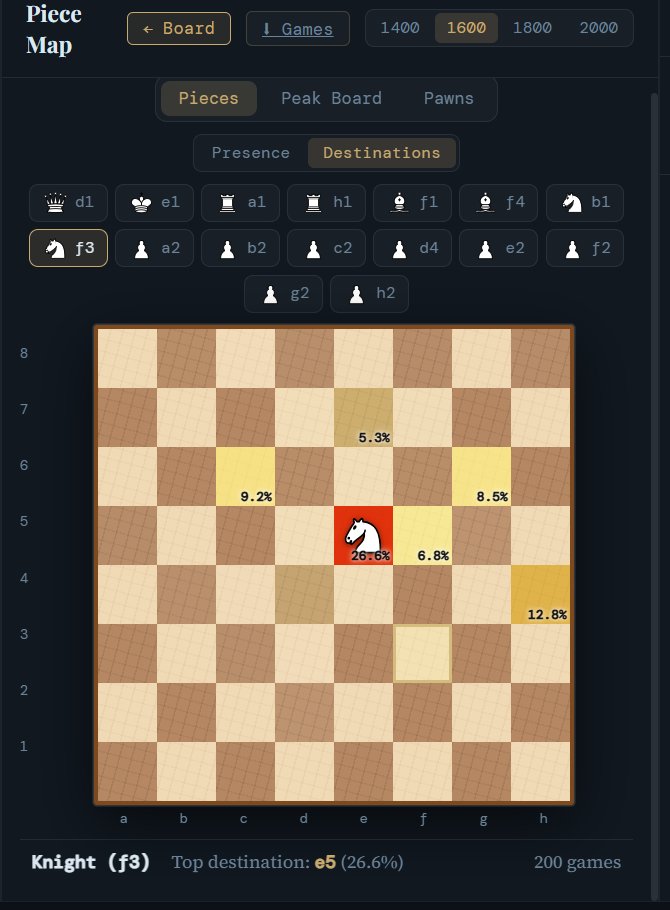
Knight (f3) — top destination e5, appearing in 26.6% of 200 winning games. London System, 1600 level.
This kind of visualisation does not appear in opening books. It is not part of any standard training tool that the author is aware of. The reason is probably that it requires a specific combination of inputs — a large sample of games in a single opening, filtered by rating level, all resulting in a win for one side — that has not previously been assembled and analysed in this form.
A strategy and gameplan document tells you where your pieces should go. A piece map shows you where they actually went, across 200 games that all ended in a win.
What Piece Maps Are For
Opening preparation typically produces two kinds of knowledge. The first is move-specific: in this position, after this sequence, the correct response is this move. The second is structural: in this opening, the knight belongs on e5, the rook belongs on the d-file, the bishop is aiming at h7. Strategy documents and gameplans try to convey this second kind of knowledge, but they do so in language — and language, however precise, is an approximation of something spatial.
Piece maps convey the same information visually. Where the knight tends to stand in winning games is not a rule to memorise but a picture to absorb. The difference matters when the game has moved beyond the prepared lines and the player is navigating on their own. A rule requires active recall. A picture is simply there.
This is particularly relevant for the question of converting advantages — the gap that opening books tend to leave open. A player who has emerged from the opening with a positional edge knows, in principle, that they should centralise the knight and activate the rooks. Piece maps give that principle a concrete visual anchor: this is where the knight tended to stand in 200 games that were won from this position. That is a different kind of guidance.
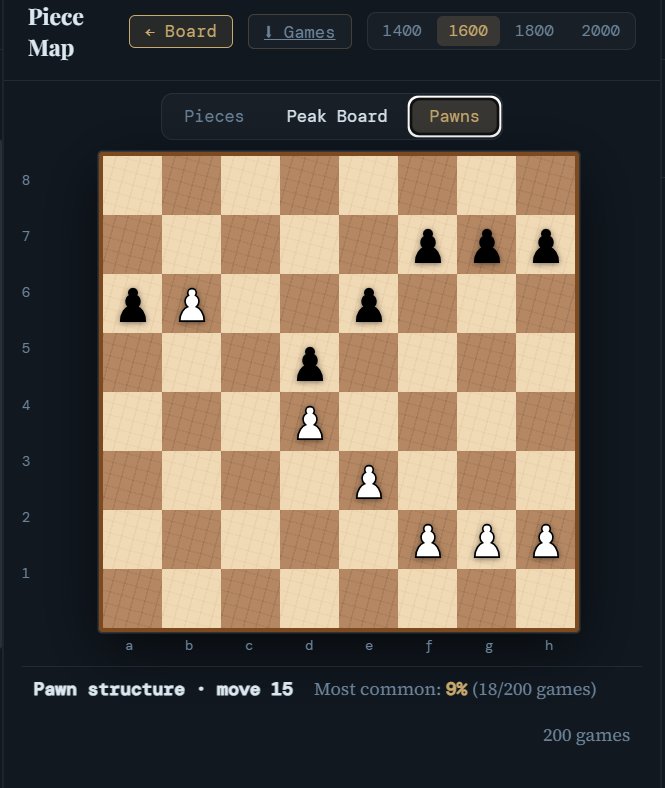
Most common pawn structure at move 15 across 200 winning games. London System, 1600 level.
Complete Games as Study Material
The 200 games are also worth considering as whole games, not just as a source for piece maps. Downloading the PGN and working through the games in a familiar analysis tool — Lichess, ChessBase, or any other — gives access to the full arc of how the opening converts into middlegame play and eventually into a decisive endgame.
This kind of study sits somewhere between opening preparation and general chess improvement, which may be part of why it is underused. It does not fit neatly into the usual categories. But for a player who wants to understand not just what to play in the opening but what the resulting position typically leads to — and how games at their level are actually won — complete game study in a single opening is a practical and underrated approach.
The games in RBOTChess are not grandmaster games. They are games between a strong engine and an opponent rated at the specific level being trained for. That distinction matters: the middlegame and endgame patterns that emerge from these games are patterns that arise from the positions your opponents at that level create.
Guess the Move — Filtered by Opening Line
One feature recently added, takes the 200 winning games a step further. Rather than presenting the games as a collection to browse, it structures them as an interactive training exercise: for each position in the game, the player is asked to find the move that was played.
This format — Guess the Move — is not new in chess training. What differs here is the filtering. The 200 games can be filtered by opening line, which means the positions presented in the exercise are not drawn from the full collection at random. They are drawn specifically from games that passed through the position the player has just been studying in the tree.
The practical consequence is direct. A player who has worked through the lines arising after 3...c5 in the French Defense against 3.Nc3 can then train on complete games that began with exactly that continuation — seeing how the position develops through the middlegame and into the endgame, and being asked to find the moves at each step. The opening study and the complete game study become a single connected workflow rather than two separate activities.
For players who have been told that middlegame and endgame training should take priority over opening preparation, this may be of interest. The games are complete. The middlegame and endgame are there. The connection to a specific opening line simply means that the positions encountered in training are the positions that arise from the preparation already done — rather than positions from unrelated games that may never appear on the board.
The criticism of opening study for club players is worth taking seriously. Time spent on endgames and tactics is rarely wasted, and opening preparation without a supporting understanding of the resulting positions is of limited value. None of that is in dispute here.
The question is what opening preparation can look like when it goes beyond move sequences — when it includes the complete games that follow from those moves, and a visual record of where the pieces ended up across two hundred of them. That kind of preparation connects the opening to the rest of the game in a way that move trees alone do not.
The complete London System — opening tree, strategy and gameplan documents, piece maps, 200 downloadable winning games, and Guess the Move training — is free with registration at rbotchess.com.
Premium subscribers get access to 14 additional openings, selected by statistical popularity across Lichess rating levels.
Stefan Rebner is the developer of RBOTChess (Rating Based Opening Training), a platform for opening preparation built around Lichess game data at specific rating levels.
The first article in this series — What Your Opening Book Doesn't Know About Your Opponents — is available on Lichess.
Comments and feedback on the methodology are welcome.
You may also like
 StefanRebner
Three Openings Where the Right Reply Depends on Rating
Opening preparation is usually built on a quiet assumption: that there's a single right answer to a …StefanRebnerA Different Approach to Chess Improvement
Every chess improvement guide eventually tells you the same thing: solve tactics, study endgames, an…StefanRebnerWhat Your Opening Book Doesn ́t Know About Your Opponents
Most opening preparation is built around one assumption: your opponent will play the best available … DaBassie
Improving at chess: calculation as a skill
This post is about me rambling about calculation. I provide some techniques that make chess calculat… RuyLopez1000
Fischer vs Karpov: The Match That Never Was
Explore one of the Greatest Potential Rivalries in the History of Chess NM ZugAddict