
Progress!?
I used to think my lack of rating rise meant I wasn't improving. Now I think it was an artefact of the rating system.
Warning: more than most, this post is really for my own consumption and likely to be rather boring to everyone else.
My chess history is that due to having older siblings I learnt the moves at a very early stage (probably aged 3-4) but my immediate family never really took to the game so it was only in school holidays when I played against my uncle and grandfather (who lived a fair way away). At school ("high school") there was a Friday afternoon chess club for a while. It wasn't taken at all seriously - no coaching, we mostly just goofed around playing bughouse or "doubles" as we called it, but there were enough competent players to form a school team that entered some competitions and I was keen enough to play in a handful of weekend congresses. I had a rating in the low 1400s - this is the Scottish chess federation in the 1980s so who knows what that really compares to these days, but it's nothing special.
I then went to university and pretty much stopped playing, just having the odd casual game (including the first internet chess server ICS) but still fitting in blitz sessions when visiting my uncle, who remains an enthusiastic social player now well into his 80s. During the bulk of my career (in scientific/mathematical research) I had neither the opportunity nor the motivation to spend evenings staring at a chess board thinking hard about complex problems that had no value outside of a chess board after a day of staring at a computer screen thinking hard about complex problems that actually mattered (at least a little) in the real world!
A number of factors rekindled my interest around 2020-ish. My work was winding down (I'm now fully retired), I enjoyed the "Queens' Gambit" miniseries, covid lockdowns cut down on other activities, and then after I'd been playing a bit online on The Other Site, someone retired to the town where I live (Settle) and decided to set up a real chess club - he had been a headteacher who'd run the chess club at his school. Prior to that, the nearest club was a 45 min drive and I just hadn't been that keen.
My first real OTB games in several decades were at the Ilkley Chess Festival in 2022. I entered the U1700 section and scored 4/5, a performance rating of 1845 (from here on all ratings I'm discussing are ECF classical). Then Settle chess club entered a team in the local league and after a few more games over the winter I got my first official rating of 1839 in the spring of 2023. I thought, hey this chess thing is quite easy, I have somehow improved 400 points in about 40 years without trying, so now I'm working at it I'm surely going to rise. I then spent the next couple of years mostly drifting gently down and was as low as 1800 this time last year. This was a bit disappointing as I was actually studying chess quite enthusiastically over this time and felt I was learning a reasonable amount even at my advanced age.
Over the past year, a few decent results have pushed my rating up and I went past 1850 for the first time in April 2026.
So what's actually going on? Why did I seemingly get worse for such a long time, and am I really getting better now?
I think it can mostly be explained as an artefact of the ECF rating system. Your first official rating under this system is a performance rating based on your first 10 games (with an additional dummy draw against an 1800-rated player added to stabilise the calculation). The idea is you calculate the average rating of the opponents (including the fictional 1800 player), then look up on a standard table what your percentage score means in terms of rating differential. To a rough approximation, a 65%-35% score represents a 100 point difference in rating and 75%-25% is 200 points.
However a key point to recognise is that the uncertainty on this initial rating is huge, because 10 games is a very small sample. As a simple analogy, consider tossing an unbiased coin 10 times. The expected number of heads is 5, but the standard deviation of this number is quite substantial at about 1.6, meaning 4 or 6 heads would be entirely unremarkable and in fact anything from about 2 to 8 heads is quite plausible (95% confidence interval = 2 standard deviations, meaning that if you repeat the "10 coin tosses" experiment many times, about 5% of the experiments will have fewer than 2 or more than 8 heads, even though the coin is intrinsically fair). Once you include a realistic probability of a draw (say 20%), the variation in the outcome decreases somewhat but the 95% range of expected scores from 10 fair chess games (assuming equal skill opponent, 40% win, 20% draw, 40% loss) is still about 2.5 to 7.5 out of 10.
This means that if you play 10 fair games of chess against equal opposition it would be very normal to score 3.5 or 6.5, and you could plausibly get scores of 2.5 or 7.5, just through random variation. These results translate into an estimate rating differential of 100 and 200 points respectively, versus your opponents, even if you're actually the same skill level as them. (NB adding in the dummy draw to the 10 games alters these values very marginally, not enough to materially affect the argument.)
In my first 10 games I scored 7. The average rating of my opponents was 1703. Including the dummy 1800 makes the average 1712 and my performance 68% (indicating a rating differential +133 points) which gives a performance rating of ...well actually it's not precisely the 1839 I was credited with but it's close enough. However, I've just shown that even if my true rating was actually 1703 and my expected result was therefore 5 out of 10, I could easily have scored 7 just with a bit of luck. In fact I could have been somewhat weaker than 1700 and still got 7 out of 10. This is borne out by my next 10 games where I only scored 4 out of 10 against an average rating of 1767. Including the dummy draw, the performance estimate of that second set of 10 games using the ECF method is about 1700. Over this time, my rating drifted down about 35 points to just over 1800.
However if I'd played that second set of 10 games first, and then my first 10 games after that, I would have started with an initial rating of about 1700, and then gained about 50 points over the next 10 games. I'd have only been about 1750 after the 20 games but would have thought I was improving.
Over the next year I bounced around between 1800 and 1835, never even reaching my initial rating, which to be honest was a bit of a disappointment. Was I really not improving at all? I felt like I was learning stuff but it didn't seem to be showing.
However, last year I did quite well at Ilkley, scoring 4 and sharing first place in the U1900 section. Another 4 (and another share of first place) in the U1900 at Huddersfield, some decent games for the U1850 Yorkshire team, and my rating finally crept over 1850 for the first time this summer. A decent performance in the Open section at Ilkley this summer and a win in the final U1850 county match has now pushed me to a new high of 1863. My performance rating at these last three congresses has been well over 1900 each time, and over my last 20 games my performance rating has been about 1930.
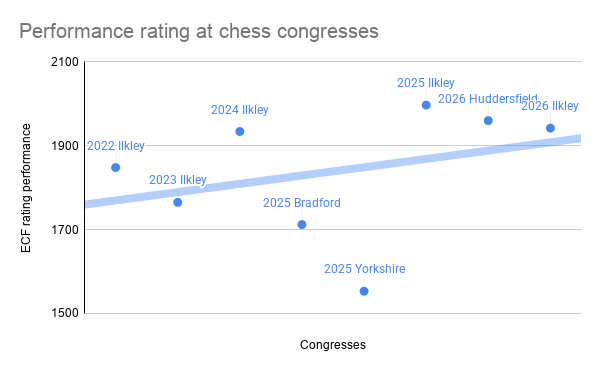
Here's another way of presenting the data, just plotting my performance rating at each congress I've played in from 2022-26 (as calculated by chess-results - I don't know their exact algorithm but it's surely similar to the ECF method). The linear fit suggests a positive trend (albeit it's not statistically significant in this method) and also points to my true strength at the start indeed being considerably below the 1845 performance rating I achieved in my first event and the 1839 rating I was initially given. You can see I had a big wobble in the middle with one mediocre and one truly awful event. Not sure what went wrong there, the format for the latter was unusual (3 Sundays spread over several months) and I just never got my head in the game.
And here finally as a reward for anyone who read this far, is my final game this season - the final of the U1850 county competition, where I won my game on board 5 but the team lost 7-9. I think I played a decent game, a small wobble in the middle but a nice finish. I don't have any more OTB chess planned for a while.
You may also like
 ChessMonitor_Stats
Where do Grandmasters play Chess? - Lichess vs. Chess.com
This is the first large-scale analysis of Grandmaster activity across Chess.com and Lichess from 200… CM HGabor
How titled players lie to you
This post is a word of warning for the average club player. As the chess world is becoming increasin… flash3s
How you should create and execute your middlegame plans
The process of selecting and achieving your post-opening ideas Fire-work
I made a program to find craziest sacrifices in a row. Here is what it found
"Aren't those 2 bishops our last hope? Surely not, we can sacrifice them to create a perfect checkma… jdannan
45+45 is a bad time control
A discussion of time controls for chess games RuyLopez1000