
Raising Chess Players
Teaching Strategies and Personal GrowthProgress in Teaching My Daughters
Everything is going well in the chess, and my daughters are improving. I see progress every week. We are constantly learning something new, and their understanding and abilities are increasing.
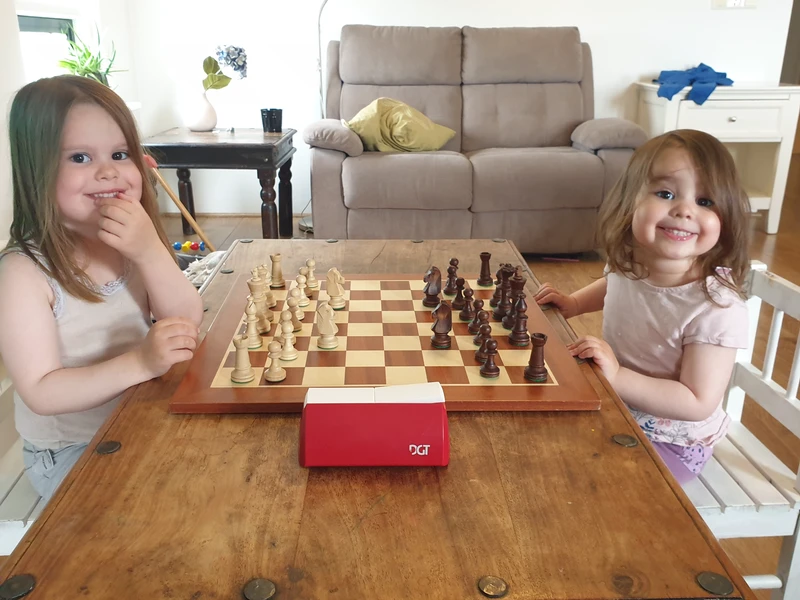
Ready to play.
My Older Daughter
With my older daughter, I’m currently focusing on advancing through the center in the opening, developing the pieces efficiently, and castling as early as possible while ensuring that each piece is moved only once during the opening phase. I’m also teaching her to connect the rooks and to be cautious about bringing the queen out too early in the game.
She’s even developed a special name for the move where she pushes the h-pawn one square forward to create an escape route for the king after castling. She calls it Prump! (fart in English) This name originated because when I first showed her the move, I jokingly said the king had "farted" and needed fresh air. Now, any move with the h-pawn (and even the a-pawn) is simply called Prump!
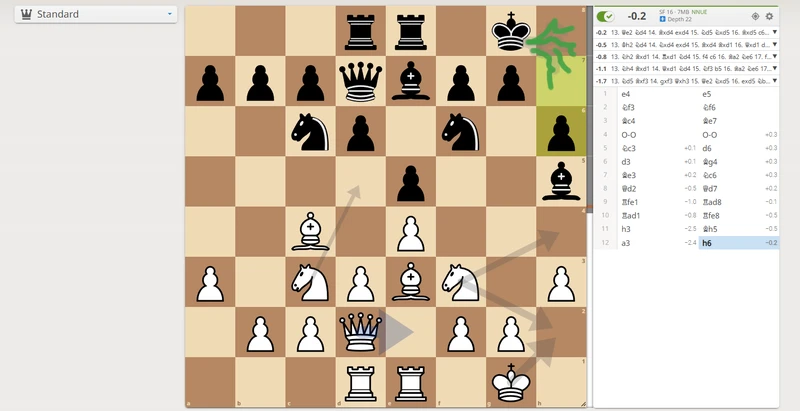
This is a typical position after the opening, where the move Prump! has been played.
This approach of personalizing the moves and giving them meaning has worked well for teaching them.
We’ve also been learning the relative value of pieces: the queen equals 9 pawns, a rook is worth 5, bishops and knights are worth 3 each, pawns are worth 1, and the king is priceless. I use the concept of “cost” (connecting it to money and shopping) when explaining this, saying, for example, that the queen “costs” 9 pawns. Additionally, we’re learning to avoid losing our pieces carelessly and to trade only when it’s advantageous—for example, not exchanging a knight, which is worth 3 pawns, for a single pawn.
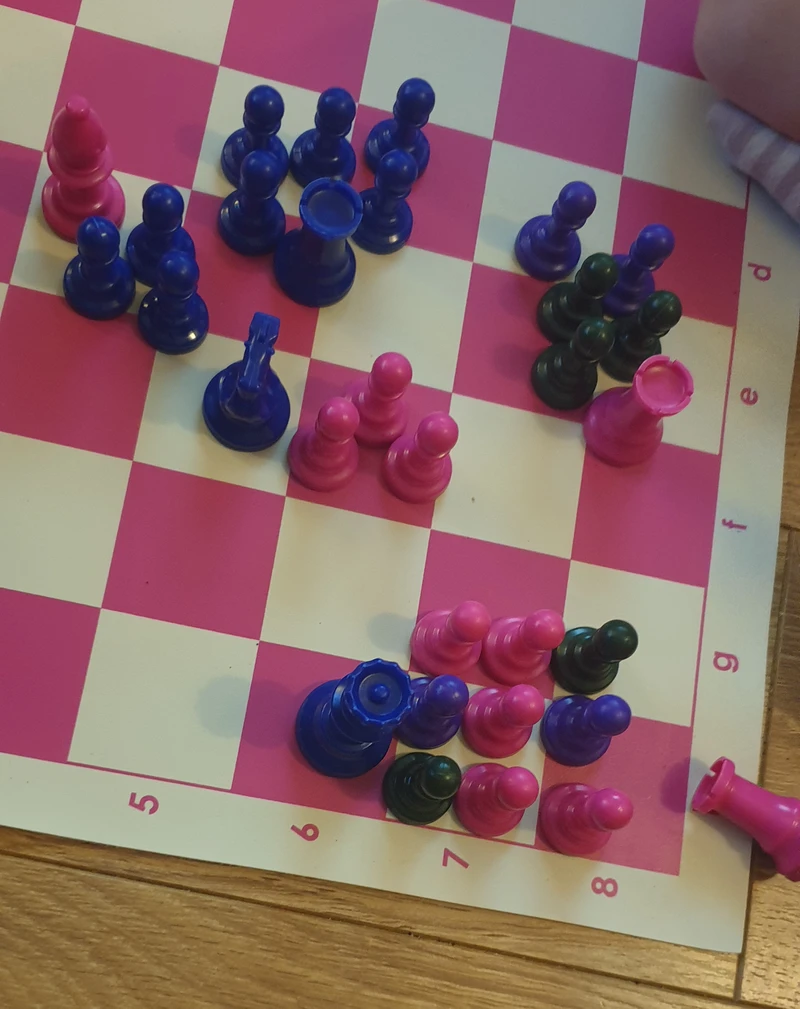
There she is, showing me the value of the pieces.
Some days are better than others. She still occasionally tries to cheat, like moving pawns backward to capture, but she’s a playful personality who enjoys trying to trick me.
I’m also encouraging her to play chess against herself, switching sides at the board. I’ve begun asking her to justify her moves and explain their purpose, but this is still a work in progress. My goal is to help her think strategically, not just to attack for the sake of capturing pieces.
Although she struggles to articulate her reasoning, I’m pleased that when I show her a 2-3 move combination, she often takes over and shows me her own ideas. She’s independent and prefers to explore moves from her perspective. Surprisingly, her moves often make sense and have a logical foundation, even if she can’t always explain them clearly.
My Younger Daughter
My younger daughter, on the other hand, has now learned to set up the chessboard correctly and understands that the queen starts on its matching-colored square. She calls the queen "Mommy," the king "Daddy," and sometimes refers to the pawns as "the kids."
She occasionally tests me when setting up the board by deliberately placing pieces incorrectly, asking, “Does this go here?” I respond, “No, you know it doesn’t belong there,” and she promptly fixes it. It’s part of her playful learning process.
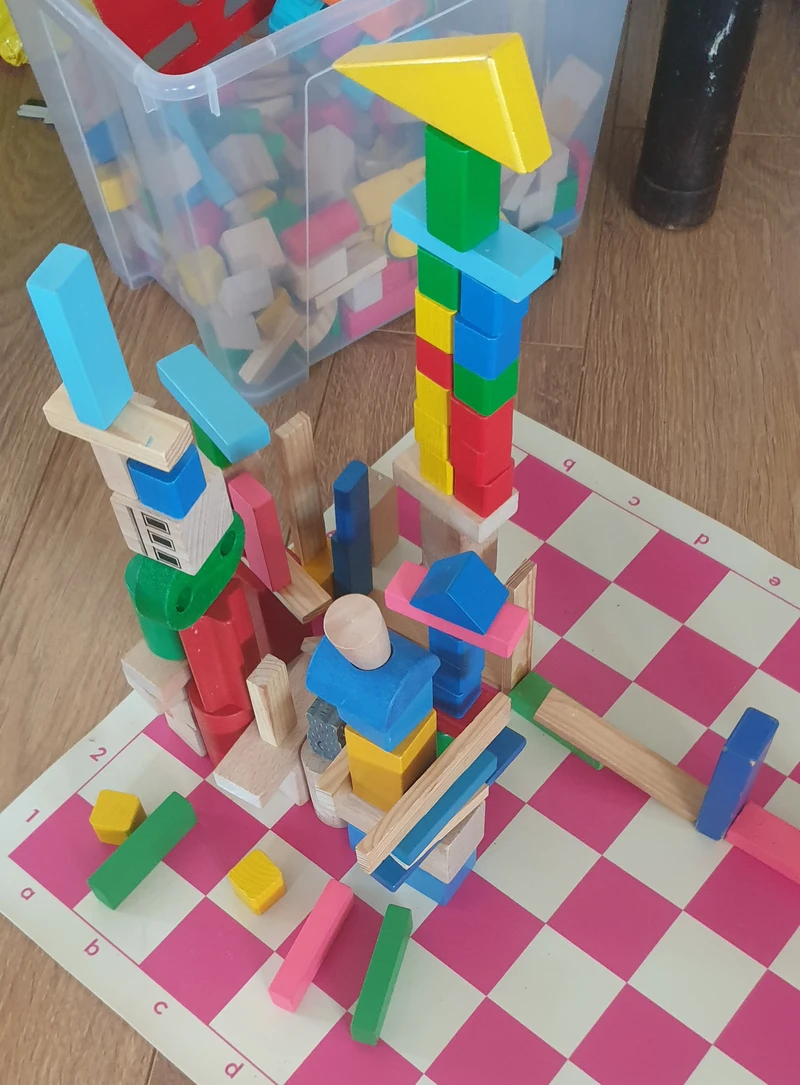
You can use the chessboard in many ways—even as a foundation for a skyscraper!
I’m teaching her differently than I taught my older daughter. Instead of breaking everything down into separate lessons, I’m teaching her everything at once: how the pieces move and how to start the game well. This approach seems to be working fine. When I notice something she struggles with, I focus on that specifically during the game. We learn as we play, and I’m not spending too much time explaining advanced concepts like en passant or the difference between long and short castling—those will come later.
My Chess Progress
As for my chess, I haven’t been as active as I’d like in playing rated games. I’ve mostly been playing casual games, avoiding rated ones because I feel too busy to commit fully. This is something I need to change. My goal this month is to play more rated games—at least more than I managed last month.
Last month, I played 29 games in total, including 13 rated ones. Of those, I won 19, drew 1, and lost 9. On November 1st, my Rapid rating was 1408, and now it’s 1450. I’m happy with the progress.
I’ve also improved in solving puzzles, though my performance varies depending on my focus. I’ve learned to stop when I feel my concentration slipping, preferring quality over quantity.
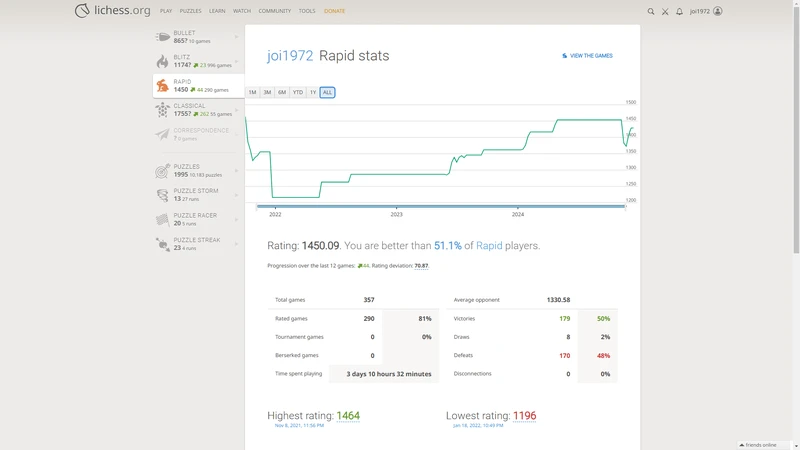
This is my progress as of the beginning of December.
A lot of my time has gone into watching the World Championship match between Gukesh and Ding. I keep switching my favorite between the two because they’re both extraordinary players and personalities. Even my wife, who usually isn’t interested in chess, has become excited and follows the match closely.
One thing I’ve learned from watching and listening to the commentators is the importance of piece placement. Everything needs to harmonize to create a strong endgame. That has been my biggest takeaway from the match so far.
I also enjoy the variety of insights from different commentators on YouTube. Judit Polgár and Daniel Naroditsky are among my favorites.
Interestingly, I recently dreamed about asking Judit Polgár for advice on teaching chess to my daughters. Her advice was simple: 'Keep it fun; just play.' So, I’ll continue teaching my daughters through play and make sure to keep it fun. Thank you, Judit, for the advice.
For more posts, feel welcome to check out FamilyChessJourney on Substack


