
Teaching My Toddlers Chess
A Journey Through Play and CuriosityHow It All Started: Introducing Chess to My Little Ones
As much as I enjoy chess, I’m very interested in the best ways to learn it and explore everything related to the game. That’s why I find it especially intriguing to watch my daughters play and learn chess.
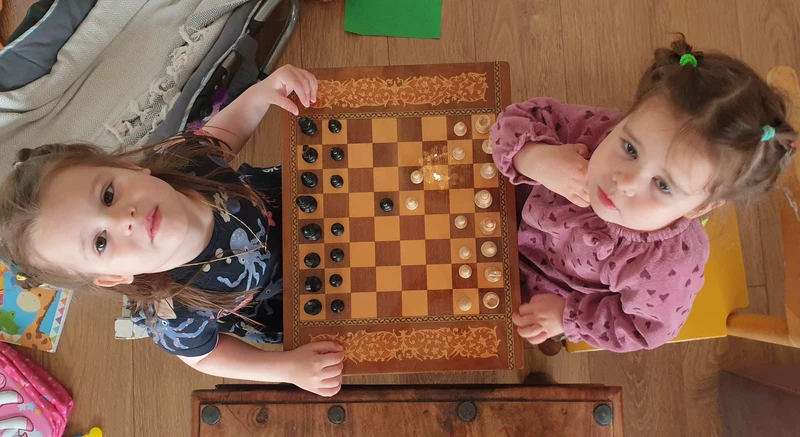
-At the beginning of a game.
My older daughter, who has just turned four, has learned how the pieces move and some basic concepts, though there’s still much she doesn’t fully understand. Meanwhile, my younger daughter, who is two and a half, has only learned how to set up the pieces correctly and knows their names and roughly how they move, though she sometimes gets it mixed up.
But I think they’re both doing well.
Searching for Resources: Reinventing the Wheel
When I looked online for materials on teaching chess to young children, I couldn’t find anything suited for kids as young as mine. Most resources were geared toward much older children, so I had to figure it out on my own—reinvent the wheel, so to speak. But then again, it’s just a game. Sometimes, it’s best to start by letting them play around with the pieces as they’re developmentally able. As we often say, “fake it until you make it.” I’ve realized there’s little point in trying to explain things like “check” and “checkmate” to a two-year-old.
The Developmental Stages of Learning Chess
What they both have in common is that they seem to go through similar developmental stages as they learn. Since they started playing with chess pieces early, with a dad who’s always into chess—whether on the computer, on the phone, on TV, or on a traditional chessboard—it comes naturally to them. Their interest seems to grow from their motivation, not because I pressure them into it.
In over 90% of cases, they’re the ones who ask me to play. Our sessions can last anywhere from 5 minutes to 3 hours, depending on their interest at the time. I try to say yes whenever possible, whether it’s 7 in the morning or evening. Rarely do I say no, and we usually play every day or every other day, with only occasional longer gaps. Sometimes we play once a day and sometimes up to five times.
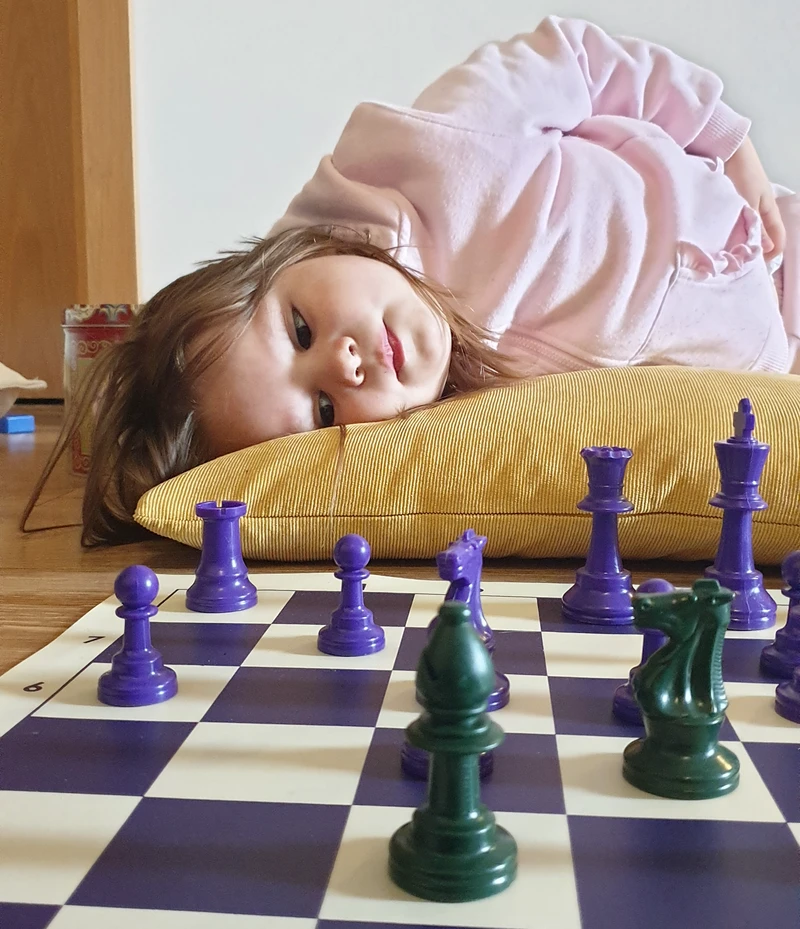
-After 3 hours of chess, you can get tired, so you just have to lie down.
The main point is to almost always be ready to play. When I say no, it’s usually because I sense they’re just pestering me rather than wanting to play.
As I mentioned, they go through developmental stages, and it will be fun to see how this progresses, especially since my youngest son, now three months old, has started sitting on my lap as I play with his sisters. I’m curious to see if he’ll follow the same path if he shows an interest in chess as he gets older.
Here are the main developmental stages I’ve noticed so far:
- Learning that chess pieces aren’t to be eaten. (around 1 year old)
- Understanding the pieces belong on the table or chessboard, not the floor.
- Realizing the pieces are stored in a box with two compartments—white on one side, black on the other.
- Arranging white pieces on one side of the board and black on the other.
- Taking turns (using a chess clock can add some fun).
- Keeping the pieces on the board, not on the table.
- Learning the pieces go in a specific order, and each has a name.
- Understanding how each piece moves.
- Learning how different pieces capture.
- Recognizing what a “check” is.
- Beginning to understand “checkmate.”
- Avoiding “hanging” (losing) pieces.
- Playing by the rules—and also playing without rules as a variant.
This is just from memory, and I expect the list will grow. My older daughter is now at stage 13, while my younger one is at stage 8. We always start by playing by the rules, but I let them bend the rules once they’re tired of them, explaining that this isn’t how it’s done in “real chess.” They seem to understand the difference, which helps keep chess fun.
Making Chess Fun: Rules, Flexibility, and Patience
I’ve noticed that if I’m too strict or try to explain something beyond their comprehension, they lose interest. Often, I need to hold back a bit.
Right now, I’m gradually teaching my younger daughter how the pieces move, starting with the simpler ones like pawns. I expect we’ll spend the next 6 to 12 months on these basics.
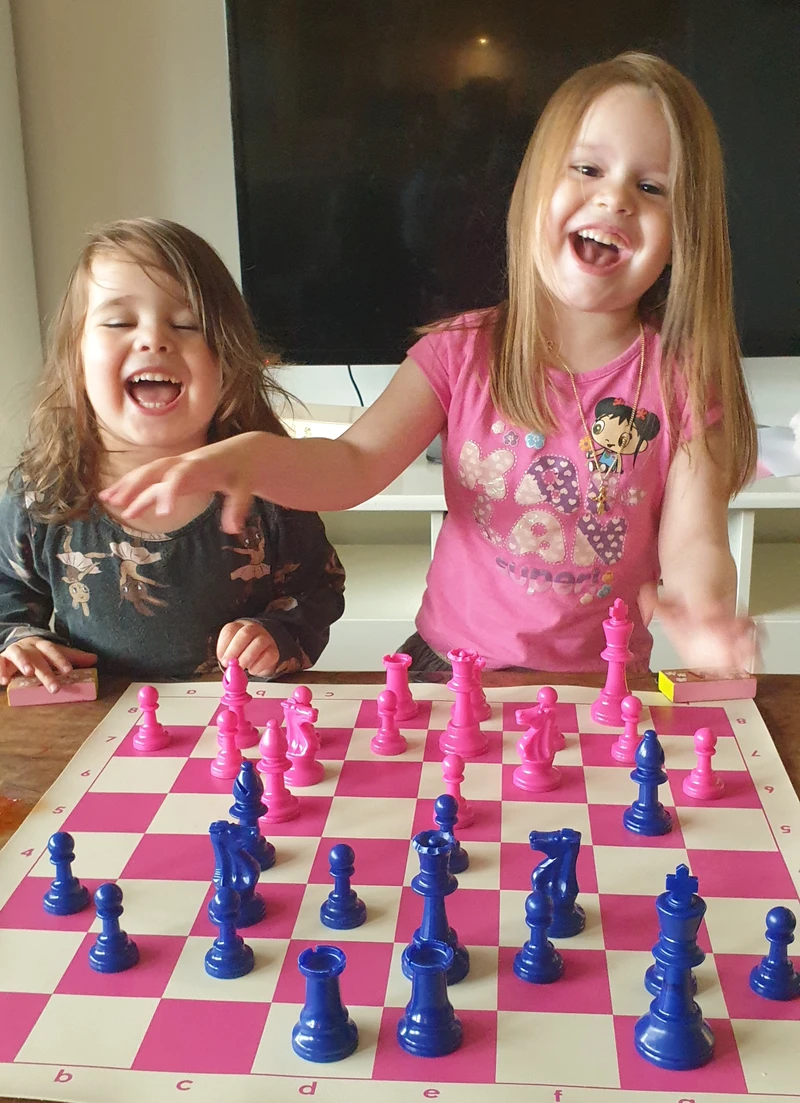
-The most important thing is to have fun when you play.
Meanwhile, my older daughter is beginning to understand that some pieces are more valuable than others; for example, she knows a bishop is more valuable than a pawn. She loves her bishops so much that she'll sometimes place her hand over them on the board to protect them from being captured! She’s learning the basics of development—like not moving the same piece twice in the opening and trying to bring all the pieces out.
Early Lessons in Strategy: Capturing, Developing, and Naming Squares
Occasionally, we set up a simple checkmate-in-one position from a book, and she enjoys setting up real board positions or replaying games I find online. She’s still not ready to translate her chessboard skills to the computer screen or apps, which is fine by me.
From the Chessboard to the Screen: Adapting to Technology
We’ve tried some apps designed for younger kids, but they’re all still too complex and not in her native language, so that hasn’t worked either. Plus, I’m generally opposed to such young kids having phones or computers, though I’ve made exceptions for chess.
What’s Next? Letting Their Interest Lead the Way
This is essentially where we are, and I’m curious to see if they’ll keep their interest in chess or move on to something else. That’s entirely up to them—it’s just a game, after all.
Thanks for reading, and I’ll share more with you later.
For more posts, feel welcome to check out FamilyChessJourney on Substack
You may also like
 joi1972
Chess is now more than just a game of Chess
Building Skills Beyond the Board joi1972
What It Means to Be an Adult Chess Improver
Reflections on My Journey, Challenges, and Growth in the World of Chess joi1972
Transitioning to Longer Chess Games and A New Training Routine
I Quit Blitz and Focused on 15:10 Rapid joi1972
Raising Chess Players
Teaching Strategies and Personal Growth joi1972