
Confidential Chess Files: Pawn
We are entering serious territory now, as I’m starting a series exploring each piece in what is essentially a hybrid style. Each of them will be personified, with their stories told in the first person. We will study their typical day in the chess office while introducing the human elements of what we actually think, struggle with, or have epiphanies about during the game. Fiction and realism combined into one.
The piece narrative format has nothing to do with my outlook on the board or life. I just came up with the concept, created the game, the writing arc, and the design. But of course, all of this is completely unrelated to the author’s vision.
We will now open the series with the pawn, giving it a personality and a “case file.” Let’s jump on a reading ride.
Table of Contents
Prologue
Ascension
Fracture
Inevitability
Conclusion
Prologue
Today is a new game of chess. I haven’t even recovered from the last battle. There’s an encouraging notion that some pawns sleep for only two hours, so I guess I shouldn’t complain. I exceeded the norm by doubling that time.
Pawns are not programmed to rest too much. The consequences of our delay in early action are sometimes too high. You know, the expectations are mighty. We are gifted with being sent first into battle. Truly honored, because, you know, someone has to initiate things, shape the terrain, and clear the paths for the rest of our army to join the march.
A clear vision is what we like. And getting some credit from time to time, as we tend to struggle with growth. We are not easily upgraded to a higher status, as our form rests on being very small. We compensate for this flaw in our design by demonstrating strengths in other areas, crossing our fingers in hope that our stamina will be recognized.
So yes, we like to daydream sometimes. But now, I really have to wake up. Another match is about to start. We’re clashing with the nation that lives across the board – our enemies since the birth of the game itself.
Before stepping into my uniform and joining the pawn crew, I know you have one question in mind: Who am I?
They like to call me expendable. I don’t quite know what to think about that. Sometimes I disagree, so I prefer to add another description to my identity.
I am the voice of all the pawns.
In the meantime, the officials state that I belong to the dark side, on the g-file.

Ascension
The game has started as expected. We entered the Slav Defense. The center is controlled by our pawn on d5, while the bishop and knights add another layer of support. This is the moment our opponents pause.
My friend on b7 is left unguarded. This is the first thing we learn about our role that makes me uncomfortable. We are supposed to sacrifice ourselves when the right moment comes. They don’t really ask us if this is what we want. So we have to embrace our destiny, hoping that the designers of our path will also reach the same fate of surrender. Then, I suppose, we could talk about equality.
The white army has to decide whether to grab the pawn and claim the advantage. But we would not really be behind. The b-file would open for our rook to spring into play, and we would gain useful tempos by chasing the white queen, which would accelerate our development. Momentum and quick mobilization would follow.
This is why my friend offers the sacrifice. For the greater good.
Another fella is marching forward, proudly challenging the center and clearing the path for our bishop. The pawn on e5 also asks for the exchange, even though the resulting trade would end in its disappearance from the board.
But that’s why we are here. Or at least we are told so: to set the stage for the actions that follow, bringing other forces into play. Despite the early losses we may endure in our pawn crew, I am happy with how our piercing advances shape the course of the game.
Our army has managed to improve piece coordination, and a very keen observer would say that the pieces occupy ideal squares at this moment. However, the carefully planned strategy has left us with an isolated pawn on d5. Its lonely nature is classified as a pawn weakness in the chess books of wisdom. With no pawns on adjacent files, it can only be supported by other pieces, which often have more important things to do than defend us.
While White taking the pawn on d5 now would be a bad idea due to tactical repercussions, I still feel both happy and sad for my friend. Happy that it will probably survive, but sad that there are no fellow pawns nearby to create a strong backbone. Its importance is minor compared to the hunt for White’s king.
If we forget our struggle for a while, we may notice that the white side has issues with activity and development. Their pawn crew looks healthier, but for how long can they persist without making any concessions?

Fracture
There is something almost mythical about romanticizing resilience in tough moments, as if persistence in avoiding complete failure is automatically considered heroic. Sometimes it truly deserves a big round of applause. The thing is, defending yourself from utter collapse requires bravery, but it is often rooted in forced survival. You just want to make it out alive. Nothing wrong with that. It simply widens the gap between resilience that is forced and resilience that is chosen.
In many situations, you don’t have to set yourself on fire and perform survival just to exercise its romantic appeal. On the other hand, there is always a certain passion for greed. If you have extra material, you want to keep it. You barricade, go passive, and try to preserve all the gold you have gathered. What an investment of energy in such a noble cause.
Like the white side contemplating how to continue in the presented position. Looking for an effective way to mobilize while subtly trying to keep the extra pawn. It comes up with all sorts of inventive ways to protect it, while in essence it is greed pretending to be resilience. Keeping control while staying fully armed.
While I appreciate the white pawn on b2 they are trying to keep, I know their motives are not sentimental. They are not protecting it out of loyalty, but to stay fully equipped and ready to serve the greater goal.
I find White’s position a bit comic at the moment. There are a lot of pieces on the first rank, but they seek freedom by advancing the a-pawn. Often we are the first ones to experience the downsides of a strategy gone wrong. When the forces fail to come up with a functional plan, they love to just throw us out there while they brainstorm another way to fall into the same trap.
White wants to keep the material intact and tries to disturb our pieces by either jumping with a knight to b5 or advancing the a-pawn further, perhaps offering a bishop trade. Our bishop on d7 eyes the h3 pawn in White’s camp, imagining all the ways it could sacrifice itself to expose the White king. White’s idea is valid. It is just wrongly timed and focused on trivial gains.
The fear is a bizarre little companion. It makes you see all kinds of things that don’t exist. Creating invisible threats is quite an achievement sometimes. I know this very well. You create the collapsing arc and put yourself in the center of it, while also wondering why others don’t share your artistic doom. So you overstep.
White saw the pawn on h3 as a target that would be easier to defend if they advanced the pawn forward and just tucked the king back to g1. All fears are valid. And very much appreciated. They make you feel less alone and less dumb. While White’s position was already weak, creating additional weakness on the side where the king sleeps was not exactly the most “resilient” approach to continue the game.
And what followed... felt inevitable.
Inevitability
You know, often we get tired of being called the weakest. Like, whoever came up with that scale clearly ignored our capacity. When you start equating size with strength, you clearly have a bug in your sense of worth. I may not be happy with the form and role I received in this life of 64 squares, but I don’t see myself as that unimportant. If you need me to clear the path for you to breathe, I think you might very well reconsider who holds the power.
Perhaps our in-built design doesn’t let us expand, jump, or slide all the way to the other side, but that’s because we still follow the old rules. Textbook definitions. And, as with all of them, they don’t last forever. Power shifts. Importance changes. Recognition arrives. Traditional values often stall innovation, but progress comes back like a boomerang – the baby steps transform into gigantic slides. I am optimistic about our chances. And now, even more confident, as I am about to embark on the walk of pride.
This is it. My time has finally arrived to join the arena and shape the remainder of the game. The g-pawns often remain on their starting square for the entire game, so I’m happy that I can be useful. Stepping forward instead of watching the battle unfold from a safe distance. It may look like I weakened my own king in the desire to reach the opponent’s, but the white forces are so disorganized that my king will not suffer even a tiny scratch. My role is to advance to g4 and disconnect White’s bishop from protecting the h5 pawn.
While I step forward, I have time to look to the left and silently greet the white fellow who is soon going to be abandoned. It looks strangely like me. Different color, but same weight. Should I question my army’s altruistic motives and abandon them to join all the pawns of this realm? I don’t know, but it feels like a step in the right direction. Until then, I shift my gaze to make myself less confrontational.
Yet another pawn clearing the path for success. Despite being a piece down, it is White who is on the edge of defeat, with their king endangered and cut off from escaping to the other side of the board. White’s queenside is a symbolic reminder of overprotection, creating more warmth on that side of the board but shivering cold on the other, which lacks support.
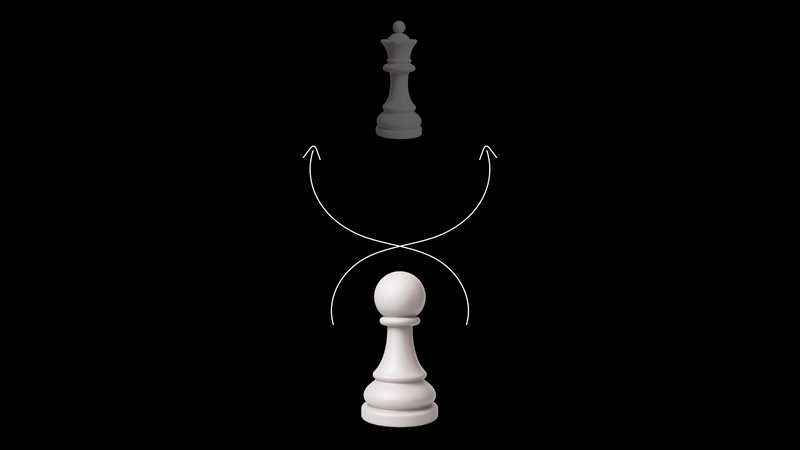
After doing so much clearance of the dusty roads with my pawn crew, I now feel beyond excited to see that the queen cleared the promotion path for me. I am now what they call a passed pawn. The road in front of me is uninterrupted by other pawns, and my future seems bright. This is the time when our strength comes to the forefront. We are the only pieces able to transform. It’s our signature mark. And if you find yourself grinding for months and years to reach the metamorphosis stage, keep in mind that it is a pawn effect: starting small and rising far above.
This is the moment our opponent resigns, before waiting for my promotion – exactly where we prefer to look away, and not into the eyes of the transformed ones. There is a subtle rejection of what others have achieved, as their path doesn’t resemble ours.
It doesn’t bother me. I still reached the apex of the mountain. For a brief moment, I matter in the eyes of my army.
Maybe they’ll give me a medal. Shout my name when talking about the g5 brilliance. Wink disturbingly.
But still, I prefer to enjoy the view with my pawn crew. Sometimes we are the ones who both open the battle and close it. It makes us wrinkle faster when tiresome clashes take a toll. So we lie down, replay the strategies and sacrifices that shaped the game, rewatching the entire battle as it unfolds again. Uninterrupted and at peace.
Conclusion
Here we come to the end of the pawn’s confessions, which hopefully helped you step into their shoes and understand their unique role better. Sure, I know it’s hard to abandon the self-centered perspective, but give it a try. Pawns exist, too. In a game where everyone is expected to contribute for life to thrive, those who do the most work are surprisingly marked as less important, even though their sacrifices directly influence the journey and the outcome.
As you’ve probably noticed by now from my constant rambling about it, I am very much not a fan of conformity and invented rules. So, when we finish the overview of all chess pieces, I’ll give each of them a very “realistic” strength, based on how they really contribute. This is, of course, not just a talk about pawns, pieces, and the chessboard – it’s about life as well. I’m sure you’ve already caught that part.
In the meantime, appreciate more those who work hard to make your life thrive. They may be invisible or standing right in front of you, but neglecting them just because “luck” hasn’t been on their side yet is a serious sign of everything wrong with the value system we’ve adopted. You may think you will never end up as a pawn, but it’s inevitable to enter its journey at some point in life. No power can stop you from that.
Until next time, when the knight takes the stage.
You may also like
 WGM jovanaeric
The Center Is Not Where Power Lies
Controlling the center often paints a target. WGM jovanaeric
Confidential Chess Files: Bishop
Following our two-week schedule, we meet again to continue the personified stories of each chess pie… WGM jovanaeric
How to Say No with Prophylaxis
You are sitting at the board, clenched like a statue, working on the fantastic variation that will t… WGM jovanaeric
Confidential Chess Files: Queen
We are reaching the point from which there is no going back. After the rook’s networking idea, the r… WGM jovanaeric
Confidential Chess Files: Rook
After wrapping up minor pieces with the bishop last time, we now turn our attention to the so-called… WGM jovanaeric