@cauffybeen said ^
The mate was four moves!
Not three moves!
there may be ways to mate in 4, but the quickest one is three. i had the engine solve it for me.
I had my engine solve it for me.
@cauffybeen said [^](/forum/redirect/post/fz41fiKj)
> > The mate was four moves!
> >
> > Not three moves!
>
> there may be ways to mate in 4, but the quickest one is three. i had the engine solve it for me.
I had my engine solve it for me.
@cauffybeen Wait you were right
look:https://lichess.org/analysis/8/1n4K1/qpB4p/3R3P/4kp1N/2p4P/2P1pP2/6R1_w_-_-_0_1?color=white
https://lichess.org/analysis/8/1n4K1/qpB4p/3R3P/4kp1N/2p4P/2P1pP2/6R1_w_-_-_0_1?color=white#5
"People are rated higher than you because they are more interested in..."
Nope. It's just their genetics. It's actually the opposite. I am more interested in openings, theory, history, endgames more than everyone I've ever talked to rated hundreds of points higher.
"People are rated higher than you because they are more interested in..."
Nope. It's just their genetics. It's actually the opposite. I am more interested in openings, theory, history, endgames more than everyone I've ever talked to rated hundreds of points higher.
@Rickdudester said ^
Try and solve a real chess problem that was composed by a human being, and not a "tactics trainer" puzzle that are essentially the empty calories of chess nutrition. Here's one to start with.
This seems like a highly contentious claim. I would argue that tactics that show up in real games are a lot more relevant for one's play than compositions.
You're right, I've overstated things there. I wouldn't say "regular" tactics are useless - they clearly are not. They are, however, one side of a coin that often obscures the other which is creative and flexible thought. Regular chess puzzles focus on established patterns that are fairly narrow and repetitive that we learn to apply in a somewhat rote manner to various situations. Actual, artistic, composed chess problems tend to be more about overcoming the ingrained filters "normal" tactics build up, and I suspect this helps us reduce blind spots and makes us more intellectually resourceful.
But my larger point is that, for me, at any rate, a beautiful puzzle isn't solved because it's "useful" but because t's actually really interesting and, paradoxically, that's what makes it also useful - beauty is memorable and "sticks" in the mind in a way rote training for training sake generally doesn't.
Interesting point. But, as a practical issue, aren't most composed problems really too difficult for someone rated between 1200 and 1600? They tend to involve, firstly, seeing one promising line a few moves deep, then, keeping the strengths/weaknesses of that line in mind, dong the same with another line, and so on. The general consensus seems to be that spending lots of time on "normal" tactics is a prerequisite to getting to intermediate stage. Another consideration is that even a "normal" pin, especially if combined with a fork, looks beautiful to me because it's something I couldn't have imagined not so long ago.
I'm not aware of the general consensus, but I don't think composed problems are intended to have a rating "cutoff", they simply take however much time they take to solve and one tends to gets better at it each time. As far as regular tactics, I also can't speak for others but I don't think I did tactics puzzles until I was already around 2000 or so, I mostly learned through playing and reading.
@Rickdudester said [^](/forum/redirect/post/SKLTh87Y)
> > > >Try and solve a real chess problem that was composed by a human being, and not a "tactics trainer" puzzle that are essentially the empty calories of chess nutrition. Here's one to start with.
> > >
> > > This seems like a highly contentious claim. I would argue that tactics that show up in real games are a lot more relevant for one's play than compositions.
> >
> > You're right, I've overstated things there. I wouldn't say "regular" tactics are useless - they clearly are not. They are, however, one side of a coin that often obscures the other which is creative and flexible thought. Regular chess puzzles focus on established patterns that are fairly narrow and repetitive that we learn to apply in a somewhat rote manner to various situations. Actual, artistic, composed chess problems tend to be more about overcoming the ingrained filters "normal" tactics build up, and I suspect this helps us reduce blind spots and makes us more intellectually resourceful.
> >
> > But my larger point is that, for me, at any rate, a beautiful puzzle isn't solved because it's "useful" but because t's actually really interesting and, paradoxically, that's what makes it also useful - beauty is memorable and "sticks" in the mind in a way rote training for training sake generally doesn't.
>
> Interesting point. But, as a practical issue, aren't most composed problems really too difficult for someone rated between 1200 and 1600? They tend to involve, firstly, seeing one promising line a few moves deep, then, keeping the strengths/weaknesses of that line in mind, dong the same with another line, and so on. The general consensus seems to be that spending lots of time on "normal" tactics is a prerequisite to getting to intermediate stage. Another consideration is that even a "normal" pin, especially if combined with a fork, looks beautiful to me because it's something I couldn't have imagined not so long ago.
I'm not aware of the general consensus, but I don't think composed problems are intended to have a rating "cutoff", they simply take however much time they take to solve and one tends to gets better at it each time. As far as regular tactics, I also can't speak for others but I don't think I did tactics puzzles until I was already around 2000 or so, I mostly learned through playing and reading.
<Comment deleted by user>
@Krenium said ^
"People are rated higher than you because they are more interested in..."
Nope. It's just their genetics. It's actually the opposite. I am more interested in openings, theory, history, endgames more than everyone I've ever talked to rated hundreds of points higher.
Oh. Nevermind then. :)
@Krenium said [^](/forum/redirect/post/DYCzNc98)
> "People are rated higher than you because they are more interested in..."
>
> Nope. It's just their genetics. It's actually the opposite. I am more interested in openings, theory, history, endgames more than everyone I've ever talked to rated hundreds of points higher.
Oh. Nevermind then. :)
@ZugAddict said ^
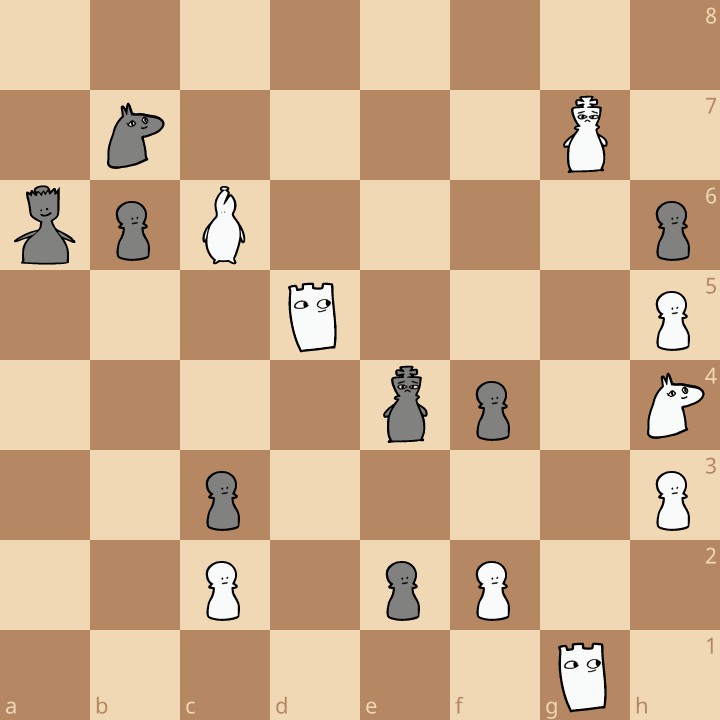
Edit: Isn't the solution Rd3+ Ng6+ and Bd7#?
Nope (Rd3+ Ke5 Ng6+ Kf5! Bd7+ Ke4@ZugAddict said ^
bro whats the board theme fr
My apologies. Here's a proper board:
lichess_study_puzzles-again_chapter-3_by_ZugAddict_2026.06.04.jpg (https://image.lichess1.org/display?op=noop&path=EL_2T21GTOTU.jpg&sig=65612034ab11c597c89a0791d55dfeff24719a18)
Sir how can you understand this board, understand this unless you're a drawer :D
@ZugAddict said [^](/forum/redirect/post/hDIUaAut)
>
> > Edit: Isn't the solution Rd3+ Ng6+ and Bd7#?
>
> Nope (Rd3+ Ke5 Ng6+ Kf5! Bd7+ Ke4@ZugAddict said [^](/forum/redirect/post/YVjheeGe)
> > bro whats the board theme fr
>
> My apologies. Here's a proper board:
>
> lichess_study_puzzles-again_chapter-3_by_ZugAddict_2026.06.04.jpg (https://image.lichess1.org/display?op=noop&path=EL_2T21GTOTU.jpg&sig=65612034ab11c597c89a0791d55dfeff24719a18)
Sir how can you understand this board, understand this unless you're a drawer :D