<Comment deleted by user>

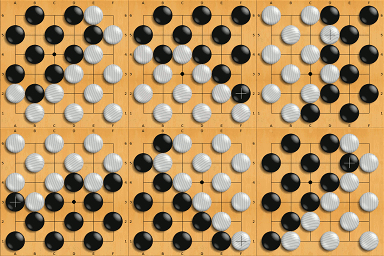
The Go table (in the Go table pic) looks like a mouse (or a Dedenne if u r into Pokemon)
The Go table (in the Go table pic) looks like a mouse (or a Dedenne if u r into Pokemon)

@MrLizardWizard said in #30:
Yes, this is what I meant as well. Shogi endgames are often brutally sharp, where a single misstep in a checkmate sequence could give your opponent enough pieces in hand to achieve a forced checkmate of their own.
Exactly since number of pieces does not get smaller endgame happens inevitably in rather violent way. As "parashooters" start working trough enemy defence it is unstoppable. So only defence is carry out your own attack. Typical winning attack final phase consist only checking moves. Most of shogi puzzles are forced checkmates with checking mates moves only.
@MrLizardWizard said in #30:
> Yes, this is what I meant as well. Shogi endgames are often brutally sharp, where a single misstep in a checkmate sequence could give your opponent enough pieces in hand to achieve a forced checkmate of their own.
Exactly since number of pieces does not get smaller endgame happens inevitably in rather violent way. As "parashooters" start working trough enemy defence it is unstoppable. So only defence is carry out your own attack. Typical winning attack final phase consist only checking moves. Most of shogi puzzles are forced checkmates with checking mates moves only.
@dboing said in #3:
often decided by being tired in the middle of one last try to gather the kittens...
so while in standard chess we can maintain the illusion of calculation for a long time. I think, Shogi might have bypassed such illulsion very early. Same with Go,
In go you need calculate deeper than in chess to be truly good. Noobs like me can beat other similar players just by feeling the game. But on top level no. And since in Go forcing moves in chess sense do not exist pruning of replies needs to based understanging (well is confined space life-death it is way closer to chess. some moves are really forcing - until you condisider thing like if I let that group die what I can get in return)
@dboing said in #3:
often decided by being tired in the middle of one last try to gather the kittens...
>
> so while in standard chess we can maintain the illusion of calculation for a long time. I think, Shogi might have bypassed such illulsion very early. Same with Go,
In go you need calculate deeper than in chess to be truly good. Noobs like me can beat other similar players just by feeling the game. But on top level no. And since in Go forcing moves in chess sense do not exist pruning of replies needs to based understanging (well is confined space life-death it is way closer to chess. some moves are really forcing - until you condisider thing like if I let that group die what I can get in return)

@petri999 said in #35:
groups of grid points (simply connected in graph sense of adjacency), or territory chunks? those are the emerging building blocks that are being traded or weighed as some overall spatial imbalance globally on the board? calculation at that level of imbalances, the turn by turn "move" following that level to thinking? I think the word "calculation" is orphan, if used to compare across that different of game rulesets. it needs the things being calculated over, and I don't think it is the last previous placement of a pellet on a grid point. If I am gradually understanding more or well.
@petri999 said in #35:
>
groups of grid points (simply connected in graph sense of adjacency), or territory chunks? those are the emerging building blocks that are being traded or weighed as some overall spatial imbalance globally on the board? calculation at that level of imbalances, the turn by turn "move" following that level to thinking? I think the word "calculation" is orphan, if used to compare across that different of game rulesets. it needs the things being calculated over, and I don't think it is the last previous placement of a pellet on a grid point. If I am gradually understanding more or well.
As a Japanese who touched shogi for 20 years and started chess few years ago, I feel that chess is more tactical than shogi.
(I've read many shogi books but I rarely played it, so I am like a 1400 lichess in shogi. I am way stronger in chess now.)
Forks and skewers are fewer in shogi because the pieces are short ranged and the knight only goes two places in its front.
The drop rule looks like that it makes shogi tactical, but it can be used to defend from tactics, such as blocking a skewer.
The checkmate tactics in shogi are insane, but until we can directly attack the king I feel it is more positional than chess.
We solve checkmate puzzles instead of tactics puzzles because force checkmate is more important and middle game tactics are fewer.
Crazyhouse is sometimes considered as a mixture of chess and shogi, but I feel that it is "more chess than chess". It is too tactical too compare with shogi.
Shogi piece moves might look complex, but since they are short ranged, you can focus on a local region when calculating. You can forget about the pieces which are far from the region where the battle is happening. I still struggle to see a bishop attacking my piece from the other side of the board. I don't think shogi is more complex then chess. They are both simple enough for humans and they are both complex enough for humans.
As a Japanese who touched shogi for 20 years and started chess few years ago, I feel that chess is more tactical than shogi.
(I've read many shogi books but I rarely played it, so I am like a 1400 lichess in shogi. I am way stronger in chess now.)
Forks and skewers are fewer in shogi because the pieces are short ranged and the knight only goes two places in its front.
The drop rule looks like that it makes shogi tactical, but it can be used to defend from tactics, such as blocking a skewer.
The checkmate tactics in shogi are insane, but until we can directly attack the king I feel it is more positional than chess.
We solve checkmate puzzles instead of tactics puzzles because force checkmate is more important and middle game tactics are fewer.
Crazyhouse is sometimes considered as a mixture of chess and shogi, but I feel that it is "more chess than chess". It is too tactical too compare with shogi.
Shogi piece moves might look complex, but since they are short ranged, you can focus on a local region when calculating. You can forget about the pieces which are far from the region where the battle is happening. I still struggle to see a bishop attacking my piece from the other side of the board. I don't think shogi is more complex then chess. They are both simple enough for humans and they are both complex enough for humans.
@dboing yes that sort of considerations. In addition thing that are related to balance stong positions and large areas. Strategic level of go is more complex than in chess but still never the less is very concrete on tactical level.
https://senseis.xmp.net/?Furikawari
has few examples with strategic choises leading to swap of territories. Either side see that hanging on what I have gives a bad result so give up and take something else instead. Term furikawari if for these where exchange is still quite local.
@dboing yes that sort of considerations. In addition thing that are related to balance stong positions and large areas. Strategic level of go is more complex than in chess but still never the less is very concrete on tactical level.
https://senseis.xmp.net/?Furikawari
has few examples with strategic choises leading to swap of territories. Either side see that hanging on what I have gives a bad result so give up and take something else instead. Term furikawari if for these where exchange is still quite local.
@petri999 said in #37:
>
Thanks for the link, and this peek on the nature of exchanges in GO.
@silman2 said in #39:
lol your o dum
http://towardstengen.files.wordpress.com/2010/03/superkoless-loop.gif
https://senseis.xmp.net/?Cycle
@silman2 said in #39:
> lol your o dum
http://towardstengen.files.wordpress.com/2010/03/superkoless-loop.gif
https://senseis.xmp.net/?Cycle

Please read my post on lishogi with free resource: lishogi.org/forum/general-shogi-discussion/shogi-book-resourse#1
Roger the author of the shogi book, mentioned that there is currently a Shogi session running on Wednesday evenings at the Gherkin, 312 Slade Ln, Levenshulme, Manchester M19 2BY. They have a former semi-pro player from Osaka attend ocassionally.
Shogi has well established handicap systems that allow players at all grades to have challenging games against each other. Please post your comments on handicap systems here: lishogi.org/forum/lishogi-feedback/tournaments-that-incorporate-handicap-systems
Any contacts in northwest England may be interested in Doki Doki, The Manchester Japanese Festival on 9th and 10th Sept 2023. They will be doing Shogi demonstrations. Here is the link: http://www.dokidokifestival.com/
Please read my post on lishogi with free resource: lishogi.org/forum/general-shogi-discussion/shogi-book-resourse#1
Roger the author of the shogi book, mentioned that there is currently a Shogi session running on Wednesday evenings at the Gherkin, 312 Slade Ln, Levenshulme, Manchester M19 2BY. They have a former semi-pro player from Osaka attend ocassionally.
Shogi has well established handicap systems that allow players at all grades to have challenging games against each other. Please post your comments on handicap systems here: lishogi.org/forum/lishogi-feedback/tournaments-that-incorporate-handicap-systems
Any contacts in northwest England may be interested in Doki Doki, The Manchester Japanese Festival on 9th and 10th Sept 2023. They will be doing Shogi demonstrations. Here is the link: http://www.dokidokifestival.com/