Very nice blog and good topic, the point of the engine is that analyzes like black and white would never make mistakes, but we are humans, even GMs will make mistakes and they are closer to play as engines, so people like us under 2000 will obviously make mistakes, and that's what allows us to win sometimes in positions that seem obvious draw for the computer, but are very complicated to solve for human, specially if we remember we play with time, so engine does not take into consideration if we were on a rush, plus, engine does not play by principles, it just calculates all the good ones from the beginning and like I said before, it thinks both sides will play all the good ones up until the end game. Also pointing out something, idk if it was your intention but I think you try to point out some moves as innacuracy and you used this one "!?", which is for interesting, innacuracy is "?!".
Very nice blog and good topic, the point of the engine is that analyzes like black and white would never make mistakes, but we are humans, even GMs will make mistakes and they are closer to play as engines, so people like us under 2000 will obviously make mistakes, and that's what allows us to win sometimes in positions that seem obvious draw for the computer, but are very complicated to solve for human, specially if we remember we play with time, so engine does not take into consideration if we were on a rush, plus, engine does not play by principles, it just calculates all the good ones from the beginning and like I said before, it thinks both sides will play all the good ones up until the end game. Also pointing out something, idk if it was your intention but I think you try to point out some moves as innacuracy and you used this one "!?", which is for interesting, innacuracy is "?!".
@Escanorsama1910 said in #31:
Very nice blog and good topic, the point of the engine is that analyzes like black and white would never make mistakes, but we are humans, even GMs will make mistakes and they are closer to play as engines, so people like us under 2000 will obviously make mistakes, and that's what allows us to win sometimes in positions that seem obvious draw for the computer, but are very complicated to solve for human, specially if we remember we play with time, so engine does not take into consideration if we were on a rush, plus, engine does not play by principles, it just calculates all the good ones from the beginning and like I said before, it thinks both sides will play all the good ones up until the end game. Also pointing out something, idk if it was your intention but I think you try to point out some moves as innacuracy and you used this one "!?", which is for interesting, innacuracy is "?!".
Thanks for the support, a great example of the computer expecting every move to be perfect is someone telling Magnus a game he won was a drawn position and he said "well it doesn't matter this position is won every time" Thanks for the comment about the innacuracy vs interesting moves. According to the lichess study annotation, ?! means interesting move, meanwhile !? means dubious move, but I chose !? to get the idea of inaccuracy across because the blue is the color the lichess computer analysis uses for inaccuracies
@Escanorsama1910 said in #31:
> Very nice blog and good topic, the point of the engine is that analyzes like black and white would never make mistakes, but we are humans, even GMs will make mistakes and they are closer to play as engines, so people like us under 2000 will obviously make mistakes, and that's what allows us to win sometimes in positions that seem obvious draw for the computer, but are very complicated to solve for human, specially if we remember we play with time, so engine does not take into consideration if we were on a rush, plus, engine does not play by principles, it just calculates all the good ones from the beginning and like I said before, it thinks both sides will play all the good ones up until the end game. Also pointing out something, idk if it was your intention but I think you try to point out some moves as innacuracy and you used this one "!?", which is for interesting, innacuracy is "?!".
Thanks for the support, a great example of the computer expecting every move to be perfect is someone telling Magnus a game he won was a drawn position and he said "well it doesn't matter this position is won every time" Thanks for the comment about the innacuracy vs interesting moves. According to the lichess study annotation, ?! means interesting move, meanwhile !? means dubious move, but I chose !? to get the idea of inaccuracy across because the blue is the color the lichess computer analysis uses for inaccuracies
Lots of thumbs down, understandably so. Similar to the saying of "openings are bad" for sub 2k's, it all boils down to how the tools are used. You can study openings without understanding why certain moves are played. However, it is also logical to avoid theory-heavy openings like the Sicilian or KID for certain ELOs where a level of precision is required to survive as black. You can accelerate your elo gains by understanding how to punish opening mistakes, common mid-game plans and blow low elo opponents off the board, and if you're not doing so, you're missing out. The people who make comments under videos criticising how higher elo players played bad and their low elo opponents played better are also the ones who don't understand their openings and therefore resultant positions, letting all mistakes or blunders go unpunished, therefore all games seem like GM-level slow grinds. Engines are very useful across all levels, but for those lacking understanding, more effort can be put in, ask questions about certain positions in forums, or even AI to help analyse more nuanced positional mistakes.
Lots of thumbs down, understandably so. Similar to the saying of "openings are bad" for sub 2k's, it all boils down to how the tools are used. You can study openings without understanding why certain moves are played. However, it is also logical to avoid theory-heavy openings like the Sicilian or KID for certain ELOs where a level of precision is required to survive as black. You can accelerate your elo gains by understanding how to punish opening mistakes, common mid-game plans and blow low elo opponents off the board, and if you're not doing so, you're missing out. The people who make comments under videos criticising how higher elo players played bad and their low elo opponents played better are also the ones who don't understand their openings and therefore resultant positions, letting all mistakes or blunders go unpunished, therefore all games seem like GM-level slow grinds. Engines are very useful across all levels, but for those lacking understanding, more effort can be put in, ask questions about certain positions in forums, or even AI to help analyse more nuanced positional mistakes.
<Comment deleted by user>
I have a feeling that you only think that way because when you look at chess engines, and in this post "AI" to help you write, you are looking at it like this,
"Looks at AI answer"
"Toscani think: Yeah I would have thought the same way!"
"Toscani never actually improves"
I have seen your name around before. Maybe even in tournaments I play in. It's enough to recognize the name more than others on this post. I believe that the writer of this post is accurate. However, I would say that no one should look at accuracy as if it means anything. Instead you should look at an engine in this way.
"Be honest with yourself in that, would you have played this for real."
"If not: Do you understand the move presented?"
"If yes: Keep the move and remember it later"
"If no: Try to understand it yourself first. If you can't understand it, get a higher rated player to help."
"If the higher rated player doesn't understand it, keep trying and try to get some masters to weigh in."
"If you got masters and no one can explain it to you. Throw the move out."
"If you would have played the move for real, then it's normal."
Then what you want to do is do a blunder check. See if there are moves that come up ? or ?? and see why the engine says it. Go through the same verbose as above. Wash-Rinse-Repeat until you are 29000000 rated.
@Toscani said in #20:
There’s a common belief that focusing on engine accuracy is a waste of time for players rated below 2000, but I see it differently. To me, accuracy is like using the right terminology. Just as we move from basic shorthand in childhood to precise language in higher education, chess requires a growing "vocabulary" to be mastered. A game is essentially a conversation between two players and the pieces; when we aim for accuracy, we are trying to speak the game’s language as clearly as possible. If we stop striving for precision just because we aren’t "pros" yet, we risk stagnating. Whether you are 800 or 1800, aiming for that high accuracy percentage shows a fundamental respect for the game’s depth.
Think of a chess match as a debate. If one player makes sloppy, imprecise moves, the other naturally appears more elegant and convincing by comparison. Accuracy shows who is actually taking control of the conversation and who is merely guessing. Being below 2000 doesn't mean our games are less valuable or that our "arguments" on the board shouldn't be sharp. Growth comes through this pursuit of excellence, and while I used AI to help refine the "vocabulary" of this post, the sentiment remains the same: don’t let anyone tell you that accuracy is only for the elite.
I have a feeling that you only think that way because when you look at chess engines, and in this post "AI" to help you write, you are looking at it like this,
"Looks at AI answer"
"Toscani think: Yeah I would have thought the same way!"
"Toscani never actually improves"
I have seen your name around before. Maybe even in tournaments I play in. It's enough to recognize the name more than others on this post. I believe that the writer of this post is accurate. However, I would say that no one should look at accuracy as if it means anything. Instead you should look at an engine in this way.
"Be honest with yourself in that, would you have played this for real."
"If not: Do you understand the move presented?"
"If yes: Keep the move and remember it later"
"If no: Try to understand it yourself first. If you can't understand it, get a higher rated player to help."
"If the higher rated player doesn't understand it, keep trying and try to get some masters to weigh in."
"If you got masters and no one can explain it to you. Throw the move out."
"If you would have played the move for real, then it's normal."
Then what you want to do is do a blunder check. See if there are moves that come up ? or ?? and see why the engine says it. Go through the same verbose as above. Wash-Rinse-Repeat until you are 29000000 rated.
@Toscani said in #20:
> There’s a common belief that focusing on engine accuracy is a waste of time for players rated below 2000, but I see it differently. To me, accuracy is like using the right terminology. Just as we move from basic shorthand in childhood to precise language in higher education, chess requires a growing "vocabulary" to be mastered. A game is essentially a conversation between two players and the pieces; when we aim for accuracy, we are trying to speak the game’s language as clearly as possible. If we stop striving for precision just because we aren’t "pros" yet, we risk stagnating. Whether you are 800 or 1800, aiming for that high accuracy percentage shows a fundamental respect for the game’s depth.
>
> Think of a chess match as a debate. If one player makes sloppy, imprecise moves, the other naturally appears more elegant and convincing by comparison. Accuracy shows who is actually taking control of the conversation and who is merely guessing. Being below 2000 doesn't mean our games are less valuable or that our "arguments" on the board shouldn't be sharp. Growth comes through this pursuit of excellence, and while I used AI to help refine the "vocabulary" of this post, the sentiment remains the same: don’t let anyone tell you that accuracy is only for the elite.
I don't actually care about the quote, I just wanted to make sure you know this post is for you.
I wanted to know if your coach at least asked you about this position? If not, we can discuss it. If he did, can you tell me why I am highlighting it. I am curious if you learned anything from it. I might ask more from the other game, but I am curious about certain things. I do agree with your sentiment here. Who cares about the haters. To be honest, the only people who should be disagreeing with you are sub-2000 players who think they play like their engine till they don't, and then some convince themselves they saw the move in the game. Which is fine, but here is the issue. Most of the time an engine can come up with moves you see but don't actually understand. Sometimes, engines come up with moves you didn't see and do understand. And then there is the times engines come up with moves that you didn't see and no one can understand. The last one, you always toss, because if a 2500 rated player doesn't understand it, you don't need it. Most people who are over 2000 would not disagree with you about the subject of this post.
Here is an extra for you. I think that the threshold should be raised. Because I am pretty high rated here consistently. But I am still having trouble OTB maintaining 2000 in USCF. Probably due to lack of tournament access, and my FIDE rating is barely maintaining 1900, probably for the same reason. But.. I don't consider myself good enough to take any engine analysis seriously on my game. The most I use them for is tactical puke, and seeing if I understand the suggestions. Unfortunately, I don't have the friends, or the money to afford to worry about coaching, and technically I am too old to even consider rough training now. However, if I had the money.. I may find an old coach of mine like Cyrus Lakdawala, and ask him to explain it to me from time to time. We don't work together really anymore, but I still hold him as my top pick for coaches to this day.
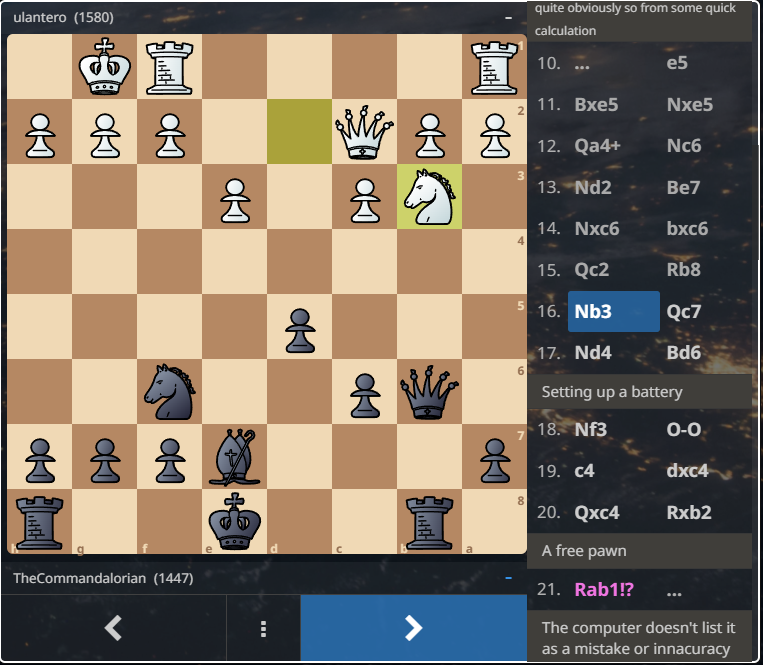
@TheCommandalorian said in #32:
Very nice blog and good topic, the point of the engine is that analyzes like black and white would never make mistakes, but we are humans, even GMs will make mistakes and they are closer to play as engines, so people like us under 2000 will obviously make mistakes, and that's what allows us to win sometimes in positions that seem obvious draw for the computer, but are very complicated to solve for human, specially if we remember we play with time, so engine does not take into consideration if we were on a rush, plus, engine does not play by principles, it just calculates all the good ones from the beginning and like I said before, it thinks both sides will play all the good ones up until the end game. Also pointing out something, idk if it was your intention but I think you try to point out some moves as innacuracy and you used this one "!?", which is for interesting, innacuracy is "?!".
Thanks for the support, a great example of the computer expecting every move to be perfect is someone telling Magnus a game he won was a drawn position and he said "well it doesn't matter this position is won every time" Thanks for the comment about the innacuracy vs interesting moves. According to the lichess study annotation, ?! means interesting move, meanwhile !? means dubious move, but I chose !? to get the idea of inaccuracy across because the blue is the color the lichess computer analysis uses for inaccuracies
I don't actually care about the quote, I just wanted to make sure you know this post is for you.
I wanted to know if your coach at least asked you about this position? If not, we can discuss it. If he did, can you tell me why I am highlighting it. I am curious if you learned anything from it. I might ask more from the other game, but I am curious about certain things. I do agree with your sentiment here. Who cares about the haters. To be honest, the only people who should be disagreeing with you are sub-2000 players who think they play like their engine till they don't, and then some convince themselves they saw the move in the game. Which is fine, but here is the issue. Most of the time an engine can come up with moves you see but don't actually understand. Sometimes, engines come up with moves you didn't see and do understand. And then there is the times engines come up with moves that you didn't see and no one can understand. The last one, you always toss, because if a 2500 rated player doesn't understand it, you don't need it. Most people who are over 2000 would not disagree with you about the subject of this post.
Here is an extra for you. I think that the threshold should be raised. Because I am pretty high rated here consistently. But I am still having trouble OTB maintaining 2000 in USCF. Probably due to lack of tournament access, and my FIDE rating is barely maintaining 1900, probably for the same reason. But.. I don't consider myself good enough to take any engine analysis seriously on my game. The most I use them for is tactical puke, and seeing if I understand the suggestions. Unfortunately, I don't have the friends, or the money to afford to worry about coaching, and technically I am too old to even consider rough training now. However, if I had the money.. I may find an old coach of mine like Cyrus Lakdawala, and ask him to explain it to me from time to time. We don't work together really anymore, but I still hold him as my top pick for coaches to this day.

@TheCommandalorian said in #32:
> > Very nice blog and good topic, the point of the engine is that analyzes like black and white would never make mistakes, but we are humans, even GMs will make mistakes and they are closer to play as engines, so people like us under 2000 will obviously make mistakes, and that's what allows us to win sometimes in positions that seem obvious draw for the computer, but are very complicated to solve for human, specially if we remember we play with time, so engine does not take into consideration if we were on a rush, plus, engine does not play by principles, it just calculates all the good ones from the beginning and like I said before, it thinks both sides will play all the good ones up until the end game. Also pointing out something, idk if it was your intention but I think you try to point out some moves as innacuracy and you used this one "!?", which is for interesting, innacuracy is "?!".
>
> Thanks for the support, a great example of the computer expecting every move to be perfect is someone telling Magnus a game he won was a drawn position and he said "well it doesn't matter this position is won every time" Thanks for the comment about the innacuracy vs interesting moves. According to the lichess study annotation, ?! means interesting move, meanwhile !? means dubious move, but I chose !? to get the idea of inaccuracy across because the blue is the color the lichess computer analysis uses for inaccuracies
Chess analysis tools and GUIs represent significant work by their developers. They offer structured perspectives on games, but like any analytical tool, they reflect the assumptions and limitations of the models they are built on. How much value they provide ultimately depends on how they are used.
i would like to add using leela with Nibbler GUI is very useful for analysis too, leela plays more human and nibbler GUI gives you the option to view all the good possible moves, it is also great for opening prep if you want something unusual to play
> Chess analysis tools and GUIs represent significant work by their developers. They offer structured perspectives on games, but like any analytical tool, they reflect the assumptions and limitations of the models they are built on. How much value they provide ultimately depends on how they are used.
i would like to add using leela with Nibbler GUI is very useful for analysis too, leela plays more human and nibbler GUI gives you the option to view all the good possible moves, it is also great for opening prep if you want something unusual to play
@MeWantCookieMobile said in #35:
I have a feeling that you only think that way because when you look at chess engines, and in this post "AI" to help you write, you are looking at it like this,
"Looks at AI answer"
"Toscani think: Yeah I would have thought the same way!"
"Toscani never actually improves"
I have seen your name around before. Maybe even in tournaments I play in. It's enough to recognize the name more than others on this post. I believe that the writer of this post is accurate. However, I would say that no one should look at accuracy as if it means anything. Instead you should look at an engine in this way.
"Be honest with yourself in that, would you have played this for real."
"If not: Do you understand the move presented?"
"If yes: Keep the move and remember it later"
"If no: Try to understand it yourself first. If you can't understand it, get a higher rated player to help."
"If the higher rated player doesn't understand it, keep trying and try to get some masters to weigh in."
"If you got masters and no one can explain it to you. Throw the move out."
"If you would have played the move for real, then it's normal."
Then what you want to do is do a blunder check. See if there are moves that come up ? or ?? and see why the engine says it. Go through the same verbose as above. Wash-Rinse-Repeat until you are 29000000 rated.
@Toscani said in #20:
There’s a common belief that focusing on engine accuracy is a waste of time for players rated below 2000, but I see it differently. To me, accuracy is like using the right terminology. Just as we move from basic shorthand in childhood to precise language in higher education, chess requires a growing "vocabulary" to be mastered. A game is essentially a conversation between two players and the pieces; when we aim for accuracy, we are trying to speak the game’s language as clearly as possible. If we stop striving for precision just because we aren’t "pros" yet, we risk stagnating. Whether you are 800 or 1800, aiming for that high accuracy percentage shows a fundamental respect for the game’s depth.
Think of a chess match as a debate. If one player makes sloppy, imprecise moves, the other naturally appears more elegant and convincing by comparison. Accuracy shows who is actually taking control of the conversation and who is merely guessing. Being below 2000 doesn't mean our games are less valuable or that our "arguments" on the board shouldn't be sharp. Growth comes through this pursuit of excellence, and while I used AI to help refine the "vocabulary" of this post, the sentiment remains the same: don’t let anyone tell you that accuracy is only for the elite.
Nobody wants to be rude and ratio, but if someone is 34k+ games and below 1700, then they should not overanalyse the game and should just focus on learning the fundamentals.
@MeWantCookieMobile said in #35:
> I have a feeling that you only think that way because when you look at chess engines, and in this post "AI" to help you write, you are looking at it like this,
>
> "Looks at AI answer"
>
> "Toscani think: Yeah I would have thought the same way!"
>
> "Toscani never actually improves"
>
> I have seen your name around before. Maybe even in tournaments I play in. It's enough to recognize the name more than others on this post. I believe that the writer of this post is accurate. However, I would say that no one should look at accuracy as if it means anything. Instead you should look at an engine in this way.
>
> "Be honest with yourself in that, would you have played this for real."
> "If not: Do you understand the move presented?"
> "If yes: Keep the move and remember it later"
> "If no: Try to understand it yourself first. If you can't understand it, get a higher rated player to help."
> "If the higher rated player doesn't understand it, keep trying and try to get some masters to weigh in."
> "If you got masters and no one can explain it to you. Throw the move out."
> "If you would have played the move for real, then it's normal."
>
> Then what you want to do is do a blunder check. See if there are moves that come up ? or ?? and see why the engine says it. Go through the same verbose as above. Wash-Rinse-Repeat until you are 29000000 rated.
>
> @Toscani said in #20:
> > There’s a common belief that focusing on engine accuracy is a waste of time for players rated below 2000, but I see it differently. To me, accuracy is like using the right terminology. Just as we move from basic shorthand in childhood to precise language in higher education, chess requires a growing "vocabulary" to be mastered. A game is essentially a conversation between two players and the pieces; when we aim for accuracy, we are trying to speak the game’s language as clearly as possible. If we stop striving for precision just because we aren’t "pros" yet, we risk stagnating. Whether you are 800 or 1800, aiming for that high accuracy percentage shows a fundamental respect for the game’s depth.
> >
> > Think of a chess match as a debate. If one player makes sloppy, imprecise moves, the other naturally appears more elegant and convincing by comparison. Accuracy shows who is actually taking control of the conversation and who is merely guessing. Being below 2000 doesn't mean our games are less valuable or that our "arguments" on the board shouldn't be sharp. Growth comes through this pursuit of excellence, and while I used AI to help refine the "vocabulary" of this post, the sentiment remains the same: don’t let anyone tell you that accuracy is only for the elite.
Nobody wants to be rude and ratio, but if someone is 34k+ games and below 1700, then they should not overanalyse the game and should just focus on learning the fundamentals.
Well.. I am not sure it isn't a necessary comment. Too many people have done this since before engines got strong enough to beat 2000 players. And funny enough, I remember those days. Sargon III on C64 could barely beat me when I was rated 900. And if you put an engine on a 486 like fritz, it had trouble with 2000. Some versions got as high as beating 2300 rated, but there wasn't a consistently winning bot till around the pentium. And then it consistently did about 2300. Some on here will say, "Hey! Crafty was 2400+ in pentium days!" And that is true, but it also depends on your system.
On the other side of that, I was "offering" lessons to a 900 player. She said, "I'll think about it." and then I said, well you can challenge me on chess.com if you like. And she did. And then she beat me. But at the club she played like a rank beginner. When I asked her about it, she said, she uses an engine. And her process is that she turns it on before she moves. But she said it this way. "I think about the position first. And then I turn on the engine. If the move matches I play it." I asked a few friends if they thought that was possible, because I thought it was literally impossible. A few masters looked at me and said, "A 900 player beating a 2000 player? Online? And doesn't come close in person? Impossible in any universe!" So I dropped it. But I explained to her once why and how it's incorrect thinking. I think she understood and stopped, but I don't actually know the results. People rarely get better when they trust computers too much!
@vitalkachessstudy said in #38:
Nobody wants to be rude and ratio, but if someone is 34k+ games and below 1700, then they should not overanalyse the game and should just focus on learning the fundamentals.
Well.. I am not sure it isn't a necessary comment. Too many people have done this since before engines got strong enough to beat 2000 players. And funny enough, I remember those days. Sargon III on C64 could barely beat me when I was rated 900. And if you put an engine on a 486 like fritz, it had trouble with 2000. Some versions got as high as beating 2300 rated, but there wasn't a consistently winning bot till around the pentium. And then it consistently did about 2300. Some on here will say, "Hey! Crafty was 2400+ in pentium days!" And that is true, but it also depends on your system.
On the other side of that, I was "offering" lessons to a 900 player. She said, "I'll think about it." and then I said, well you can challenge me on chess.com if you like. And she did. And then she beat me. But at the club she played like a rank beginner. When I asked her about it, she said, she uses an engine. And her process is that she turns it on before she moves. But she said it this way. "I think about the position first. And then I turn on the engine. If the move matches I play it." I asked a few friends if they thought that was possible, because I thought it was literally impossible. A few masters looked at me and said, "A 900 player beating a 2000 player? Online? And doesn't come close in person? Impossible in any universe!" So I dropped it. But I explained to her once why and how it's incorrect thinking. I think she understood and stopped, but I don't actually know the results. People rarely get better when they trust computers too much!
@vitalkachessstudy said in #38:
> Nobody wants to be rude and ratio, but if someone is 34k+ games and below 1700, then they should not overanalyse the game and should just focus on learning the fundamentals.
@MeWantCookieMobile said in #36:
Here is an extra for you. I think that the threshold should be raised. Because I am pretty high rated here consistently. But I am still having trouble OTB maintaining 2000 in USCF. Probably due to lack of tournament access, and my FIDE rating is barely maintaining 1900, probably for the same reason. But.. I don't consider myself good enough to take any engine analysis seriously on my game. The most I use them for is tactical puke, and seeing if I understand the suggestions. Unfortunately, I don't have the friends, or the money to afford to worry about coaching, and technically I am too old to even consider rough training now. However, if I had the money.. I may find an old coach of mine like Cyrus Lakdawala, and ask him to explain it to me from time to time. We don't work together really anymore, but I still hold him as my top pick for coaches to this day.
The only reason I said at least for sub-2000 players is because the only above 2000 rated player I know in person is my coach, and I'm not sure whether engine analysis is useful to him. Being only around 1700 at the time of creating this, (I've gained 50 or so points since) Without having knowledge of the actual usefulness of the engine for this level, I was worried about being either completely wrong about that or offending the over 2000 players by saying they aren't good enough to use engine when I am clearly much worse than them, meanwhile every other level up until where I am now I have been at some point in time, (I was 850 on lichess just back in May) I have learned from experience that it isn't useful.
@MeWantCookieMobile said in #36:
> Here is an extra for you. I think that the threshold should be raised. Because I am pretty high rated here consistently. But I am still having trouble OTB maintaining 2000 in USCF. Probably due to lack of tournament access, and my FIDE rating is barely maintaining 1900, probably for the same reason. But.. I don't consider myself good enough to take any engine analysis seriously on my game. The most I use them for is tactical puke, and seeing if I understand the suggestions. Unfortunately, I don't have the friends, or the money to afford to worry about coaching, and technically I am too old to even consider rough training now. However, if I had the money.. I may find an old coach of mine like Cyrus Lakdawala, and ask him to explain it to me from time to time. We don't work together really anymore, but I still hold him as my top pick for coaches to this day.
The only reason I said at least for sub-2000 players is because the only above 2000 rated player I know in person is my coach, and I'm not sure whether engine analysis is useful to him. Being only around 1700 at the time of creating this, (I've gained 50 or so points since) Without having knowledge of the actual usefulness of the engine for this level, I was worried about being either completely wrong about that or offending the over 2000 players by saying they aren't good enough to use engine when I am clearly much worse than them, meanwhile every other level up until where I am now I have been at some point in time, (I was 850 on lichess just back in May) I have learned from experience that it isn't useful.


