
Comments on https://lichess.org/@/noobmasterplayer123/blog/human-estimate-eval-function/uRmmoeXp
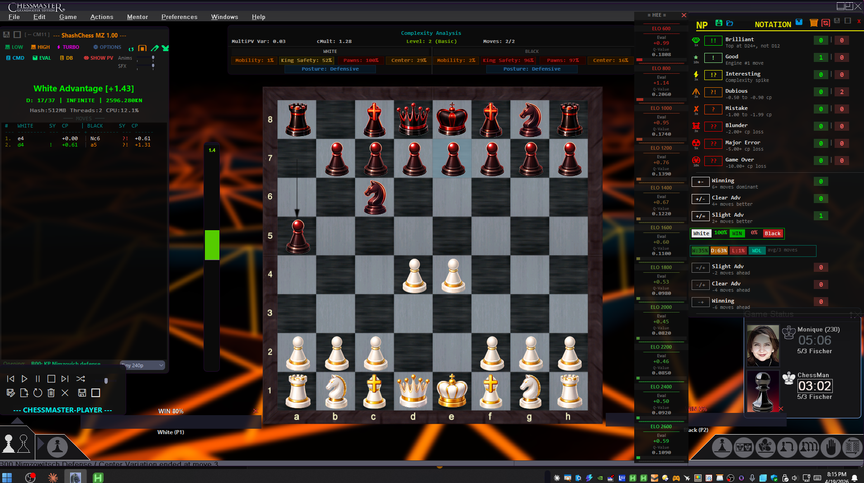
HEE in Cm11 ! lol

HEE in Cm11 ! lol

It might be neater to write the headline formula as ln(1+Q/1-Q)x271.586 which is totally equivalent, replacing division by multiplication and removing the negative using the fact the ln(a^{-1})=-1xln(a)
It might be neater to write the headline formula as ln(1+Q/1-Q)x271.586 which is totally equivalent, replacing division by multiplication and removing the negative using the fact the ln(a^{-1})=-1xln(a)
@retro_sort said ^
It might be neater to write the headline formula as ln(1+Q/1-Q)x271.586 which is totally equivalent, replacing division by multiplication and removing the negative using the fact the ln(a^{-1})=-1xln(a)
True, I just wrote it the way I derived it on pen and paper while thinking about how to write code for it
@retro_sort said [^](/forum/redirect/post/zE0334RY)
> It might be neater to write the headline formula as ln(1+Q/1-Q)x271.586 which is totally equivalent, replacing division by multiplication and removing the negative using the fact the ln(a^{-1})=-1xln(a)
True, I just wrote it the way I derived it on pen and paper while thinking about how to write code for it
I haven't thought a lot about this, but has anyone considered evals as distributions rather than just a single number? I.e., to account for uncertainty in a position, sharpness etc. Mean of distribution == the eval but the shape of the distributions provides qualitative information that sounds useful.
A simple example would be "when winning simplify" - this leads to favoring distributions whose left tail is shorter (less likely for a loss) at perhaps the expensive of shifting the mean.
I haven't thought a lot about this, but has anyone considered evals as distributions rather than just a single number? I.e., to account for uncertainty in a position, sharpness etc. Mean of distribution == the eval but the shape of the distributions provides qualitative information that sounds useful.
A simple example would be "when winning simplify" - this leads to favoring distributions whose left tail is shorter (less likely for a loss) at perhaps the expensive of shifting the mean.
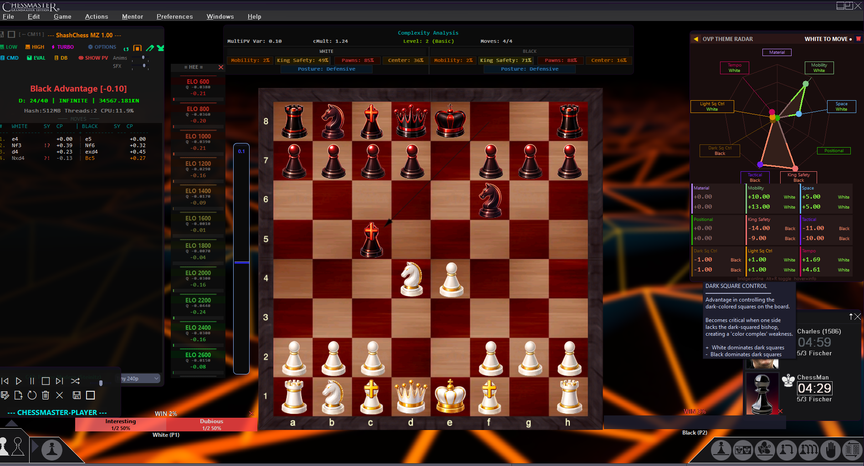
HEE revamped look+theme radar !

HEE revamped look+theme radar !
Could you explain Q_h = P(win)+0.5P(draw) / ( P(win)+P(draw)+P(loss) ) ?
As the sum in the denominator goes over all the 3 possible outcomes, is it not just equal to exactly 1.0?
Could you explain Q_h = P(win)+0.5P(draw) / ( P(win)+P(draw)+P(loss) ) ?
As the sum in the denominator goes over all the 3 possible outcomes, is it not just equal to exactly 1.0?
@MrLizardWizard said ^
Could you explain Q_h = P(win)+0.5P(draw) / ( P(win)+P(draw)+P(loss) ) ?
As the sum in the denominator goes over all the 3 possible outcomes, is it not just equal to exactly 1.0?
how can denominator sum go in all outcomes? if your win rate is 90% so P(W) = 0.90 and draw is 2 P(D) = 0.02 and loss is P(L) = 0.08, than Q_H = 0.90 + 0.5 (0.02) / 0.90 + 0.02 + 0.08 = 0.91 / 1 = 0.91 but if your loss rate is very high lets say you losing by 90% P(L) = 0.90
your draw rate is P(D) = 0.02 and P(W) = 0.08
than we get Q_H = 0.08 + 0.5 (0.02) / 0.08 + 0.02 + 0.90 = 0.09 so when P(W) goes up its close to 1 but when P(W) goes down it reachs 0
@MrLizardWizard said [^](/forum/redirect/post/pqDYYcli)
> Could you explain Q_h = P(win)+0.5P(draw) / ( P(win)+P(draw)+P(loss) ) ?
> As the sum in the denominator goes over all the 3 possible outcomes, is it not just equal to exactly 1.0?
how can denominator sum go in all outcomes? if your win rate is 90% so P(W) = 0.90 and draw is 2 P(D) = 0.02 and loss is P(L) = 0.08, than Q_H = 0.90 + 0.5 (0.02) / 0.90 + 0.02 + 0.08 = 0.91 / 1 = 0.91 but if your loss rate is very high lets say you losing by 90% P(L) = 0.90
your draw rate is P(D) = 0.02 and P(W) = 0.08
than we get Q_H = 0.08 + 0.5 (0.02) / 0.08 + 0.02 + 0.90 = 0.09 so when P(W) goes up its close to 1 but when P(W) goes down it reachs 0
I haven't thought a lot about this, but has anyone considered evals as distributions rather than just a single number? I.e., to account for uncertainty in a position, sharpness etc. Mean of distribution == the eval but the shape of the distributions provides qualitative information that sounds useful.
A simple example would be "when winning simplify" - this leads to favoring distributions whose left tail is shorter (less likely for a loss) at perhaps the expensive of shifting the mean.
interesting insight
@troywins said [^](/forum/redirect/post/h8kDNZbT)
> I haven't thought a lot about this, but has anyone considered evals as distributions rather than just a single number? I.e., to account for uncertainty in a position, sharpness etc. Mean of distribution == the eval but the shape of the distributions provides qualitative information that sounds useful.
>
> A simple example would be "when winning simplify" - this leads to favoring distributions whose left tail is shorter (less likely for a loss) at perhaps the expensive of shifting the mean.
interesting insight
@Noobmasterplayer123 said ^
Could you explain Q_h = P(win)+0.5P(draw) / ( P(win)+P(draw)+P(loss) ) ?
As the sum in the denominator goes over all the 3 possible outcomes, is it not just equal to exactly 1.0?how can denominator sum go in all outcomes? if your win rate is 90% so P(W) = 0.90 and draw is 2 P(D) = 0.02 and loss is P(L) = 0.08, than Q_H = 0.90 + 0.5 (0.02) / 0.90 + 0.02 + 0.08 = 0.91 / 1 = 0.91 but if your loss rate is very high lets say you losing by 90% P(L) = 0.90
your draw rate is P(D) = 0.02 and P(W) = 0.08than we get Q_H = 0.08 + 0.5 (0.02) / 0.08 + 0.02 + 0.90 = 0.09 so when P(W) goes up its close to 1 but when P(W) goes down it reachs 0
No, I mean why even have the denominator in the equation at all? You could just write Q_h = P(win)+0.5P(draw).
P(win)+P(draw)+P(loss) = 1.0 by definition
@Noobmasterplayer123 said [^](/forum/redirect/post/cunvyusc)
> > Could you explain Q_h = P(win)+0.5P(draw) / ( P(win)+P(draw)+P(loss) ) ?
> > As the sum in the denominator goes over all the 3 possible outcomes, is it not just equal to exactly 1.0?
>
> how can denominator sum go in all outcomes? if your win rate is 90% so P(W) = 0.90 and draw is 2 P(D) = 0.02 and loss is P(L) = 0.08, than Q_H = 0.90 + 0.5 (0.02) / 0.90 + 0.02 + 0.08 = 0.91 / 1 = 0.91 but if your loss rate is very high lets say you losing by 90% P(L) = 0.90
> your draw rate is P(D) = 0.02 and P(W) = 0.08
>
> than we get Q_H = 0.08 + 0.5 (0.02) / 0.08 + 0.02 + 0.90 = 0.09 so when P(W) goes up its close to 1 but when P(W) goes down it reachs 0
No, I mean why even have the denominator in the equation at all? You could just write Q_h = P(win)+0.5P(draw).
P(win)+P(draw)+P(loss) = 1.0 by definition