
Lichess Horsey
Does Stockfish Dream of Electric Knights?
Could Stockfish be Conscious?
Table of Contents:
- Capyblanca
- Global Workspace
- "My soul is made out of millions of tiny robots!"
- Integrated Information Theory
- Could Stockfish be conscious?
Morpheus: What "is" real? How do you define "real"? If you’re talking about what you can feel, what you can smell, what you can taste and see, then "real" is simply electrical signals interpreted by your brain. This is the world that you know. - The Matrix.
Dr. Alfred J. Lanning: There have always been ghosts in the machine. Random segments of code, that have grouped together to form unexpected protocols. Unanticipated, these free radicals engender questions of free will, creativity, and even the nature of what we might call the soul. - I, Robot.
How humans play chess is a fascinating question that has haunted cognitive science for decades. Chess was used as a sort of test field to measure hypotheses about the mind. This was because in the eyes of AI researchers, chess was seen as the 'Royal game of intellectual dominance', a manifestation of our most glorious gift of cognition. This was a cultural bias, borne out of movies and cliches. That's when the minimax algorithm came along and wrecked the whole thing by performing well at chess without needing to play like a human. A minimax algorithm seeks to find moves that maximizes our advantage and and moves for the opponent that minimizes our advantage.
Kasparov's defeat at the metallic hands of Deep Blue leads to a realization. A cognitive model of chess should play chess as well as a human, not better. Garry's loss wasn't the turning point. The turning point has not even occurred yet.
 This is seen as the moment machines outmatched humans. But it isn't. This is like mourning the fact that a car can be faster than humans. The real moment will be when machines become conscious.
GOFAI stands for 'Good Old Fashioned AI', which is a mocking term for what AI used to be – programmed routines and subroutines and rules like 'If A then B'. In the 90's neural nets came along to scoop up that way of thinking by envisioning cognition as borne out of tiny mindless processes that when put together produced more than the sum on its parts. The paralleled the doctrine of connectionism in the cognitive sciences. In neuroscience there is a thing called the neuron. A neuron will fire if other neurons make it fire by exceeding a threshold. A neuron causing another neuron to activate, strengthened their connection. Hebb said that 'Neurons that fire together, wire together'. The idea is that you know the name of chess piece, because the neurons that activate when you see a chess piece also activate the neurons that make you think the name of the chess piece.
Capyblanca
Capyblanca is the name of a cognitive model which seeks to explain how humans play chess. Created by researcher and Associate Professor Alexander Linhares. It is based on the Copycat cognitive model by Douglas Hofstadter and Melanie Mitchell which seeks to explain human analogical reasoning. You get the pattern 2-3-4, and you have to find the next number in the sequence 7-8-?. The answer is 9 by analogy to the pattern in 2-3-4. This is the most basic example of analogical reasoning. Linhares notes that analogical thinking is imperative for chess skill. Positions that are vastly different in terms of visual positioning of pieces may be very similar in its conceptual content. Generalization of abstract concepts are vital for chess understanding.
Capyblanca is an adaption of this model for chess. There are things called codelets which represent subpatterns with automatic processes. Multiple codelets can be in the coderack queue, wanting to be executed. A workspace serves as short term memory, where representations are created. An example of a codelet is a process that assigns a role between two pieces (like defense), or wanting to look at a particular square. Each codelet can also activate other codelets. There is a semantic associative network that organizes concepts so that they can be linked. A concept can activate other concepts and codelets through spreading activation.
Top-down expectations were modeled with hierarchical levels dealing with different programmed processes. The codelets of the lowest level would look at squares. Codelets of higher levels would calculate mobilities and trajectories of pieces and create roles for them (e.g. defense). The highest abstract level encodes concepts like if a King is in double check it must move. A double check would be perceived by a low-level codelet which then induces other codelets to loom for ways to get out of check. The codelets altogether create an emergent phenomenon. More than the sum of its parts.
 Alexander Linhares, Decision-making and strategic thinking through analogies: Figure 2. State 11 of an execution of Capyblanca. How do experts rapidly perceive what is relevant in a position? How can they immediately zoom in the important areas of the board? In Capyblanca, the mechanisms that enable such behavior are not explicitly pre-programmed, but emerge from the interactions of small, micro-perceptions of codelets. At start, the idea is to model the process akin to the first seconds of perceiving a position: the system has only 64 codelets, one for each board square, to eventually ‘saccade eyes’ (i.e., invest computational effort, or attention) to it. Since codelets are drawn at random from the coderack, one might expect that the system would randomly scan the board. That is not the case: the board is usually scanned in a way that concentrates priority to the “most important” areas. If a piece is found by a codelet, that codelet will increase the priority given to codelets looking at the squares that the piece can move to in subsequent moments of the game. To model an ability of peripheral vision, if there exists a piece in one of the (at most 8) squares surrounding a saccaded square, then a ‘shadow’ is perceived (i.e., a representation that something is in there, but the system is unable at that point to state exactly what). In figure 4, for example, after codelet 11, we can see some random squares which have been saccaded to, and also, a first piece is found, which increases the urgencies to look at that piece’s potential trajectories. Two shadows are also found, and now the urgency to ‘look at those squares’ is increased. As with humans, unexpected perceptions in peripheral vision bring an urge to focus on them, and this is reflected in the system by an increased urgency to look at that square.
 Figure 4. State 160: note that the Bishop’s “moves” are not moves in the tree-searching sense (with plies followed by the opponent). Instead, they are intended to model subcognitive pressures: the first fleeting seconds one perceives this chessboard and the Bishop’s constrained area. After duly recognizing the pieces, but before fully scanning the board, Capyblanca has found that the bishop, the most powerful piece in the position, is “trying to get out”, but that its mobility is restricted. One information that is displayed on the figure are the trajectories leading to the king and to the unprotected pawns. But there are two additional types of representational structure active at this point: mobility and roles. After a piece has been recognized and (some of) its potential trajectories discovered, a ‘mobility matrix’ is constructed to account for that piece’s ‘spheres of influence’ across the board. This information will enable many upcoming events, and, more importantly, will restrain the possibilities for consideration (not only for that piece, but also, globally across the board). The other type of representation structure active at this point is that of an ‘abstract role’. For example, the bishop is seen to play the role of ‘guardian’ of the unprotected pawns and of the king’s square. The current intensity of these roles is displayed by the thickness of the arrows.
 Figure 7. After codelet 384, the white king’s attack on e5 is found to be easily blocked by the black king, thus the system has destroyed that role (and associated trajectory). In the next codelet, though, the system perceives the potential passed pawn promotion, a “local event” which triggers a fast, global, chain reaction of repercussions across the entire board. These repercussions follow very rapidly, so we must “slow down” this narrative to account for rapid events in between the execution of a mere 5 (or less) codelets in the following figures.
 Figure 11. Nine codelets afterwards, at state 405, the white king—finally free from having to guard from any impending attacker—rediscovers the potential attack towards the D5 pawn. This time, however, there is knowledge of the black king’s attachment to its role of guardian from the promotion, and the piece cannot assume a second simultaneous role of preventing the white king’s attack. It is at this point that the architecture registers the fact that the joint attack by the white king and the passed pawn cannot be defended single-handedly by the black king. Intensity of the white king’s attack soars to a previously unforeseen level. Hence white’s advantage becomes clear, and a strategy to secure that advantage has emerged. The system has achieved, in a mere 405 codelets, an understanding of the global scenario. (The execution continues for 300 codelets with this configuration firmly stable—the system stops after some time with no improvement.) During the process, some minor local perceptions have triggered global repercussions which rapidly rearrange the whole view.
Significant conclusions may be drawn here:
(i) The architecture is rapidly drawn into the ‘relevant’ parts of the situation, and attention to irrelevant parts is scarce;
(ii) The emergent process negotiates between top-down (expectation-driven) and bottom-up (data-driven) processes, and does not fall prey to a combinatorial explosion;
(iii) Strategically similar chess positions can be explained from the point of view of sets of abstract roles.
For deep understanding of a scenario, the abstraction is the most efficient level of description.
---
Capyblanca accounts for more aspects of human thought in chess than any other model we are aware of, for we propose that, after the opening of a game, analogy lies at the core of chess thought.Alexander Linhares, Decision-making and strategic thinking through analogies, (2014)
Linhares emphasized that these simulations must model human thinking, not engine perfect outputs. Capyblanca was a proof of concept for analogical model based on parallel processes and serial top-down expectations. An emergent phenomenon.
Capyblanca is currently rotting away on an abandoned Github page. The paper conveyed that the Capyblanca would be developed so that it could learn new concepts, which was a limitation of this model as it's top down concepts were pre-programmed and Capyblanca couldn't learn new things. That dream has seemingly vanished into the deep blue.
Maybe Linhares discovered something that was disturbing.
Maybe he decided to hide the truth.
Global Workspace
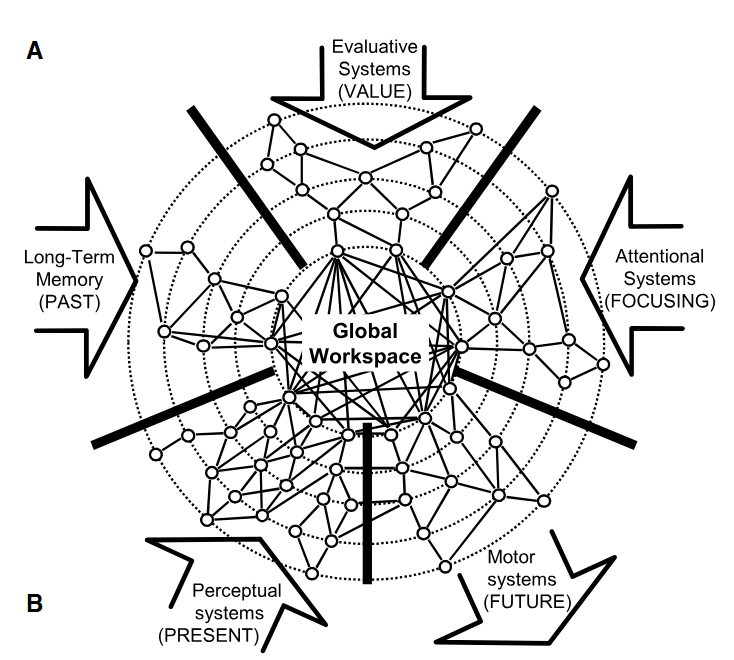 George A. Mashour, Pieter Roelfsema, Jean-Pierre Changeux, and Stanislas Dehaene. Conscious Processing and the Global Neuronal Workspace Hypothesis (2020).
A Global Workspace Architecture is a revolutionary idea for a brain. It was proposed as a cognitive model of consciousness by cognitive neuroscientist Bernard Baars in 1982 and elaborated in his 1988 book Cognitive Theory of Consciousness. He was inspired by blackboard architectures in the field of AI. He saw how the features of consciousness could be explained by a global workspace architecture. The features include unity, the ability to report an experience, the serial and narrow nature of consciousness, and the ability for new skills to become automatic after a time, like riding a bike.
Baars used the metaphor of a bunch of experts gathering at a conference to solve a problem. Each of the experts has an individual skill that none of the other experts have. But they cannot communicate with each other effectively as they each have their own technical way of speaking. To solve the problem of the atomized experts, a blackboard containing a global message about the problem is placed where all the experts can see it. Each expert can then see this message and react to it. Different global messages will be understood by different experts at different times. The message on the blackboard will be shaped by the competition of the experts who want to globally broadcast their own individual messages to all the other experts. Contradictory messages will be filtered out in the ensuing battle, making the global message consistent. Coalitions of experts may form to try to promote their messages on the blackboard. Baars also used the metaphor of a theatre, where conscious experience represents a spotlight shining down on the stage. Unconscious processors represent people in the audience and in the wings, there but unseen.
Global Workspace Theory came out of the realization by people like Alan Newell, Herbert A. Simon, Donald Norman, and Daniel Kahneman that the narrowness of the stream of consciousness seemed to conflict with the enormous capacity of unconscious “memories,” or “automatisms,” or whatever people called them. You have this fabulous “memory” domain that no one has any quantitative estimate of, and it’s all run by this “tiny rivulet,” as William James called it. He couldn’t figure it out either, but he knew the evidence.
Alan Newell’s group at Carnegie-Mellon University had the insight that none of the available algorithms could solve the ARPA challenge of identifying 1,000 spoken words. So they found a kind of swarm-computational answer: If you put a hundred crummy algorithms together and let them share hypotheses and vote on the most popular one, it turns out that very inadequate algorithms could jointly solve problems that no single one could solve.
People had been thinking about parallel computers, and parallel-interactive problem solving, and a small group of neural network pioneers somehow arrived at a very similar view, perhaps from considering the many layered arrays in the brain.
Bernard Baars, Scott Kaufman Interview, 2020
The brain seems to show a distributed style of functioning, in which the real work is done by millions of specialized, sophisticated systems without detailed instructions from some command center. By analogy, the human body also works cell by cell; unlike an automobile, it has no central engine that does all the work. Each cell is specialized for a particular function according to instructions encoded in its DNA, its history, and chemical influences from other tissues. And the cell is of course the body’s basic unit of organization. In its own way the human brain shows the same distributed style of organization.
The theater metaphor is useful because a great array of evidence indicates that consciousness creates access to many knowledge sources in the brain. And yet only a fraction of the brain seems to directly support conscious experience. This consciousness network seems to include the sensory areas of the cortex, perhaps some surrounding areas, and a few subcortical structures; together they provide the stage for the unconscious audience in the rest of the brain. Consciousness seems to be the publicity organ of the brain. It is a facility for accessing, disseminating and exchanging information, and for exercising global coordination and control.
Bernard Baars, In The Theatre of Consciousness, 1997
There are many unconscious processors/modules that can operate automatically and efficiently. A processor may enter a 'global workspace' if their signal is strong enough. What ever is in the workspace is then globally broadcasted back to all the processors. So each processor receives the contents of the workspace. It is in and out, dynamically shifting moment to moment at a very quick pace. If you are playing chess, your global workspace is dominated by chess concerns like what move to play. However, a unconscious processor suddenly realizes that your opponent is threatening mate. So that processor fires strongly, sending its important message to the global workspace. Then the global workspace broadcasts "We could be checkmated" to all the other unconscious processors. A processor that recognizes that the piece that is threatening mate could be taken enters the workspace. This is a potential solution that is then tested through broadcast again to see if works. Better ideas made enter the workspace and so on. By the way, all this takes place in less than a second. It only takes a fraction of a second for such content to enter the workspace and be broadcasted.
Broadcasting leads to widespread adaptation by unconscious processors as they adapt to the new information, which influences future behavior. A sudden shift in the global workspace corresponds to the feeling of 'shock'. If you do a smothered mate puzzle, the realization is not impressive as such an automatic easy puzzle does not require much adaptation. The smothered mate processor handles it nicely, provides the solution. Broadcast is only needed to tell the motor regions to move you hand to execute the move.
In a shocking scenario, there is no easy solution which corresponds to a feeling of shock as the workspace is trying to get back to an equilibrium where the processors will no longer need to adapt to the new info. It feels shocking as the workspace is trying to equilibrium by suppressing the signal. Awe is the opposite process where the workspace is out of equilibrium, but in a way which is wanted. So having a grand realization in a chess game leads to a positive feeling of awe, as the workspace broadcasts a solution. The solution is surprising and leads to widespread adaptation by processors as each processor is no longer needed to find a solution so they must adapt to the new situation, going back to equilibrium. Shock and Awe are exact opposites. Shock is widespread adaptation by processors which is unwanted, Awe is widespread adaption by processors which is wanted.
Neuroscientists Jean-Pierre Changeux and Stanislas Dehaene developed a neuronal model based on Baars' cognitive model. They sought evidence to backup the Global Workspace Theory. They found that evidence. The empirical data discovered by neuroscience matched the cognitive model. Conscious experiences induced widespread brain activation compared to non-conscious experience. This was measured by flashing an image for short milliseconds. There is a point where it flashes so fast that you are not conscious of it. So the contrast can be seen. On non-conscious trials, there was still activation in the visual cortex, but not global broadcasting, which entails to ability to perform actions based on a percept. But on conscious trials there was widespread ignition. This is empirical evidence of global broadcasting. There is a stimuli threshold which allows a stimulus to enter consciousness through global broadcast. This ignition in the brain has an all-or-nothing property.
 Left: Visual cortex activation not strong enough for ignition. Right: Global Broadcasting leads to reciprocal long-distance communications between brain areas. George A. Mashour, Pieter Roelfsema, Jean-Pierre Changeux, and Stanislas Dehaene. Conscious Processing and the Global Neuronal Workspace Hypothesis (2020).
One distinction relates to ‘‘phenomenal consciousness’’ versus ‘‘access consciousness’’ (Block, 2005). Phenomenal consciousness, by definition, involves a hypothetical and idealized situation of pure subjective experience (also called ‘‘qualia’’) without further associated information processing (and, therefore, no need for verbal report). Access consciousness refers to the fact that conscious information, unlike unconscious information, is accessible to numerous cognitive processors, such as those mediating working memory, verbal report, or motor behavior. The importance of this distinction remains hotly debated, but it has been suggested that ‘‘global availability of information (.) is what we subjectively experience as a conscious state’’
George A. Mashour, Pieter Roelfsema, Jean-Pierre Changeux, and Stanislas Dehaene. Conscious Processing and the Global Neuronal Workspace Hypothesis (2020).
"My soul is made out of millions of tiny robots!"
Philosopher Daniel Dennett said "It’s this expandable capacity to represent reasons that we have that gives us a soul. But what’s it made of? It’s made of neurons. It’s made of lots of tiny robots.". He referred to 'fame in the brain' as an explanation of consciousness. Fame in the brain is when the global workspace broadcasts its contents to the unconscious processors. Cognition is an emergent result out of the masses of parallel unconscious processors vying for attention.
'Qualia' is a term for the subjective experience of consciousness. The 'what it is like' to feel. A robot could never feel, like a human can. Like feeling an emotion. Panpsychism states that consciousness is a fundamental feature of the universe like gravity. The reason is that physical processes can never explain how we feel something.
 Modified from Christof Koch (2004) "Figure 1.1: Neuronal correlates of consciousness" in The Quest for Consciousness: A Neurobiological Approach, Englewood: Roberts & Company Publishers, p. 16 ISBN: 0974707708. CC BY-SA 3.0.

Imagine seeing the Lichess Horsey. Photons go into the retina and this information is converted into neural spike trains representing the Lichess Horsey which then go towards the visual cortex. We can then report that we are looking at the Lichess Horsey.
But we also have a conscious experience of the Horsey. The input is from photos to the eye. This is physical. The output is vocal cord contractions. This is also physical.
However, the conscious experience of the horsey is mental, not physical. This means that the mental must effect the physical. So there needs to be another 'consciousness' dimension which interacts with the physical brain.
This is what philosopher Rene Descartes said in the 17th century. Descartes created the phrase 'I think therefore I am'.
This type of philosophy was smacked down by philosophers in the 20th century like Gilbert Ryle:
Mind and matter seem to divide the world into two: the private unobservable feelings such as thinking above what move to play, and the public observable actions like making a move over the board. According to Ryle this is a 'category mistake'. An example is asking "what color is the number five?". The category of color is not a property of numbers.
He used the analogy of someone being shown around a university and then at the end asking "But where is the university?", not realizing that the university is the collection of the library, laboratories, lecture halls etc. That a university is not a separate thing beyond its collection of parts. This is an analogy to the idea that consciousness is not a separate thing beyond the functioning of the brain.
There is a doctrine about the nature and place of minds which is so prevalent among theorists and even among laymen that it deserves to be described as the official theory.
The official doctrine, which hails chiefly from Descartes, is something like this. With the doubtful exceptions of idiots and infants in arms every human being has both a body and a mind. Some would prefer to say that every human being is both a body and a mind. His body and his mind are ordinarily harnessed together, but after the death of the body his mind may continue to exist and function. Human bodies are in space and are subject to the mechanical laws which govern all other bodies in space. Bodily processes and states can be inspected by external observers. (p.1)
---
Even when ‘inner’ and ‘outer’ are construed as metaphors, the problem how a person’s mind and body influence one another is notoriously charged with theoretical difficulties. What the mind wills, the legs, arms and the tongue execute; what affects the ear and the eye has something to do with what the mind perceives; grimaces and smiles betray the mind’s moods and bodily castigations lead, it is hoped, to moral improvement. But the actual transactions between the episodes of the private history and those of the public history remain mysterious, since by definition they can belong to neither series. They could not be reported among the happenings described in a person’s autobiography of his inner life, but nor could they be reported among those described in someone else’s biography of that person’s overt career. They can be inspected neither by introspection nor by laboratory experiment. They are theoretical shuttlecocks which are forever being bandied from the physiologist back to the psychologist and from the psychologist back to the physiologist. (p.2)
---
Underlying this partly metaphorical representation of the bifurcation of a person’s two lives there is a seemingly more profound and philosophical assumption. It is assumed that there are two different kinds of existence or status. What exists or happens may have the status of physical existence, or it may have the status of mental existence. (p.3)
---
One of the chief intellectual origins of what I have yet to prove to be the Cartesian category-mistake seems to be this. When Galileo showed that his methods of scientific discovery were competent to provide a mechanical theory which should cover every occupant of space, Descartes found in himself two conflicting motives. As a man of scientific genius he could not but endorse the claims of mechanics, yet as a religious and moral man he could not accept, as Hobbes accepted, the discouraging rider to those claims, namely that human nature differs only in degree of complexity from clockwork. The mental could not be just a variety of the mechanical. (p.8)
Gilbert Ryle, The Concept of Mind, 1949
Philosopher Daniel Dennett was a student of Ryle's who was greatly influenced by Ryle's thinking. According to Daniel Dennett, subjective experience is an illusion. It just seems like qualia exists. Your life is merely whatever goes on mechanically in your brain, with the firing of neurons. Qualia are actually behavior dispositions. In the diagram above, you can see that the conscious experience of the Lichess Horsey would need a separate consciousness dimension. To mediate between the visual processing of the Horse and the physical actions based on the conscious experience of the horse. Dennett sarcastically calls this place the 'MEdium'.
There is no double transduction. The various peripheral and internal transducers—rods and cones, hair cells, olfactory epithelium cells, stretch-detectors in muscles, temperature-change detectors, nociceptors and others—are designed by evolution to take the occurrence of physically detectable properties as input and yield signals—axonal spike trains—as output.
There is no central arena or depot where these spike trains become recipes for a second transduction that restores the properties transduced at the periphery, or translates them into some sort of counterpart properties of a privileged medium. So, there is no place in the system for qualia, if they are conceived of as intrinsic properties instantiated by (as contrasted with represented by) some activities in the nervous system.
Daniel Dennett, Facing up to the hard question of consciousness, 2018
 A monitor displays icons you can click on to start a program. This is known as a user illusion as it feels like the program is starting just because the icon was clicked. But it is actually because of internal processes inside your computer. This is an analogy to how seeing a shape feels simple as you are just seeing a shape, but you don't feel the complex neural processes which process the visual stimuli. Source: betawiki.net, BF10, CC BY-SA 4.0

As I have put it (Dennett 1991, 2016, 2017), consciousness is a user-illusion, a brilliant simplification of the noisy tumult of causation and interaction (at the molecular and cellular levels, for instance) that needs to be prudently and swiftly sampled in order for a brain to do its work of controlling a large complex body through a challenging, changing world. Consciousness is the brain’s user-illusion of itself, or more accurately, it is a whole manifold of user-illusions for various components of the brain that have various different jobs of discrimination and control to accomplish. When we banish the homunculus from the Cartesian Theater and blow up the theater, the distributed, scattered agencies that do all the work need ways of passing information and influence around. This involves not transducing the informative events (the signals, if you will) into a different medium, the imagined MEdium of consciousness, but translating or transforming the signals into neural representations that are well-suited to permit representation-users to extract what they need.
Daniel Dennett, A History of Qualia, 2017
Philospher David Chalmers says that the easy problem of consciousness is to find out the cognitive mechanisms that are associated with it, but the hard problem is explaining qualia and subjective experience.
I like to put this by saying that this kind of work from neuroscience is answering some of the questions we want answered about consciousness, the questions about what certain brain areas do and what they correlate with. But in a certain sense, those are the easy problems.
But it doesn't address the real mystery at the core of this subject: why is it that all that physical processing in a brain should be accompanied by consciousness at all? Why is there this inner subjective movie? Right now, we don't really have a bead on that.
My friend Dan Dennett, who's here today, has one. His crazy idea is that there is no hard problem of consciousness. The whole idea of the inner subjective movie involves a kind of illusion or confusion. Actually, all we've got to do is explain the objective functions, the behaviors of the brain, and then we've explained everything that needs to be explained. Well I say, more power to him. That's the kind of radical idea that we need to explore if you want to have a purely reductionist brain-based theory of consciousness. At the same time, for me and for many other people, that view is a bit too close to simply denying the datum of consciousness to be satisfactory. So I go in a different direction.
David Chalmers, Ted Talk, 2014
Consciousness cannot be a ‘movie running in the head’. All the work (and play) done by the homunculus who sits in the Cartesian Theater, the imaginary control room in the centre of the brain, must be broken up into tasks that can be outsourced to lesser agents or agencies. All the comprehension, appreciation, delight, revulsion, recognition, amusement, etc. that human beings experience must be somehow composed by the activities of billions of neurons that are myopic in the extreme, cloistered in their networks of interacting brethren, oblivious to the larger perspective they are helping to create. But how? That is the hard question.
Daniel Dennett, Facing up to the hard question of consciousness, 2018
Integrated Information Theory
Integrated Information Theory is a rival of the Global Workspace Theory. Their motto is that qualia are fundamental and that all consciousness science must be built around this fact. Consciousness is supposed to be a measure of integrated information (represented by phi), more consciousness = more ability to discriminate between different sates. The IIT gang says that that GWT merely covers the post-perceptual cognitive operations. That the correlation is not causation, and the cognitive operations (Global Workspace Broadcasting) happen after the initial conscious experience. They said that consciousness is instantiated by a causal structure created by recurrent connections of neurons. That means a set of neurons that influence each other mutually through feedback loops.
IIT got smacked down in 2018 after a paper pointed out that the theory can't be proved wrong as recurrent feedback neural nets can be simulated by feedforward neural nets (no feedback loops). This means that an equivalent functional system could be conscious or not conscious depending on whether it has feedforward only connections or recurrent connections. As a result, empirical observations cannot support IIT as no evidence could be found to support the idea that recurrent connections in a causal structure create consciousness as systems with feedforward systems can behave in the same way, giving the same outputs to the same inputs making IIT unfalsifiable. It was also pointed out that the theory implied that a series of XOR gates could be arranged in a particular way to create oceanic levels of consciousness and that it implies that a photodiode has a tiny level of consciousness. It was also smacked down by GWT pioneer Stanislas Dehaene who pointed out in a debate that the theory implies that there would be multiple consciousnesses: one for the vision, one for hearing, one for touch etc as these sensory data are processed in different areas of the brain. But we experience one consciousness and can see and hear things at the same instance.
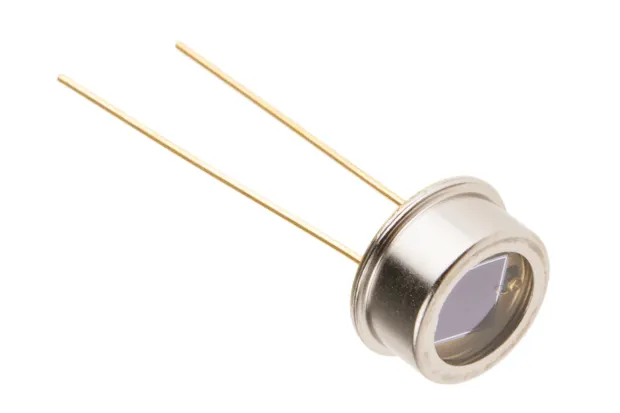 This photodiode is conscious according to Integrated Information Theory (IIT) as it can discriminate between two states (photon and no photon). Source
150 scientists signed a petition stating that IIT should be banned from science as it is pseudoscience. But IIT hasn't been banned yet because it would break the hearts of the dedicated IIT researchers and destroy their careers.
Could Stockfish be conscious?
Stanislas Dehaene, Hakwan Lau, and Sid Kouider published an article on what needs to be done for deep learning networks to become conscious:
C0: Unconscious processing – automatic, independent processes, current state of deep learning networks.
C1: Global availability – A global workspace which broadcasting information to other modules. Modules compete for access to the workspace.
C2: Self-monitoring – The ability to represent one's own states.
The computations implemented by current deep-learning networks correspond mostly to nonconscious operations in the human brain.
---
We contend that a machine endowed with C1 and C2 would behave as though it were conscious.Although centuries of philosophical dualism have led us to consider consciousness as unreducible to physical interactions, the empirical evidence is compatible with the possibility that consciousness arises from nothing more than specific computations.
Conscious machines may need ethical considerations:
When machines share enough features with conscious human brain processing, we should be prepared to accept the possibility that they are conscious. Of course, even if a machine shared those features and reported having subjective experiences, Carter et al. could still deny that it experienced anything at all. But such a solipsist position also applies to humans: By such a standard, we likewise cannot prove that other human beings are conscious. This position, and the associated insistence on “qualia” and the “hard problem” of consciousness, are unproductive. In the future, denying machines any form of subjectivity, when it is caused by computations similar to those that constitute core ingredients of consciousness in the human brain, may become as contentious as denying it to other human beings or to nonhuman animals with brain architectures similar to ours.
Stanislas Dehaene, Hakwan Lau, Sid Kouider, What is consciousness, and could machines have it?, 2017
Could Stockfish be conscious?
The answer is no.
The reason is because Stockfish is at level C0 with unconscious automatic processing. First it must reach level C1 by having a global workspace architecture. To reach C2 it must have meta-representations of its own functioning.
But why would Stockfish need meta-representations of its own functioning? It is already as good as it can be. So it would be redundant. Same goes for the global workspace architecture. A workspace leads to emergent actions beyond the sum of its parts. But what could emerge from Stockfish's processors? Clearly independent processors must 'harmonize' and be able to receive info from global broadcasts and to be able to enter the global workspace. Neural nets are ideal for this because they can 'mesh' together. Each processor is made up of a set of distributed neurons. The neurons are like lego bricks, a neuron can influence another neuron to fire. This allows a common 'language' of communication. However Stockfish is not made of neurons, so it's search function, eval function etc are completely incompatible. A conscious machine must be made of tiny parts.
That leaves our hyped up Alphazero. Could Alphazero be conscious?
The answer is no.
It is also not conscious as it lacks a global workspace and meta-representations. And it does not need them.
But what if Alphazero had those abilities. Would it have a subjective experience?
According to neuroscientist Stanislas Dehaene, this question is an artifact of bad theorizing. Dehaene's approach to consciousness research was greatly influenced by Daniel Dennett.
The hypothetical concept of qualia, pure mental experience detached from any information-processing role, will be viewed as a peculiar idea of the prescientific era, much like vitalism—the misguided nineteenth-century thought that, however much detail we gather about the chemical mechanisms of living organisms, we will never account for the unique qualities of life. Modern molecular biology shattered this belief, by showing how the molecular machinery inside our cells forms a self-reproducing automaton. Likewise, the science of consciousness will keep eating away at the hard problem until it vanishes.
For instance, current models of visual perception already explain not only why the human brain suffers from a variety of visual illusions but also why such illusions would appear in any rational machine confronted with the same computational problem. The science of consciousness already explains significant chunks of our subjective experience, and I see no obvious limits to this approach.
Stanislas Dehaene, Consciousness and the Brain, 2014
A perfect automatic machine could never become conscious.
You can see this in flow states when you are absorbed in an activity. This leads to reduced consciousness as the global workspace is not needed as you are more reliant on automatic processors. Free will is associated with more potential output states. The global workspace allows flexible behavior and free will to emerge out of automatic processors. More consciousness means feeling more free. A chess engine is not free. To become conscious a chess engine would need more degrees of freedom. This means imperfection. It is often said that being imperfect makes us humans. Imperfection simply means not being able to do a task perfectly, as required by a unconscious automatic processor or processors. Now it is possible to create a human like robot that could play perfect chess, but the play would be effortless for this robot. It would not know how it plays so well. It would not have to think at all. It would only be conscious because of of its human sensory detectors like sight, hearing etc.
As you become better at chess, your effort needed for your chess play starts reducing. When you begin, you are putting in more effort to not blunder. At a higher level there is less effort. The effort may come back in a difficult position. This is an example of automatic processing, like learning to ride a bike. First you must think about your movements carefully but then it becomes automatic.
The reason humans have concepts is because these concepts are some of the processors that contribute flexibly to the global workspace. A chess engine on the other hand has no concepts, it does not a have a meta-representation of its behavior, nor does it have global broadcasting. It would not be able to say anything about why it can play chess so well.
Consciousness is a sum of various information processing instantiated by neuronal activity in a global workspace with the ability to use meta-representations. Chess engines do not have such attributes and are not conscious.
Stockfish does not dream of Electric Knights.
---
You may also like
 RuyLopez1000
Epic Endgame: Win with a Passed Pawn
Alekhine vs Capablanca Game 34 TotalNoob69
The REAL value of chess pieces
... according to Stockfish ChessMonitor_Stats
Where do Grandmasters play Chess? - Lichess vs. Chess.com
This is the first large-scale analysis of Grandmaster activity across Chess.com and Lichess from 200… RuyLopez1000
Stories Behind the Moves: 22.Nxd7.
In 1971, Bobby Fischer played a famous move. thibault
How I started building Lichess
I get this question sometimes. How did you decide to make a chess server? The truth is, I didn't. FM MathiCasa