
Chess Diagnosis: Find Your Biggest Weaknesses
Every chess player eventually reaches a point where their progress seems to stall. You play regularly, solve tactics puzzles, study opening theory, and watch instructional videos, yet your rating barely changes. It feels as though you're putting in more and more effort, but seeing the same results.
At this stage, many players assume they simply need to train harder—or they become discouraged altogether. In reality, the problem is often not the amount of training, but its direction. It's impossible to improve efficiently if you don't know what is actually costing you points. One player regularly overlooks tactical ideas, another consistently gets difficult positions straight out of the opening, while a third fails to convert winning endgames or constantly gets into time trouble. The result is the same—lost games—but the underlying causes are completely different.
That is why real improvement begins not with searching for another opening repertoire or a new training routine, but with diagnosing your own game. Once you understand what is actually holding you back, every training session becomes more focused and far more effective. In this article, you'll learn how to diagnose your own play, identify your recurring weaknesses, and build a training plan around them.
One of the most common mistakes in chess training is practicing without a clear plan. One day you're solving tactics puzzles, the next you're studying a new opening, a week later you're watching a video on strategy, and then you move on to endgames. It may feel like you're covering every aspect of the game, but in reality, this approach rarely leads to meaningful improvement.
Imagine a doctor prescribing treatment without first making a diagnosis. Sometimes it might work by chance, but more often it won't address the real problem. Chess improvement works the same way. If your biggest weakness is calculation, studying new openings will do little to improve your results. If you constantly get into time trouble, spending extra hours solving tactics puzzles probably won't solve the issue either.
When you don't know your biggest weakness, every training session becomes a guessing game. You might spend dozens of hours improving a skill that's already one of your strengths while continuing to lose games for an entirely different reason. That's why the first step toward improvement isn't finding another course, book, or opening repertoire—it's diagnosing your own game and understanding what is truly holding you back.
Many players believe that simply playing more games automatically leads to improvement. At first glance, that seems logical: the more you play, the stronger you should become. In reality, however, you can play hundreds of games without making any meaningful progress. The reason is simple—experience by itself teaches you very little unless you take the time to learn from it.
After a loss, most players immediately jump into the next game, hoping to win back the rating they just lost. At best, they take a quick look at the engine evaluation, see where the advantage slipped away, and move on. Unfortunately, this rarely prevents the same mistakes from happening again. If you don't understand why you lost, your next game is likely to follow the same pattern: the same positional mistakes, the same calculation errors, and the same problems with time management or tactical awareness.
That is why many players remain stuck at the same rating for months—or even years. The problem isn't a lack of practice; it's a lack of meaningful feedback. Real improvement begins when every game becomes more than just a result—it becomes a source of information about your recurring weaknesses. Once you understand the reasons behind your mistakes, you can finally stop repeating them.
Effective training always has a clear purpose. It's not enough to simply solve tactics puzzles, study opening theory, or read books on strategy—you need to understand which weakness from your own games you're trying to fix. Otherwise, your training becomes a collection of useful but disconnected activities.
After reviewing your games, ask yourself one simple question: What mistake do I make most often? If you regularly overlook tactical ideas, then tactics should become your top priority. If you keep throwing away winning positions in the endgame, that's where your focus should be. If you constantly get into time trouble, the problem may not be a lack of chess knowledge at all—it may simply be poor time management or an inefficient decision-making process.
Every training session should be directly connected to your own games. It should answer one question: "Which recurring mistake from my recent games am I trying to eliminate?" This is what makes training purposeful. Instead of trying to improve everything at once, you systematically eliminate the weaknesses that are actually costing you points. That is how training stops being random and becomes a structured process of continuous improvement.
Chess strength isn't a single skill—it's a combination of several different abilities, each of which influences the outcome of a game. These include opening preparation, tactical awareness, calculation, positional understanding, endgame technique, time management, and psychological resilience. During a game, all of these skills work together, which is why many players come away thinking, "I'm just bad at chess."
In reality, that's almost never true. Even players with the same rating can have completely different strengths and weaknesses. One player may feel comfortable in complex positional battles but regularly overlook tactical ideas. Another may calculate accurately yet struggle to convert an advantage or constantly get into time trouble.
That is why a player's strength is usually limited not by dozens of weaknesses, but by just a few recurring ones. These weaknesses appear again and again across many games and account for most lost points. The goal of this diagnosis isn't to label yourself as a strong or weak player, but to identify which parts of your game deserve your attention first. That is where real improvement begins.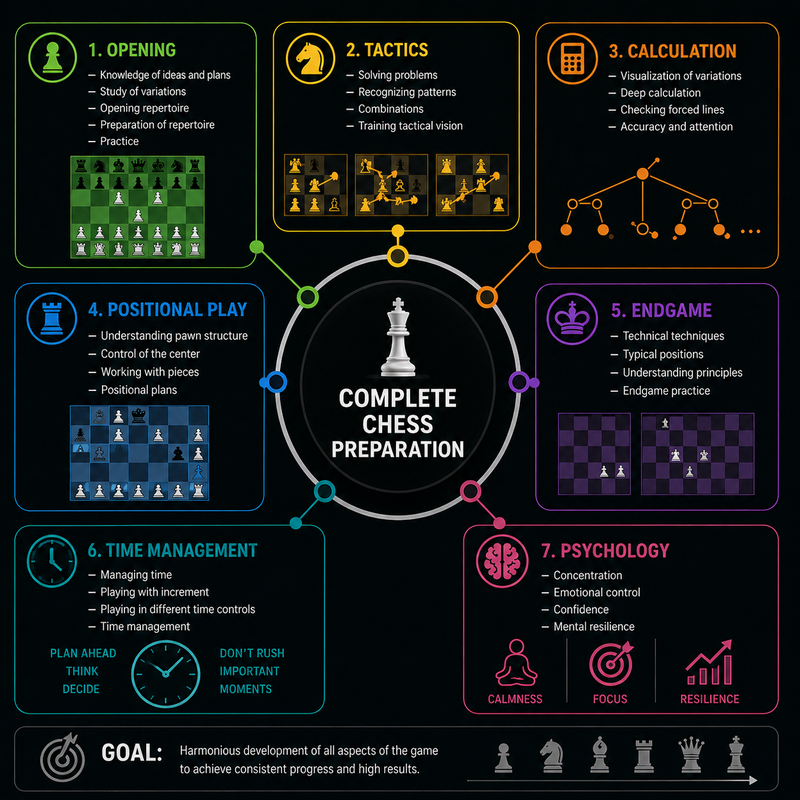
The most reliable way to identify your weaknesses is to stop focusing on individual games and start looking for patterns. A single bad game tells you very little about your actual playing strength. You may have lost because you were tired, short on time, or simply because your opponent played better. But when the same mistake keeps appearing again and again, it's no longer bad luck—it's part of your game.
Take your last 10–20 games and review them without immediately turning on the engine. Instead, ask yourself a few simple questions. At what stage of the game did things start to go wrong? What caused the loss—a tactical oversight, poor opening play, a bad strategic decision, endgame mistakes, or time trouble? Does the same pattern appear in other games? Write down your observations. Even a simple table is often enough to reveal patterns that are almost impossible to notice when looking at games one by one.
After reviewing enough games, recurring patterns begin to emerge. You may discover that most of your losses come from overlooked tactics, poor positional decisions, or constantly getting into time trouble. These recurring mistakes should become the foundation of your training plan. Chess improvement is built on patterns, not isolated games. Only by analyzing a sufficiently large sample of games can you separate random mistakes from your true weaknesses.
Reviewing your games manually is an essential part of improvement, but once you've accumulated dozens—or even hundreds—of games, specialized tools can save you a tremendous amount of time. They don't replace careful analysis, but they make it much easier to spot recurring patterns.
Lichess Insights is one of the best free tools for analyzing your own games and statistics. It lets you break down your results by opening, time control, color, and many other factors. You can quickly see whether you consistently underperform in blitz, score worse with Black, or struggle against certain opening systems. Rather than giving you answers, Insights helps you identify patterns that are worth investigating in your games.
Chess Stalker offers a more comprehensive overview of your playing style. It automatically analyzes your Lichess or Chess.com games and generates statistics on your opening repertoire, playing style, time usage, and recurring mistakes. Although it was originally designed as an opponent preparation tool, it's equally useful for self-analysis. Instead of manually reviewing dozens of games, you get an immediate overview of your strengths, weaknesses, and long-term tendencies.
ChessBase offers two particularly useful reports for self-analysis. The Style Report provides an overview of your playing style, showing whether you tend to prefer attacking or positional chess, what pawn structures you reach most often, how frequently you exchange pieces, and the kinds of positions that typically arise in your games. The Error Report complements this by highlighting where your most significant mistakes occur. It evaluates the complexity of the position, the phase of the game, and the quality of your decisions, helping you identify the situations that consistently cause you the most problems.
It's important to remember, however, that no program can fully diagnose your game. These tools can show where your mistakes happen, but they cannot always explain why they happen. That's why statistics should be treated as a starting point rather than a conclusion. The most effective approach is to combine automated analysis with your own game review. Together, they provide a much clearer picture of your recurring weaknesses and help you build a focused, effective training plan.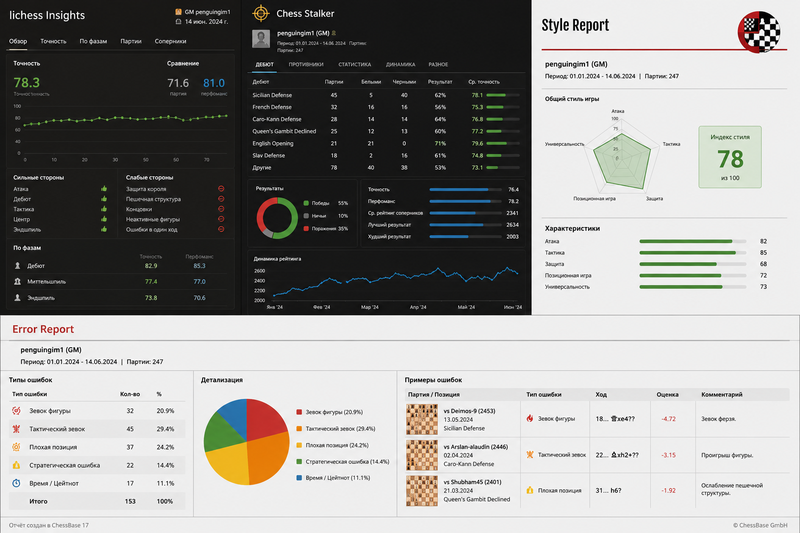
The most effective way to identify your weaknesses is to combine manual game review with the insights provided by modern chess software. These approaches don't compete with each other—they complement one another.
Start by reviewing your last 10–20 games. After each one, identify the main reason your position started to deteriorate: a tactical oversight, a calculation error, poor opening play, a bad strategic decision, weak endgame technique, or time trouble. Don't judge individual games—look for recurring patterns. If the same type of mistake appears again and again, it's probably one of the main factors holding back your progress.
Next, use analysis tools to confirm your observations. Lichess Insights helps you identify statistical trends in your results by opening, time control, color, and many other factors. Chess Stalker provides an overview of your playing style, time usage, and recurring weaknesses. If you use ChessBase, the Style Report and Error Report offer even deeper insight into your playing style and the types of mistakes you make throughout different phases of the game.
Finally, create a simple table and record the main reason for each loss or critical mistake. After reviewing just a few dozen games, you'll usually find that only one to three weaknesses account for the majority of your problems. Those are the areas that deserve most of your training time.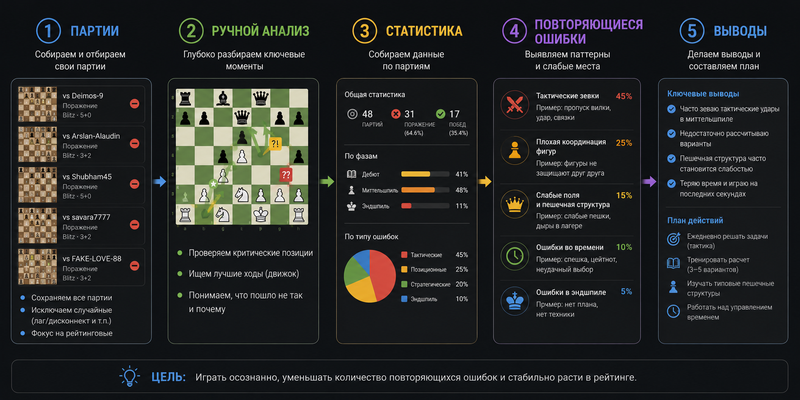
After completing your diagnosis, you'll probably discover more than one weakness. The biggest mistake at this stage is trying to fix everything at once. When you spread your attention too thin, your training loses its focus and becomes unfocused once again.
Instead, choose the weakness that appears most often in your games and costs you the most points. Tactical oversights usually deserve higher priority than minor opening inaccuracies, and constantly getting into time trouble is generally more damaging than an occasional endgame mistake. Ask yourself: If I could fix just one weakness, which one would improve my results the most?
Focus on that weakness for several weeks while continuing to review your new games. Once it starts occurring noticeably less often, move on to the next one. By improving one recurring weakness at a time, you'll make steady, measurable progress instead of trying to fix everything at once.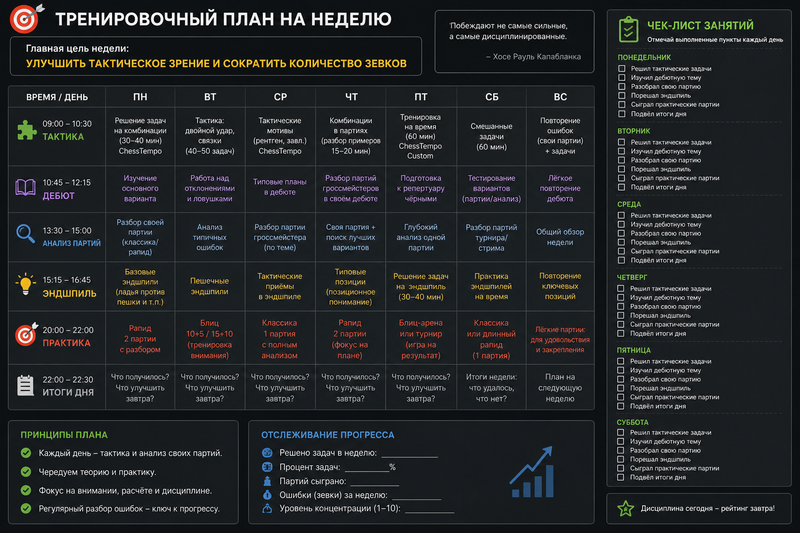
Your weaknesses depend not only on you as a player, but also on your playing strength. At lower rating levels, most games are decided by major tactical mistakes, so these are usually the biggest source of lost points. As players improve, outright blunders become less frequent, and the focus shifts toward calculation, positional understanding, planning, and converting advantages.
That is why your self-analysis should always reflect your current level of play. There is little point in a 1000-rated player searching for subtle strategic flaws if they regularly leave pieces hanging. On the other hand, for a 2200-rated player, simply counting blunders is no longer enough. Instead, they need to evaluate the quality of their decisions in complex positions. The stronger the player, the deeper and more nuanced their self-analysis needs to become. That is why there is no universal diagnosis that applies to every chess player.
Once you've identified your weaknesses, resist the temptation to fix everything at once. Instead, choose the one weakness that appears most often in your games and has the greatest impact on your results. Let that become the focus of your training for the next few weeks.The next step is to match that weakness with the right kind of training. If you frequently overlook tactical opportunities, spend more time solving tactics puzzles and asking yourself what your opponent is threatening before every move. If calculation is your main weakness, practice calculating variations without moving the pieces. If you regularly get into time trouble, work on improving your time management and making practical decisions more quickly.The guiding principle is simple: every training session should target a specific recurring mistake from your games. Your training plan shouldn't be fixed forever, though. After a few weeks, review your recent games and check whether that weakness is becoming less frequent.
In future posts, I'll take a closer look at each type of weakness and explain how to turn it into targeted training exercises and a practical weekly training plan.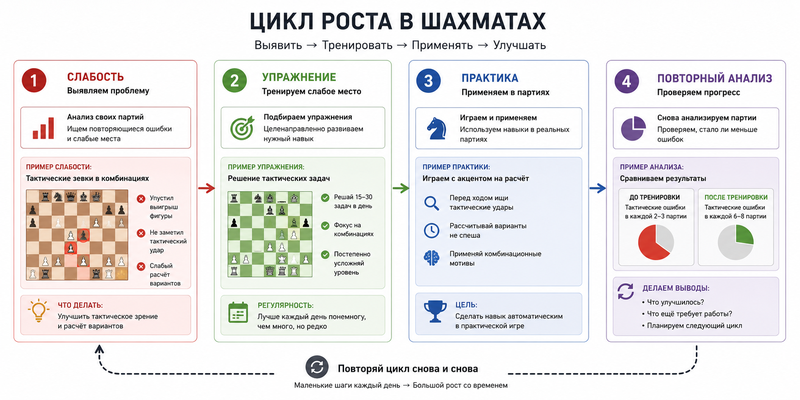
Below is an excerpt from one of my students' monthly reports. We've been compiling these reports every month for some time now, allowing us to track not only the student's current playing strength but also how it changes over time.
The report combines information from three different sources. Lichess Insights provides an overview of rating trends, game volume, accuracy, and overall performance. This makes it easy to see whether the player is actually improving and in which time controls that improvement is taking place.
The next step is analyzing the player's opening repertoire. We evaluate the results for each opening system to identify which openings produce consistent results and which repeatedly lead to difficult positions. This helps determine whether opening preparation should be a training priority.
Finally, we use the ChessBase Style Report and Error Report. Together, they provide a detailed picture of the player's style, recurring strengths and weaknesses, typical mistakes, and the types of positions where they lose the most points. In this particular case, the reports showed that the player's opening preparation was already solid, while most of their losses stemmed from middlegame play. They frequently mishandled winning positions and struggled in positional play. As a result, the next training cycle focused not on expanding the opening repertoire, but on improving calculation, converting advantages, and strengthening positional understanding.
Self-analysis is an essential part of improvement, but regular feedback can make the process much more effective. An experienced coach can often spot recurring mistakes, identify their underlying causes, and adjust your training plan before ineffective habits become ingrained. This can save you months of unfocused practice and help you improve more efficiently.
If you're looking for personalized feedback, game analysis, and a structured training plan tailored to your needs, I offer online chess coaching. You can find more information about my lessons on https://chess-place.ru/
Most chess players know that they need to train, but not everyone knows what they should train. That's one of the biggest reasons progress often stalls. Careful analysis replaces guesswork with evidence: it helps you identify recurring mistakes, set clear priorities, and build a training plan that actually improves your results.
Whether you review your games yourself or use specialized tools, keep asking one simple question:
What is the single biggest weakness holding back my chess today?
The answer will point you toward the most productive direction for your training.
Thank you for reading! I hope this article has given you a clearer idea of where real chess improvement begins.
If you'd like to follow my work, you can find me here:
🎥 Twitch — Daily live streams with tournament commentary, game analysis, and Q&A sessions.
twitch.tv/ferstep_
📢 Telegram — Stream announcements, new articles, training resources, and project updates.
Telegram channel
♟️ Online Chess Coaching — If you're interested in personalized game analysis, individual coaching, and a structured training plan, you can learn more here.
Chess Place
See you on the stream, on Telegram, or across the board. Good luck with your training!
You may also like
 Ferstep
How to Analyze Your Own Chess Games: A Step-by-Step Guide
"Don't limit your analysis to lost games." TheCommandalorian
Why Endgame Knowledge is so Critical to Improvement
If you don't want to study endgames don't worry I don't either, but it is necessary for serious impr… Ferstep
Как правильно анализировать свои партии: пошаговая система
"Анализировать нужно не только поражения" IM datajunkie
You’re studying chess openings the wrong way (do this instead)
If memorising opening lines made you stronger, many club players would be masters. thibault
How I started building Lichess
I get this question sometimes. How did you decide to make a chess server? The truth is, I didn't. Ferstep