@Molurus said in #18:
But the most reasonable explantion is that you did run out of time. (there is 0.13 seconds on your clock). If you did, this is draw according to FIDE, because black cannot win from this position. Not even with an unlikely helpmate.
They had 13 seconds not 0.13 seconds, so flagging is out of the question (unless something weird happened)
@Molurus said in #18:
> But the most reasonable explantion is that you did run out of time. (there is 0.13 seconds on your clock). If you did, this is draw according to FIDE, because black cannot win from this position. Not even with an unlikely helpmate.
They had 13 seconds not 0.13 seconds, so flagging is out of the question (unless something weird happened)
If white has a king and two knights, versus black’s lone king, and black flags, will this be declared draw according to USCF rules? Two knights can checkmate the black king “by force” in the sense that they don’t need help from other pieces, but white can’t force black to a mate unless black suicides by putting the king in the corner.
If white has a king and two knights, versus black’s lone king, and black flags, will this be declared draw according to USCF rules? Two knights can checkmate the black king “by force” in the sense that they don’t need help from other pieces, but white can’t force black to a mate unless black suicides by putting the king in the corner.
@zzc3308 said in #22:
If white has a king and two knights, versus black’s lone king, and black flags, will this be declared draw according to USCF rules? Two knights can checkmate the black king “by force” in the sense that they don’t need help from other pieces, but white can’t force black to a mate unless black suicides by putting the king in the corner.
You're right, USCF will call this a draw because you cannot force a checkmate with two knights. FIDE will call this a win because a checkmate is possible, similar to how a knight vs a corner pawn is also a win.
@zzc3308 said in #22:
> If white has a king and two knights, versus black’s lone king, and black flags, will this be declared draw according to USCF rules? Two knights can checkmate the black king “by force” in the sense that they don’t need help from other pieces, but white can’t force black to a mate unless black suicides by putting the king in the corner.
You're right, USCF will call this a draw because you cannot force a checkmate with two knights. FIDE will call this a win because a checkmate is possible, similar to how a knight vs a corner pawn is also a win.
@BigBrainChess_08 said in #15:
So does this mean that if a mate can happen without the cooperation of the king, but with the cooperation by other pieces, then USCF rules will consider this a possible win and thus not declare a draw when the opponent flags? Only if all pieces, including the king, need to cooperate for a mate to occur, then UCSF rules do not consider this a possible win and a draw is declared?
@BigBrainChess_08 said in #15:
>
So does this mean that if a mate can happen without the cooperation of the king, but with the cooperation by other pieces, then USCF rules will consider this a possible win and thus not declare a draw when the opponent flags? Only if all pieces, including the king, need to cooperate for a mate to occur, then UCSF rules do not consider this a possible win and a draw is declared?
@Ramen_Eater said in #24:
So does this mean that if a mate can happen without the cooperation of the king, but with the cooperation by other pieces, then USCF rules will consider this a possible win and thus not declare a draw when the opponent flags? Only if all pieces, including the king, need to cooperate for a mate to occur, then UCSF rules do not consider this a possible win and a draw is declared?
The King counts as mating material, and it is needed in several situations to mate. Even if you are up a full queen you need the king to contribute.
@Ramen_Eater said in #24:
> >
>
> So does this mean that if a mate can happen without the cooperation of the king, but with the cooperation by other pieces, then USCF rules will consider this a possible win and thus not declare a draw when the opponent flags? Only if all pieces, including the king, need to cooperate for a mate to occur, then UCSF rules do not consider this a possible win and a draw is declared?
The King counts as mating material, and it is needed in several situations to mate. Even if you are up a full queen you need the king to contribute.
@BigBrainChess_08 said in #25:
That is correct. But I was referring to the King of the side that is being mated.
@BigBrainChess_08 said in #25:
>
That is correct. But I was referring to the King of the side that is being mated.
@Ramen_Eater said in #26:
That is correct. But I was referring to the King of the side that is being mated.
In simple terms, for USCF they will declare it a draw if you cannot FORCE checkmate with your own pieces. So yes two knights alone will be a draw because it cannot force a checkmate ---- Black would need to cooperate.
@Ramen_Eater said in #26:
> >
>
> That is correct. But I was referring to the King of the side that is being mated.
In simple terms, for USCF they will declare it a draw if you cannot FORCE checkmate with your own pieces. So yes two knights alone will be a draw because it cannot force a checkmate ---- Black would need to cooperate.
@BigBrainChess_08 said in #27:
So yes two knights alone will be a draw because it cannot force a checkmate ---- Black would need to cooperate.
That is the general approach. Yet at move one, Black would also need to cooperate for White to win. The possible difference is that with only two knights and the Kings on the board, the Black king, in particular, would need to cooperate for White to win. So I am wondering if that is the particular definition of cooperation that is underlying the USCF rules.
@BigBrainChess_08 said in #27:
> So yes two knights alone will be a draw because it cannot force a checkmate ---- Black would need to cooperate.
That is the general approach. Yet at move one, Black would also need to cooperate for White to win. The possible difference is that with only two knights and the Kings on the board, the Black king, in particular, would need to cooperate for White to win. So I am wondering if that is the particular definition of cooperation that is underlying the USCF rules.
I tried playing this position out on chess.com, black flags when white has mate-in-one, but a draw is still declared. This is a bit weird since white can force mate.
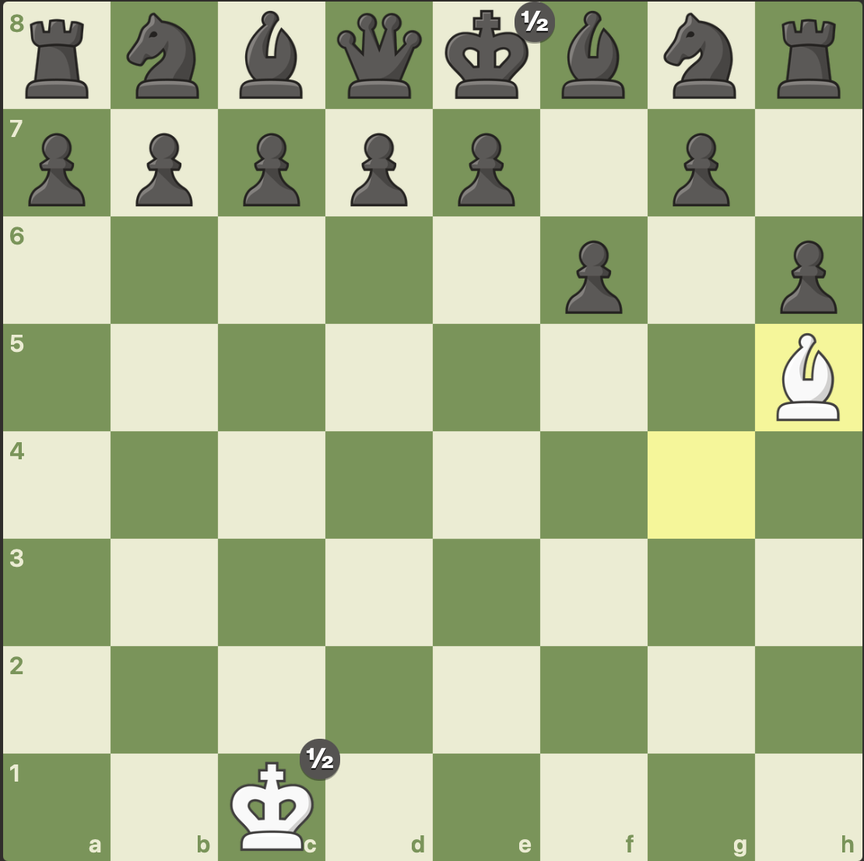
I tried playing this position out on chess.com, black flags when white has mate-in-one, but a draw is still declared. This is a bit weird since white can force mate.

I think there is another way to help make a possible legal mate come true: the timeout side has a pawn vs a bishop, which by itself is unmatable, but they can promote to a knight or a bishop to get mated.
I think there is another way to help make a possible legal mate come true: the timeout side has a pawn vs a bishop, which by itself is unmatable, but they can promote to a knight or a bishop to get mated.

