here is the nice board (if you dont understand the first board pic)
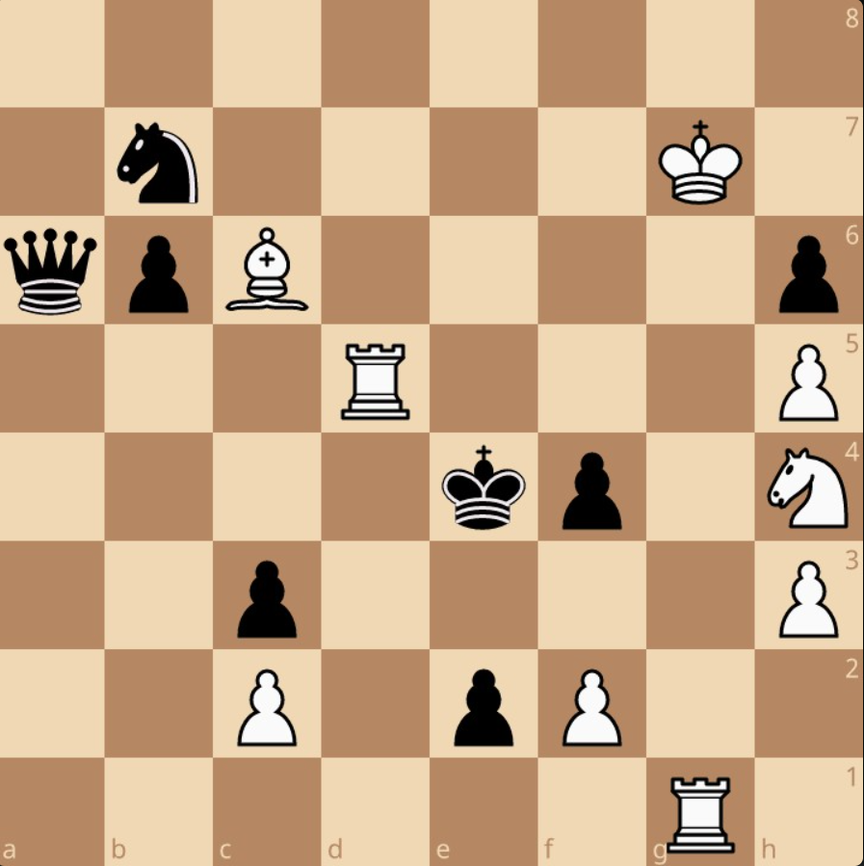
here is the nice board (if you dont understand the first board pic)

The vast majority of people are higher rated not because they watched the right video or signed up for the proper online training course but because they, for whatever reason, are interested in some aspects of chess more than you, be it rook endgames, isolated queen pawns, the history of chess theory, hyper-modernism, the postwar soviet chess revolution, and so forth.
They are also probably more talented than me. There is significant variation in how long it takes a player to reach master level:
But the variation around that average is what makes the study genuinely important. The fastest player in the sample reached Master level in just 3,016 hours. The slowest required 23,608 hours. Some players in the study accumulated over 25,000 hours of practice and never reached the Master level at all.
See: https://kingdomofchess.com/how-long-to-reach-each-chess-rating-level/
For the original study:
https://www.researchgate.net/publication/222697134_The_role_of_practice_in_chess_A_longitudinal_study
Besides, I don't think being single-mindedly obsessed about say King and pawn endgames is enough to improve someone's game if that person can't make it out of the opening without a significant disadvantage.
Additionally, the best players are really obsessed about chess but that's because they are also good at it.
For instance, Ramanujan was obsessed about math from an early age and taught himself quite a lot by checking out books from the library. The same applies to Hanna Caira who dedicated her life to math through Khan Academy videos, ultimately proving a very challenging result in harmonic analysis: https://www.scientificamerican.com/article/how-teen-mathematician-hannah-cairo-disproved-a-major-conjecture-in-harmonic/
From these examples, it doesn't make sense to tell people "look if only you were as interested in math as Cairo and Ramanujan, you would also be as accomplished". Yes in that if you were as talented, perhaps you would be also as obsessed but more emphatically no, because you aren't.
>The vast majority of people are higher rated not because they watched the right video or signed up for the proper online training course but because they, for **whatever reason**, are interested in some aspects of chess more than you, be it rook endgames, isolated queen pawns, the history of chess theory, hyper-modernism, the postwar soviet chess revolution, and so forth.
They are also probably more talented than me. There is significant variation in how long it takes a player to reach master level:
>But the variation around that average is what makes the study genuinely important. The fastest player in the sample reached Master level in just 3,016 hours. The slowest required 23,608 hours. Some players in the study accumulated over 25,000 hours of practice and never reached the Master level at all.
See: https://kingdomofchess.com/how-long-to-reach-each-chess-rating-level/
For the original study:
https://www.researchgate.net/publication/222697134_The_role_of_practice_in_chess_A_longitudinal_study
Besides, I don't think being single-mindedly obsessed about say King and pawn endgames is enough to improve someone's game if that person can't make it out of the opening without a significant disadvantage.
Additionally, the best players are really obsessed about chess but that's because they are also good at it.
For instance, Ramanujan was obsessed about math from an early age and taught himself quite a lot by checking out books from the library. The same applies to Hanna Caira who dedicated her life to math through Khan Academy videos, ultimately proving a very challenging result in harmonic analysis: https://www.scientificamerican.com/article/how-teen-mathematician-hannah-cairo-disproved-a-major-conjecture-in-harmonic/
From these examples, it doesn't make sense to tell people "look if only you were as interested in math as Cairo and Ramanujan, you would also be as accomplished". Yes in that if you were as talented, perhaps you would be also as obsessed but more emphatically no, because you aren't.
@AnlamK said ^
For instance, Ramanujan was obsessed about math from an early age and taught himself quite a lot by checking out books from the library. The same applies to Hanna Caira who dedicated her life to math through Khan Academy videos, ultimately proving a very challenging result in harmonic analysis: https://www.scientificamerican.com/article/how-teen-mathematician-hannah-cairo-disproved-a-major-conjecture-in-harmonic/
From these examples, it doesn't make sense to tell people "look if only you were as interested in math as Cairo and Ramanujan, you would also be as accomplished". Yes in that if you were as talented, perhaps you would be also as obsessed but more emphatically no, because you aren't.
I might be misunderstanding you on this (and if so I apologize), but those examples seem to prove my point - talent is often, essentially, a form of obsession. It is the brain choosing to dwell continuously, often subconsciously, upon a subject, and especially when this occurs at a young age when the brain is still developing it appears to manifest itself as an "innate" ability.
That said, I'm not talking directly about outliers/professionals in a field, because that's a somewhat different discussion - work is work. I'm talking mainly about people who are consuming instructional "entertainment" and expecting it to improve them relative to others doing the exact same things. I suspect that most of the time If they were actually interested in chess (as opposed to getting "better" at it) they'd read something about it and, ultimately, "talent" has little to do with it.
@AnlamK said [^](/forum/redirect/post/3tYgoM6c)
> For instance, Ramanujan was obsessed about math from an early age and taught himself quite a lot by checking out books from the library. The same applies to Hanna Caira who dedicated her life to math through Khan Academy videos, ultimately proving a very challenging result in harmonic analysis: https://www.scientificamerican.com/article/how-teen-mathematician-hannah-cairo-disproved-a-major-conjecture-in-harmonic/
>
> From these examples, it doesn't make sense to tell people "look if only you were as interested in math as Cairo and Ramanujan, you would also be as accomplished". Yes in that if you were as talented, perhaps you would be also as obsessed but more emphatically no, because you aren't.
I might be misunderstanding you on this (and if so I apologize), but those examples seem to prove my point - talent is often, essentially, a form of obsession. It is the brain choosing to dwell continuously, often subconsciously, upon a subject, and especially when this occurs at a young age when the brain is still developing it appears to manifest itself as an "innate" ability.
That said, I'm not talking directly about outliers/professionals in a field, because that's a somewhat different discussion - work is work. I'm talking mainly about people who are consuming instructional "entertainment" and expecting it to improve them relative to others doing the exact same things. I suspect that most of the time If they were actually interested in chess (as opposed to getting "better" at it) they'd read something about it and, ultimately, "talent" has little to do with it.
@ZugAddict How old are you? You drawing littlle worse than me (im 10) at banner of blog
@ZugAddict How old are you? You drawing littlle worse than me (im 10) at banner of blog
@AnlamK said ^
Try and solve a real chess problem that was composed by a human being, and not a "tactics trainer" puzzle that are essentially the empty calories of chess nutrition. Here's one to start with.
This seems like a highly contentious claim. I would argue that tactics that show up in real games are a lot more relevant for one's play than compositions.
You're right, I've overstated things there. I wouldn't say "regular" tactics are useless - they clearly are not. They are, however, one side of a coin that often obscures the other which is creative and flexible thought. Regular chess puzzles focus on established patterns that are fairly narrow and repetitive that we learn to apply in a somewhat rote manner to various situations. Actual, artistic, composed chess problems tend to be more about overcoming the ingrained filters "normal" tactics build up, and I suspect this helps us reduce blind spots and makes us more intellectually resourceful.
But my larger point is that, for me, at any rate, a beautiful puzzle isn't solved because it's "useful" but because t's actually really interesting and, paradoxically, that's what makes it also useful - beauty is memorable and "sticks" in the mind in a way rote training for training sake generally doesn't.
@AnlamK said [^](/forum/redirect/post/4WlXoG32)
> >Try and solve a real chess problem that was composed by a human being, and not a "tactics trainer" puzzle that are essentially the empty calories of chess nutrition. Here's one to start with.
>
> This seems like a highly contentious claim. I would argue that tactics that show up in real games are a lot more relevant for one's play than compositions.
You're right, I've overstated things there. I wouldn't say "regular" tactics are useless - they clearly are not. They are, however, one side of a coin that often obscures the other which is creative and flexible thought. Regular chess puzzles focus on established patterns that are fairly narrow and repetitive that we learn to apply in a somewhat rote manner to various situations. Actual, artistic, composed chess problems tend to be more about overcoming the ingrained filters "normal" tactics build up, and I suspect this helps us reduce blind spots and makes us more intellectually resourceful.
But my larger point is that, for me, at any rate, a beautiful puzzle isn't solved because it's "useful" but because t's actually really interesting and, paradoxically, that's what makes it also useful - beauty is memorable and "sticks" in the mind in a way rote training for training sake generally doesn't.
@BoRyS_PrO_2015 said ^
@ZugAddict How old are you? You drawing littlle worse than me (im 10) at banner of blog
While it's admittedly pretty bad, I still think it's better than any of the AI generated pictures currently infesting the lichess blogosphere.
@BoRyS_PrO_2015 said [^](/forum/redirect/post/0UmYc96L)
> @ZugAddict How old are you? You drawing littlle worse than me (im 10) at banner of blog
While it's admittedly pretty bad, I still think it's better than any of the AI generated pictures currently infesting the lichess blogosphere.
<Comment deleted by user>
@ZugAddict said ^
@ZugAddict How old are you? You drawing littlle worse than me (im 10) at banner of blog
While it's admittedly pretty bad, I still think it's better than any of the AI generated pictures currently infesting the lichess blogosphere.
Yep I agree
@ZugAddict said [^](/forum/redirect/post/aGLz2hag)
> > @ZugAddict How old are you? You drawing littlle worse than me (im 10) at banner of blog
>
> While it's admittedly pretty bad, I still think it's better than any of the AI generated pictures currently infesting the lichess blogosphere.
Yep I agree
@ZugAddict said ^
@ZugAddict How old are you? You drawing littlle worse than me (im 10) at banner of blog
I still think it's better than any of the AI generated pictures
Nuh-uh.
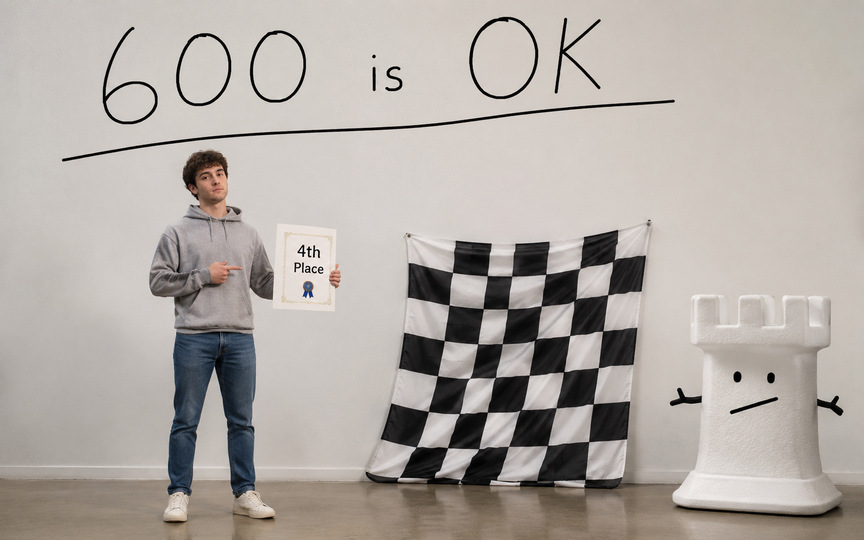
P.S.
On a serious note, drawing it out was 100% much better than using AI.
@ZugAddict said [^](/forum/redirect/post/aGLz2hag)
> > @ZugAddict How old are you? You drawing littlle worse than me (im 10) at banner of blog
>
> I still think it's better than any of the AI generated pictures
Nuh-uh.

P.S.
On a serious note, drawing it out was 100% much better than using AI.
@ZugAddict said ^
@ZugAddict How old are you? You drawing littlle worse than me (im 10) at banner of blog
While it's admittedly pretty bad, I still think it's better than any of the AI generated pictures currently infesting the lichess blogosphere.
It's still insane to me that uncredited artwork is featured on Lichess' main page (blog thumbnails).
@ZugAddict said [^](/forum/redirect/post/aGLz2hag)
> > @ZugAddict How old are you? You drawing littlle worse than me (im 10) at banner of blog
>
> While it's admittedly pretty bad, I still think it's better than any of the AI generated pictures currently infesting the lichess blogosphere.
It's still insane to me that uncredited artwork is featured on Lichess' main page (blog thumbnails).


