Dunning-Kruger time again... sigh
Dunning-Kruger time again... *sigh*
The wiki explains it well the Dunning–Kruger_effect
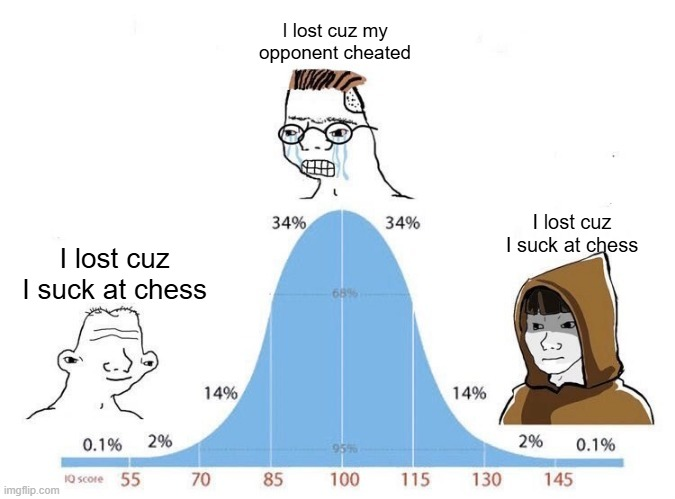
The graph images nearly look like they would apply to chess standings too.
The wiki explains it well the Dunning–Kruger_effect
The graph images nearly look like they would apply to chess standings too.
@lizani said ^
It's not the actual cheating, it's the threat which is stronger than the execution.
Look at OTB chess - classical dominates. Walk into a club and you'll also see people playing casual blitz but never 1 0 bullet.
It's the complete opposite online, bullet and blitz dominate. There are many reasons but one of them is the fear of cheating at longer time controls.
Of course, Magnus Carlsen plays classy chess at any time control. But we are not Magnus. If you mainly play fast online games, it is bad for your chess development. You become reliant on superficial thinking and aiming to win on the clock rather than the board.
Most people would cheat in blitz and bullet rather than classical because they don't want to wait around for 30 minutes waiting for their opponent to move, they want instant gratification.
@lizani said [^](/forum/redirect/post/gCDD9zq2)
> It's not the actual cheating, it's the threat which is stronger than the execution.
> Look at OTB chess - classical dominates. Walk into a club and you'll also see people playing casual blitz but never 1 0 bullet.
> It's the complete opposite online, bullet and blitz dominate. There are many reasons but one of them is the fear of cheating at longer time controls.
> Of course, Magnus Carlsen plays classy chess at any time control. But we are not Magnus. If you mainly play fast online games, it is bad for your chess development. You become reliant on superficial thinking and aiming to win on the clock rather than the board.
Most people would cheat in blitz and bullet rather than classical because they don't want to wait around for 30 minutes waiting for their opponent to move, they want instant gratification.
@gruuk said ^
I’ve noticed a shift in my mindset. I now catch myself assuming that my opponent might be cheating until proven otherwise. It is not a great place to be, but in a strange way it gives me a certain peace of mind, because it removes the emotional rollercoaster. I stop taking every loss personally, and I stop overinterpreting every brilliant move.
At the same time, it says something troubling about the state of the game online.
Why does your personal anecdote not based on evidence say 'something troubling about the state of the game online'?
@gruuk said [^](/forum/redirect/post/auQyax5d)
>I’ve noticed a shift in my mindset. I now catch myself assuming that my opponent might be cheating until proven otherwise. It is not a great place to be, but in a strange way it gives me a certain peace of mind, because it removes the emotional rollercoaster. I stop taking every loss personally, and I stop overinterpreting every brilliant move.
> At the same time, it says something troubling about the state of the game online.
Why does your personal anecdote not based on evidence say 'something troubling about the state of the game online'?
More like it says something troubling about the mental state of some players online...
More like it says something troubling about the mental state of some players online...
When a chess position becomes difficult, the curiosity to glance at an engine’s move can be overwhelming, especially when it is so easily accessible. If the risk of detection is low and creating a new account is effortless, it becomes a recipe for rampant cheating.
One solution is to increase the "friction" of account creation. A mandatory delay before a banned user can register again would serve as a much stronger deterrent. To implement this effectively, platforms could ask for explicit permission to "fingerprint" a user’s browser during signup. Interestingly, the mere act of asking for permission, even for data a site can technically already see, could increase the perceived risk of detection and discourage dishonest behaviour.
Techniques like canvas rendering can create a unique profile of a user even when they aren't logged in. An automated inbox message explaining that a "Hardware/Browser Profile" has been established for fair play would signal to potential cheaters that they are being watched. While some will try to bypass this, I don't believe it is "normal" behaviour for an honest player to constantly switch browsers or spoof their data just to play a game of chess.
https://www.zenrows.com/blog/browser-fingerprinting
https://browserleaks.com/
https://pmc.ncbi.nlm.nih.gov/articles/PMC12717500/
Players are often searching for a shortcut to an easy win. If a site were more transparent about how many users are caught breaking the Terms of Service (TOS) daily, potential cheaters might be more hesitant.
I can imagine a perfect spot for this data: right on the homepage, directly under the 'Number of Players' and 'Games in Progress' statistics. A live numerical counter showing 'Players Banned in the Last 24 Hours' would serve as a constant reminder that the anti-cheat system is active and effective.
When a chess position becomes difficult, the curiosity to glance at an engine’s move can be overwhelming, especially when it is so easily accessible. If the risk of detection is low and creating a new account is effortless, it becomes a recipe for rampant cheating.
One solution is to increase the "friction" of account creation. A mandatory delay before a banned user can register again would serve as a much stronger deterrent. To implement this effectively, platforms could ask for explicit permission to "fingerprint" a user’s browser during signup. Interestingly, the mere act of asking for permission, even for data a site can technically already see, could increase the perceived risk of detection and discourage dishonest behaviour.
Techniques like canvas rendering can create a unique profile of a user even when they aren't logged in. An automated inbox message explaining that a "Hardware/Browser Profile" has been established for fair play would signal to potential cheaters that they are being watched. While some will try to bypass this, I don't believe it is "normal" behaviour for an honest player to constantly switch browsers or spoof their data just to play a game of chess.
https://www.zenrows.com/blog/browser-fingerprinting
https://browserleaks.com/
https://pmc.ncbi.nlm.nih.gov/articles/PMC12717500/
Players are often searching for a shortcut to an easy win. If a site were more transparent about how many users are caught breaking the Terms of Service (TOS) daily, potential cheaters might be more hesitant.
I can imagine a perfect spot for this data: right on the homepage, directly under the 'Number of Players' and 'Games in Progress' statistics. A live numerical counter showing 'Players Banned in the Last 24 Hours' would serve as a constant reminder that the anti-cheat system is active and effective.
@Toscani said ^
When a chess position becomes difficult, the curiosity to glance at an engine’s move can be overwhelming, especially when it is so easily accessible. If the risk of detection is low and creating a new account is effortless, it becomes a recipe for rampant cheating.
One solution is to increase the "friction" of account creation. A mandatory delay before a banned user can register again would serve as a much stronger deterrent. To implement this effectively, platforms could ask for explicit permission to "fingerprint" a user’s browser during signup. Interestingly, the mere act of asking for permission, even for data a site can technically already see, could increase the perceived risk of detection and discourage dishonest behaviour.
Techniques like canvas rendering can create a unique profile of a user even when they aren't logged in. An automated inbox message explaining that a "Hardware/Browser Profile" has been established for fair play would signal to potential cheaters that they are being watched. While some will try to bypass this, I don't believe it is "normal" behaviour for an honest player to constantly switch browsers or spoof their data just to play a game of chess.
https://www.zenrows.com/blog/browser-fingerprinting
https://browserleaks.com/
https://pmc.ncbi.nlm.nih.gov/articles/PMC12717500/
Players are often searching for a shortcut to an easy win. If a site were more transparent about how many users are caught breaking the Terms of Service (TOS) daily, potential cheaters might be more hesitant.
I can imagine a perfect spot for this data: right on the homepage, directly under the 'Number of Players' and 'Games in Progress' statistics. A live numerical counter showing 'Players Banned in the Last 24 Hours' would serve as a constant reminder that the anti-cheat system is active and effective.
this is a great idea. should be opt in for data protection etc. but a brilliant way to increase perceived trust
@Toscani said [^](/forum/redirect/post/e2No9caO)
> When a chess position becomes difficult, the curiosity to glance at an engine’s move can be overwhelming, especially when it is so easily accessible. If the risk of detection is low and creating a new account is effortless, it becomes a recipe for rampant cheating.
>
> One solution is to increase the "friction" of account creation. A mandatory delay before a banned user can register again would serve as a much stronger deterrent. To implement this effectively, platforms could ask for explicit permission to "fingerprint" a user’s browser during signup. Interestingly, the mere act of asking for permission, even for data a site can technically already see, could increase the perceived risk of detection and discourage dishonest behaviour.
>
> Techniques like canvas rendering can create a unique profile of a user even when they aren't logged in. An automated inbox message explaining that a "Hardware/Browser Profile" has been established for fair play would signal to potential cheaters that they are being watched. While some will try to bypass this, I don't believe it is "normal" behaviour for an honest player to constantly switch browsers or spoof their data just to play a game of chess.
>
> https://www.zenrows.com/blog/browser-fingerprinting
> https://browserleaks.com/
> https://pmc.ncbi.nlm.nih.gov/articles/PMC12717500/
>
> Players are often searching for a shortcut to an easy win. If a site were more transparent about how many users are caught breaking the Terms of Service (TOS) daily, potential cheaters might be more hesitant.
>
> I can imagine a perfect spot for this data: right on the homepage, directly under the 'Number of Players' and 'Games in Progress' statistics. A live numerical counter showing 'Players Banned in the Last 24 Hours' would serve as a constant reminder that the anti-cheat system is active and effective.
this is a great idea. should be opt in for data protection etc. but a brilliant way to increase perceived trust
When you're playing against an endless string of anonymous players the only thing that begins to matter is rating. This is the real problem on-line chess has. Nowadays I only play in a paid federation tournament, which brings a more human feel to things. Really what's the difference between an anonymous player and a Bot?
This month I have been playing over on Chessiverse - aforementioned tournament has been on a three month break . One thing I have noticed is that the Bots are far more 'stable' than on-line human players. By 'stable' I mean the expected quality of play is much more consistent with repeated games against the same Bot, and the variation across elo ranges is even smoother. As the Bots don't cheat it does make you wonder at times but then again you would individual humans to be far more variable in their play. The interesting thing is that the Bot's absolute elo ratings are benchmarked against LiChess Blitz ratings - there are actually four of the reference Bots available to play here. Anyway I certainly think Chessiverse is worth a peek at if you're getting cheat- or elo-stress here - the platform has much more to offer than just playing Bots and clearly is a professional set-up. IM John Bartholomew is the 'named' sponsor and co-founder.
I think the future of on-line chess lies in this direction, i.e. 'crafted' opponents.
PS: I suspect chesscom is thinking in this direction as well, given the amount of money they are throwing at Bot development.
When you're playing against an endless string of anonymous players the only thing that begins to matter is rating. This is the real problem on-line chess has. Nowadays I only play in a paid federation tournament, which brings a more human feel to things. Really what's the difference between an anonymous player and a Bot?
This month I have been playing over on Chessiverse - aforementioned tournament has been on a three month break . One thing I have noticed is that the Bots are far more 'stable' than on-line human players. By 'stable' I mean the expected quality of play is much more consistent with repeated games against the same Bot, and the variation across elo ranges is even smoother. As the Bots don't cheat it does make you wonder at times but then again you would individual humans to be far more variable in their play. The interesting thing is that the Bot's absolute elo ratings are benchmarked against LiChess Blitz ratings - there are actually four of the reference Bots available to play here. Anyway I certainly think Chessiverse is worth a peek at if you're getting cheat- or elo-stress here - the platform has much more to offer than just playing Bots and clearly is a professional set-up. IM John Bartholomew is the 'named' sponsor and co-founder.
I think the future of on-line chess lies in this direction, i.e. 'crafted' opponents.
PS: I suspect chesscom is thinking in this direction as well, given the amount of money they are throwing at Bot development.
@Toscani said ^
One solution is to increase the "friction" of account creation. A mandatory delay before a banned user can register again would serve as a much stronger deterrent.
To implement this effectively, platforms could ask for explicit permission to "fingerprint" a user’s browser during signup.
Very creepy.
Techniques like canvas rendering can create a unique profile of a user even when they aren't logged in.
Yikes.
Players are often searching for a shortcut to an easy win. If a site were more transparent about how many users are caught breaking the Terms of Service (TOS) daily, potential cheaters might be more hesitant.
I do not see how. Actually it would encourage cheaters because they would find it funny to end up on the count, and it puts the idea of cheating in peoples heads.
I can imagine a perfect spot for this data: right on the homepage, directly under the 'Number of Players' and 'Games in Progress' statistics.
That would be so bad lol.
A live numerical counter showing 'Players Banned in the Last 24 Hours' would serve as a constant reminder that the anti-cheat system is active and effective.
That is extremely negative. Not in the spirit of the website. Also it would simply fuel paranoia.
@Toscani said [^](/forum/redirect/post/e2No9caO)
> One solution is to increase the "friction" of account creation. A mandatory delay before a banned user can register again would serve as a much stronger deterrent.
>To implement this effectively, platforms could ask for explicit permission to "fingerprint" a user’s browser during signup.
Very creepy.
> Techniques like canvas rendering can create a unique profile of a user even when they aren't logged in.
Yikes.
> Players are often searching for a shortcut to an easy win. If a site were more transparent about how many users are caught breaking the Terms of Service (TOS) daily, potential cheaters might be more hesitant.
I do not see how. Actually it would encourage cheaters because they would find it funny to end up on the count, and it puts the idea of cheating in peoples heads.
> I can imagine a perfect spot for this data: right on the homepage, directly under the 'Number of Players' and 'Games in Progress' statistics.
That would be so bad lol.
>A live numerical counter showing 'Players Banned in the Last 24 Hours' would serve as a constant reminder that the anti-cheat system is active and effective.
That is extremely negative. Not in the spirit of the website. Also it would simply fuel paranoia.




