
Comments on https://lichess.org/@/danthedestroyer317/blog/the-final-round-of-the-curacao-1962-candidates-tournament/0UwtJ9TF

Thank you for this post. I enjoyed reading and following the games.
However I do not agree with some statements in the article:
the Soviet players are rather obviously colluding to play short draws among themselves in order to save energy against the American Robert “Bobby” Fischer
He, Geller and Keres drew all 12 games they played against each other and later evidence has proven Fischer’s claim that this was intentional to be true.
Bobby Fischer published an article in Sports Illustrated after the tournament called 'The Russians Have Fixed World Chess'.
https://bobby-fischer-1962.blogspot.com/2018/07/bobby-fischers-sports-illustrated-1962.html
His accusations were extensive:
Claim 1: Soviet players [Petrosian, Geller, Keres and Korchnoi] purposely colluded to eliminate Fischer.
Petrosian, Geller and Keres drew all their games with each other. Their draws were also all extremely short by a large margin compared to everyone else. This demonstrates that they got an advantage over the field by saving energy and not risking their lead.
However, this does not show that the Soviets purposely colluded to eliminate Fischer.
Firstly, Korchnoi did not make any exclusive or quick draws, neither did Tal (If the Soviets were a colluding ring, why did they not participate?)
Secondly, Fischer did not manage to reach the top of the tournament standings, which means there would be no need for them to prearrange draws and for Korchnoi to deliberately lose games.
Thirdly, Korchnoi believed that the draws between Petrosian, Geller and Keres were prearranged to give them an advantage (not to target Fischer exclusively). Korchnoi's anecdote about Geller shows they were giving themselves an advantage over the whole field (not just Fischer).
Fourthly, prearranging draws could not stop Fischer if he won more games. Only 8 of the 27 games are accounted by the draws of Petrosian, Geller and Keres. The Soviets could not reasonably keep the World Championship to their selves by just drawing games with each other.
We don't know if Petrosian, Geller and Keres had an explicit agreement or whether they just decided to draw with each other (tacit collusion). The ethics of Petrosian, Geller and Keres can be debated as they gave each other an advantage in the tournament over everyone else. Petrosian, Geller and Keres also had a history of short draws with each other. Korchnoi says the draws were prearranged ahead of time, but he seems to be offering his opinion rather then first hand knowledge.
Claim 2: Korchnoi lost his games to Petrosian, Geller and Keres in Cycle 3 deliberately.
Korchnoi disputes this claim. There are no other sources supporting the claim that Korchnoi deliberately lost to Petrosian, Geller and Keres. Fischer was also already behind the Soviets due to his performance at the beginning of the tournament.
Claim 3: Soviet players gave each other advice during the games.
I have not been able to find any sources supporting this claim. Presumably this would have been supported by others in the tournament.
Claim 4: Petrosian drew with Keres in a winning position. (Supporting collusion against Fischer).
The final position of that game was evaluated by Stockfish at -1.8 (winning for Petrosian). However, this happened at the end of the tournament in Cycle 4 when Fischer was far behind. Petrosian also had a history of short draws and conservative play. Since Petrosian was leading the tournament he might wanted to draw his way to the World Championship without risk.
@danthedestroyer317
Thank you for this post. I enjoyed reading and following the games.
However I do not agree with some statements in the article:
>the Soviet players are rather obviously colluding to play short draws among themselves in order to save energy against the American Robert “Bobby” Fischer
> He, Geller and Keres drew all 12 games they played against each other and later evidence has proven Fischer’s claim that this was intentional to be true.
Bobby Fischer published an article in Sports Illustrated after the tournament called 'The Russians Have Fixed World Chess'.
https://bobby-fischer-1962.blogspot.com/2018/07/bobby-fischers-sports-illustrated-1962.html
His accusations were extensive:
**Claim 1: Soviet players [Petrosian, Geller, Keres and Korchnoi] purposely colluded to eliminate Fischer.**
Petrosian, Geller and Keres drew all their games with each other. Their draws were also all extremely short by a large margin compared to everyone else. This demonstrates that they got an advantage over the field by saving energy and not risking their lead.
However, this does not show that the Soviets purposely colluded to eliminate Fischer.
Firstly, Korchnoi did not make any exclusive or quick draws, neither did Tal (If the Soviets were a colluding ring, why did they not participate?)
Secondly, Fischer did not manage to reach the top of the tournament standings, which means there would be no need for them to prearrange draws and for Korchnoi to deliberately lose games.
Thirdly, Korchnoi believed that the draws between Petrosian, Geller and Keres were prearranged to give them an advantage (not to target Fischer exclusively). Korchnoi's anecdote about Geller shows they were giving themselves an advantage over the whole field (not just Fischer).
Fourthly, prearranging draws could not stop Fischer if he won more games. Only 8 of the 27 games are accounted by the draws of Petrosian, Geller and Keres. The Soviets could not reasonably keep the World Championship to their selves by just drawing games with each other.
We don't know if Petrosian, Geller and Keres had an explicit agreement or whether they just decided to draw with each other (tacit collusion). The ethics of Petrosian, Geller and Keres can be debated as they gave each other an advantage in the tournament over everyone else. Petrosian, Geller and Keres also had a history of short draws with each other. Korchnoi says the draws were prearranged ahead of time, but he seems to be offering his opinion rather then first hand knowledge.
**Claim 2: Korchnoi lost his games to Petrosian, Geller and Keres in Cycle 3 deliberately.**
Korchnoi disputes this claim. There are no other sources supporting the claim that Korchnoi deliberately lost to Petrosian, Geller and Keres. Fischer was also already behind the Soviets due to his performance at the beginning of the tournament.
**Claim 3: Soviet players gave each other advice during the games.**
I have not been able to find any sources supporting this claim. Presumably this would have been supported by others in the tournament.
**Claim 4: Petrosian drew with Keres in a winning position. (Supporting collusion against Fischer).**
The final position of that game was evaluated by Stockfish at -1.8 (winning for Petrosian). However, this happened at the end of the tournament in Cycle 4 when Fischer was far behind. Petrosian also had a history of short draws and conservative play. Since Petrosian was leading the tournament he might wanted to draw his way to the World Championship without risk.
Thanks for your comment @RuyLopez1000. I think it's widely accepted that the Soviets drew their games on purpose. From the wikipedia article (https://en.wikipedia.org/wiki/World_Chess_Championship_1963#Candidates_Tournament):
"The first allegation, of the drawing pact, is widely assumed to be correct. Yuri Averbakh, who was head of the Soviet team, said in a 2002 interview that it was in their interests to draw for reasons not related to Fischer. He said Keres was the oldest competitor and wanted to conserve energy, and that Petrosian and Geller were good friends with a history of drawing with each other. "
The head of the Soviet team admitted they drew the games on purpose but claimed it wasn't related to Fischer... given the political situation at the time I think this is probably not true but of course this is my own opinion.
As for Kortchnoi, I did say in my post that it was unlikely he was part of the collusion given his history.
Thanks for your comment @RuyLopez1000. I think it's widely accepted that the Soviets drew their games on purpose. From the wikipedia article (https://en.wikipedia.org/wiki/World_Chess_Championship_1963#Candidates_Tournament):
"The first allegation, of the drawing pact, is widely assumed to be correct. Yuri Averbakh, who was head of the Soviet team, said in a 2002 interview that it was in their interests to draw for reasons not related to Fischer. He said Keres was the oldest competitor and wanted to conserve energy, and that Petrosian and Geller were good friends with a history of drawing with each other. "
The head of the Soviet team admitted they drew the games on purpose but claimed it wasn't related to Fischer... given the political situation at the time I think this is probably not true but of course this is my own opinion.
As for Kortchnoi, I did say in my post that it was unlikely he was part of the collusion given his history.
"Fischer would quit top-level chess"
- Fischer still played top level chess like the US Championship (11-0 in 1963), Interzonals Stockholm 1962, Sousse 1967, Palma de Mallorca 1970, Olympiads, USSR Rest of the World, but he vowed never to play a Candidates' tournament again and he demanded Candidates' matches instead. When FIDE finally granted this he returned to win the Candidates' matches in 1971 defeating Larsen 6-0, Taimanov 6-0 and Petrosian 6.5-2.5.
"Fischer would quit top-level chess"
* Fischer still played top level chess like the US Championship (11-0 in 1963), Interzonals Stockholm 1962, Sousse 1967, Palma de Mallorca 1970, Olympiads, USSR Rest of the World, but he vowed never to play a Candidates' tournament again and he demanded Candidates' matches instead. When FIDE finally granted this he returned to win the Candidates' matches in 1971 defeating Larsen 6-0, Taimanov 6-0 and Petrosian 6.5-2.5.
@danthedestroyer317 said ^
Thanks for your comment @RuyLopez1000. I think it's widely accepted that the Soviets drew their games on purpose.
Sure it may be 'widely accepted', but widely accepted doesn't mean it's right.
From the wikipedia article (https://en.wikipedia.org/wiki/World_Chess_Championship_1963#Candidates_Tournament):
I am a big proponent of looking at primary sources when investigating history. I understand that you were going off information in the Wikipedia article. I did the same thing you as you in an earlier blog. But then I decided to look at the matter closely and discovered that people have downplayed the extent of Fischer's claims and also falsely said that they were supported by the evidence, which they were not.
"The first allegation, of the drawing pact, is widely assumed to be correct. Yuri Averbakh, who was head of the Soviet team, said in a 2002 interview that it was in their interests to draw for reasons not related to Fischer. He said Keres was the oldest competitor and wanted to conserve energy, and that Petrosian and Geller were good friends with a history of drawing with each other. "
The head of the Soviet team admitted they drew the games on purpose
'in their interests to draw' is not the same as 'admitting they drew they games on purpose'.
Averbakh discusses Petrosian draws.
"Yuri Averbakh [...] said that "draws are a matter of style. Bobby is an aggressive player who shuns the draw, while Petrosian is not." Averbakh told the story of the game Bannik-Petrosian, an 11 move draw in a recent Russian Championship, where the judges immediately complained about the brevity of the game. Petrosian defended himself by replying that the game was a " theoretical draw" and that he would have to compromise his position in order to win- a risk he was reluctant to take."
"Averbakh also recalled a 1961 Soviet chess cartoon that depicted Geller and Petrosian sawing away together at a large wooden point and ending up with numerous half-points as shavings. The caption read : "The Fruits of a Long Friendship ." Further evidence of Petrosian's policy of non-aggression was his offers of draws to Fischer and Keres in the final rounds at Curacao, in positions in which he had a distinct advantage."
Eliot Hearst, Chess Life Magazine, Challenges At Curacao, p.8, August 1962.
https://uscf1-nyc1.aodhosting.com/CL-AND-CR-ALL/CL-ALL/1962/1962_08.pdf
but claimed it wasn't related to Fischer...
given the political situation at the time I think this is probably not true
We know it's true (edit -accidentally wrote not true). For all the reasons I listed above.
Secondly, Fischer did not manage to reach the top of the tournament standings
Fourthly, prearranging draws could not stop Fischer if he won more games. Only 8 of the 27 games are accounted by the draws of Petrosian, Geller and Keres. The Soviets could not reasonably keep the World Championship to their selves by just drawing games with each other.
"At present the safest comment to make is that Petrosian, Keres, and Geller have played a large number of draws with each other in the past, and therefore the persistent draws at Curacao give no evidence of anything particularly suspicious."
"It's true, also, that Fischer's poor start, and the immediate rise of four Russians to the top of the scoretable, made it rather convenient for the Soviet stars to continue their point-splitting course. If Bobby had won his first few games, draws among the Russians would have been the worst possible course for them to follow, since that procedure would have placed them further and further behind the American."
Eliot Hearst, Chess Life Magazine, Challenges At Curacao, p.8, August 1962.
https://uscf1-nyc1.aodhosting.com/CL-AND-CR-ALL/CL-ALL/1962/1962_08.pdf
No one agreed with Fischer at the time because they could see his claims were groundless.
Fischer started poorly in the tournament, he only caught up to fourth late in the tournament.
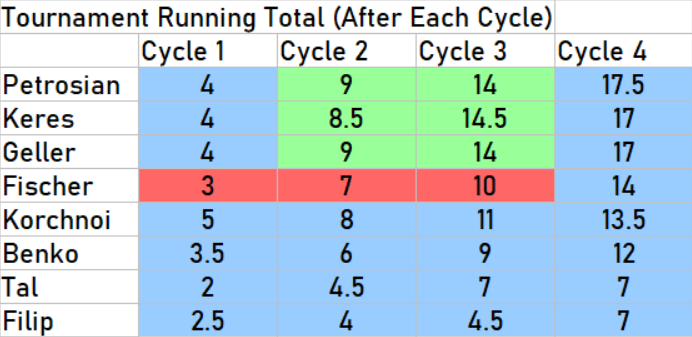
As for Kortchnoi, I did say in my post that it was unlikely he was part of the collusion given his history.
Not just 'unlikely', but zero evidence at all.
All this info is from my blog:
https://lichess.org/@/RuyLopez1000/blog/did-the-soviets-collude-against-bobby-fischer/jM3BjNcI
@danthedestroyer317 said [^](/forum/redirect/post/42LEx0o6)
> Thanks for your comment @RuyLopez1000. I think it's widely accepted that the Soviets drew their games on purpose.
Sure it may be 'widely accepted', but widely accepted doesn't mean it's right.
>From the wikipedia article (https://en.wikipedia.org/wiki/World_Chess_Championship_1963#Candidates_Tournament):
I am a big proponent of looking at *primary sources* when investigating history. I understand that you were going off information in the Wikipedia article. I did the same thing you as you in an earlier blog. But then I decided to look at the matter closely and discovered that people have downplayed the extent of Fischer's claims and also falsely said that they were supported by the evidence, which they were not.
> "The first allegation, of the drawing pact, is widely assumed to be correct. Yuri Averbakh, who was head of the Soviet team, said in a 2002 interview that it was in their interests to draw for reasons not related to Fischer. He said Keres was the oldest competitor and wanted to conserve energy, and that Petrosian and Geller were good friends with a history of drawing with each other. "
> The head of the Soviet team admitted they drew the games on purpose
'in their interests to draw' is not the same as 'admitting they drew they games on purpose'.
**Averbakh discusses Petrosian draws.**
> "Yuri Averbakh [...] said that "draws are a matter of style. Bobby is an aggressive player who shuns the draw, while Petrosian is not." Averbakh told the story of the game Bannik-Petrosian, an 11 move draw in a recent Russian Championship, where the judges immediately complained about the brevity of the game. Petrosian defended himself by replying that the game was a " theoretical draw" and that he would have to compromise his position in order to win- a risk he was reluctant to take."
>"Averbakh also recalled a 1961 Soviet chess cartoon that depicted Geller and Petrosian sawing away together at a large wooden point and ending up with numerous half-points as shavings. The caption read : "The Fruits of a Long Friendship ." Further evidence of Petrosian's policy of non-aggression was his offers of draws to Fischer and Keres in the final rounds at Curacao, in positions in which he had a distinct advantage."
Eliot Hearst, Chess Life Magazine, Challenges At Curacao, p.8, August 1962.
https://uscf1-nyc1.aodhosting.com/CL-AND-CR-ALL/CL-ALL/1962/1962_08.pdf
>but claimed it wasn't related to Fischer...
>given the political situation at the time I think this is probably not true
We know it's true *(edit -accidentally wrote not true)*. For all the reasons I listed above.
*Secondly, Fischer did not manage to reach the top of the tournament standings*
*Fourthly, prearranging draws could not stop Fischer if he won more games. Only 8 of the 27 games are accounted by the draws of Petrosian, Geller and Keres. The Soviets could not reasonably keep the World Championship to their selves by just drawing games with each other.*
"At present the safest comment to make is that Petrosian, Keres, and Geller have played a large number of draws with each other in the past, and therefore the persistent draws at Curacao give no evidence of anything particularly suspicious."
"It's true, also, that Fischer's poor start, and the immediate rise of four Russians to the top of the scoretable, made it rather convenient for the Soviet stars to continue their point-splitting course. If Bobby had won his first few games, draws among the Russians would have been the worst possible course for them to follow, since that procedure would have placed them further and further behind the American."
Eliot Hearst, Chess Life Magazine, Challenges At Curacao, p.8, August 1962.
https://uscf1-nyc1.aodhosting.com/CL-AND-CR-ALL/CL-ALL/1962/1962_08.pdf
No one agreed with Fischer at the time because they could see his claims were groundless.
Fischer started poorly in the tournament, he only caught up to fourth late in the tournament.

> As for Kortchnoi, I did say in my post that it was unlikely he was part of the collusion given his history.
Not just 'unlikely', but zero evidence at all.
All this info is from my blog:
https://lichess.org/@/RuyLopez1000/blog/did-the-soviets-collude-against-bobby-fischer/jM3BjNcI
@tpr Thanks for the clarification. I know he played a number of high-level events, I meant that he was not part of the fight for the World Championship and was much less active. I could have worded this a bit better.
@RuyLopez1000 Thanks for the detailed analysis. Perhaps we can agree to disagree on this one. I don't think there is "zero evidence at all" as you say. Twelve straight draws in an average of 19 moves per draw AND the comment of Averbakh that it was "in their interests to draw" is rather strong evidence if you ask me. But I respect your analysis and opinion.
@tpr Thanks for the clarification. I know he played a number of high-level events, I meant that he was not part of the fight for the World Championship and was much less active. I could have worded this a bit better.
@RuyLopez1000 Thanks for the detailed analysis. Perhaps we can agree to disagree on this one. I don't think there is "zero evidence at all" as you say. Twelve straight draws in an average of 19 moves per draw AND the comment of Averbakh that it was "in their interests to draw" is rather strong evidence if you ask me. But I respect your analysis and opinion.
"he was not part of the fight for the World Championship"
- He played and won Interzonals that qualified for Candidates' tournaments, but then he refused to play in those Candidates' tournaments as he vowed he would never play in such a Candidates' tournament again. So at least Fischer felt strongly the Soviet players had colluded against him and that was also what he wrote.
About Claim 3: Soviet players gave each other advice during the games.: Fischer wrote he heard them talking about the position in Russian. Fischer knew Russian.
"he was not part of the fight for the World Championship"
* He played and won Interzonals that qualified for Candidates' tournaments, but then he refused to play in those Candidates' tournaments as he vowed he would never play in such a Candidates' tournament again. So at least Fischer felt strongly the Soviet players had colluded against him and that was also what he wrote.
About Claim 3: Soviet players gave each other advice during the games.: Fischer wrote he heard them talking about the position in Russian. Fischer knew Russian.
"he was not part of the fight for the World Championship"
- He played and won Interzonals that qualified for Candidates' tournaments, but then he refused to play in those Candidates' tournaments as he vowed he would never play in such a Candidates' tournament again. So at least Fischer felt strongly the Soviet players had colluded against him and that was also what he wrote.
I feel like it's Groundhog Day today :)
From our discussion 6 months ago:
@tpr said
Anyway, the fact that Fischer wrote the article, that he never ever played a Candidates' Tournament, and that FIDE changed from Candidates' Tournament to Candidates' Matches supports Fischer was right.
@RuyLopez1000 said
"The fact that Fischer wrote the article" - So if Bobby Fischer says anything, then it means he's automatically right. The whole point of the blog post was to analyze his claims.
"FIDE changed from Candidates' Tournament to Candidates' Matches supports Fischer was right" - No it doesn't, I already showed why Fischer wasn't right in the blog post. FIDE's motivation may have been to induce Fischer to play, and/or to stop tournament leaders from sitting on their points by playing quick draws (as Petrosian, Geller and Keres did).
About Claim 3: Soviet players gave each other advice during the games.: Fischer wrote he heard them talking about the position in Russian. Fischer knew Russian.
6 months ago:
@tpr said
Bear in mind that Fischer knew Russian (he had learned it to be able to read and understand Soviet chess literature) so he could hear and understand what the Soviet players were saying to each other behind his board.
I wonder about Petrosian, because he was deaf.
@RuyLopez1000 said
Regarding Fischer's Russian, he said in 'The Russians Have Fixed World Chess' 1962 Article: "I studied Russian enough to be able to read their chess books, and I could easily understand what they were saying. They would say this move is good, or that move is good—in Russian, of course. My Russian isn't the greatest but, believe me, they weren't talking about the weather."
Now I just wonder why I couldn't find any sources backing Fischer's claim. If you can show me some sources then I will amend my blog post and give you credit. But it is striking that no one else in the Candidates tournament said this occurred (American Benko was playing, so was Korchnoi - he could have said this happened in his biography if this occurred - no reason for him to be shy considering his relationship with some of the Soviet players).
@tpr said
"any sources backing Fischer's claim" * Fischer sits at his board, behind his back 2 Soviet players talk in Russian. Who can corroborate that? Only Fischer could hear and understand what they were saying. If there is any source, then it must be some form of complaint by Fischer to to arbiter.
"Benko was playing, so was Korchnoi" * Then they could not hear it."
@RuyLopez1000 said
Have a look at this photo from the candidates. You can see Fischer at the left back. The other players are only meters away. https://images.chesscomfiles.com/uploads/images_users/tiny_mce/MACRINUS/phpvTuior.jpeg.

@tpr said [^](/forum/redirect/post/L5VJFA5P)
> "he was not part of the fight for the World Championship"
> * He played and won Interzonals that qualified for Candidates' tournaments, but then he refused to play in those Candidates' tournaments as he vowed he would never play in such a Candidates' tournament again. So at least Fischer felt strongly the Soviet players had colluded against him and that was also what he wrote.
**I feel like it's Groundhog Day today :)**
From our discussion 6 months ago:
@tpr said
>Anyway, the fact that Fischer wrote the article, that he never ever played a Candidates' Tournament, and that FIDE changed from Candidates' Tournament to Candidates' Matches supports Fischer was right.
@RuyLopez1000 said
>"The fact that Fischer wrote the article" - So if Bobby Fischer says anything, then it means he's automatically right. The whole point of the blog post was to analyze his claims.
>"FIDE changed from Candidates' Tournament to Candidates' Matches supports Fischer was right" - No it doesn't, I already showed why Fischer wasn't right in the blog post. FIDE's motivation may have been to induce Fischer to play, and/or to stop tournament leaders from sitting on their points by playing quick draws (as Petrosian, Geller and Keres did).
>> About Claim 3: Soviet players gave each other advice during the games.: Fischer wrote he heard them talking about the position in Russian. Fischer knew Russian.
6 months ago:
@tpr said
>Bear in mind that Fischer knew Russian (he had learned it to be able to read and understand Soviet chess literature) so he could hear and understand what the Soviet players were saying to each other behind his board.
I wonder about Petrosian, because he was deaf.
@RuyLopez1000 said
>Regarding Fischer's Russian, he said in 'The Russians Have Fixed World Chess' 1962 Article: "I studied Russian enough to be able to read their chess books, and I could easily understand what they were saying. They would say this move is good, or that move is good—in Russian, of course. My Russian isn't the greatest but, believe me, they weren't talking about the weather."
>Now I just wonder why I couldn't find any sources backing Fischer's claim. If you can show me some sources then I will amend my blog post and give you credit. But it is striking that no one else in the Candidates tournament said this occurred (American Benko was playing, so was Korchnoi - he could have said this happened in his biography if this occurred - no reason for him to be shy considering his relationship with some of the Soviet players).
@tpr said
>"any sources backing Fischer's claim" * Fischer sits at his board, behind his back 2 Soviet players talk in Russian. Who can corroborate that? Only Fischer could hear and understand what they were saying. If there is any source, then it must be some form of complaint by Fischer to to arbiter.
>"Benko was playing, so was Korchnoi" * Then they could not hear it."
@RuyLopez1000 said
>Have a look at this photo from the candidates. You can see Fischer at the left back. The other players are only meters away. https://images.chesscomfiles.com/uploads/images_users/tiny_mce/MACRINUS/phpvTuior.jpeg.
@danthedestroyer317 said ^
@RuyLopez1000 Thanks for the detailed analysis. Perhaps we can agree to disagree on this one.
Twelve straight draws in an average of 19 moves per draw AND the comment of Averbakh that it was "in their interests to draw" is rather strong evidence if you ask me.
If you propose we should 'agree to disagree' then why are you continuing the debate.
But I respect your analysis and opinion.
Eh. You didn't bother reading what I wrote. I addressed those points but you ignored me. Doesn't sound like respect.
This response overall is just a way to be dismissive of what I'm saying while trying to get the final word in.
As I wrote above, Averbakh dismissed the idea that Petrosian and Geller's draws were targeted against Fischer.
This is what he said in the 2002 interview. https://chesscafe.com/skittles/skittles183.pdf
"TK: Very good. A lot of people think there was collusion there between Petrosian, Keres, and Geller, to make easy draws amongst themselves, while trying hard against Fischer.
Yuri Averbakh: Fischer is not objective on this situation. Let us see the situation the way it was. Keres was the oldest participant in this competition. The tournament was 28 rounds, I believe, about two months long, and Keres naturally wanted to save his strength for the end of the tournament.
Petrosian and Geller were friends, very close friends. If you look at the games they played in any competition, including Candidates Tournaments, every time, they made a draw. [This is neither literally true nor completely wrong. Before 1962, the Petrosian-Geller score stood at +3 –4 =15. However in their previous Candidates competition, Amsterdam 1956, their two games had decisive results, each winning one. Keres’ pre-1962 score was +6 –3 =8 against Geller, and +3 –3 =14 against Petrosian.]
So we have Petrosian and Geller, these two old friends, and Keres, for practical reasons, decided why not make draws with them, since then he saves his strength for the last part of the tournament. Then, what really happened in the last part of the tournament? Keres lost to Benko, when before he had a score of 7-0 against him [Actually +7 –0 =4 to that point].
But the law of averages was against him, because Benko was not such a bad player that he should lose 100% of his games to Keres. The second thing was, in the last round Keres, to win the tournament, had to beat Fischer. The oldest player needed to beat the youngest, a nearly impossible situation, of course he couldn’t win at that stage. This explains the psychological situation. And it was not against Fischer; Keres just wanted to conserve his strength."
TK: Some have thought that the Keres/Petrosian/Geller agreement at Curaçao worked against Keres, because he was maybe just a little better than the other two at that time.
Yuri Averbakh: No, the main point was “Who would be less tired?”. And a second point: if Fischer or Tal had played better, these draws would have worked in their favor. But Fischer started with two losses: he lost to Benko, and in the second round to Geller. And after that, the situation was such that it was not necessary to win as much. The draws worked only because Fischer and Tal were in bad form.
given the political situation at the time I think this is probably not true but of course this is my own opinion.
So Averbakh is lying 40 years later in 2002? @danthedestroyer317
@danthedestroyer317 said [^](/forum/redirect/post/WXfcp6ov)
> @RuyLopez1000 Thanks for the detailed analysis. Perhaps we can agree to disagree on this one.
>Twelve straight draws in an average of 19 moves per draw AND the comment of Averbakh that it was "in their interests to draw" is rather strong evidence if you ask me.
If you propose we should 'agree to disagree' then why are you continuing the debate.
>But I respect your analysis and opinion.
Eh. You didn't bother reading what I wrote. I addressed those points but you ignored me. Doesn't sound like respect.
This response overall is just a way to be dismissive of what I'm saying while trying to get the final word in.
As I wrote above, Averbakh dismissed the idea that Petrosian and Geller's draws were targeted against Fischer.
------------
This is what he said in the 2002 interview. https://chesscafe.com/skittles/skittles183.pdf
*"TK: Very good. A lot of people think there was collusion there between Petrosian, Keres, and Geller, to make easy draws amongst themselves, while trying hard against Fischer.*
Yuri Averbakh: Fischer is not objective on this situation. Let us see the situation the way it was. Keres was the oldest participant in this competition. The tournament was 28 rounds, I believe, about two months long, and Keres naturally wanted to save his strength for the end of the tournament.
Petrosian and Geller were friends, very close friends. If you look at the games they played in any competition, including Candidates Tournaments, every time, they made a draw. [This is neither literally true nor completely wrong. Before 1962, the Petrosian-Geller score stood at +3 –4 =15. However in their previous Candidates competition, Amsterdam 1956, their two games had decisive results, each winning one. Keres’ pre-1962 score was +6 –3 =8 against Geller, and +3 –3 =14 against Petrosian.]
So we have Petrosian and Geller, these two old friends, and Keres, for practical reasons, decided why not make draws with them, since then he saves his strength for the last part of the tournament. Then, what really happened in the last part of the tournament? Keres lost to Benko, when before he had a score of 7-0 against him [Actually +7 –0 =4 to that point].
But the law of averages was against him, because Benko was not such a bad player that he should lose 100% of his games to Keres. The second thing was, in the last round Keres, to win the tournament, had to beat Fischer. The oldest player needed to beat the youngest, a nearly impossible situation, of course he couldn’t win at that stage. This explains the psychological situation. And it was not against Fischer; Keres just wanted to conserve his strength."
*TK: Some have thought that the Keres/Petrosian/Geller agreement at Curaçao worked against Keres, because he was maybe just a little better than the other two at that time.*
Yuri Averbakh: No, the main point was “Who would be less tired?”. And a second point: if Fischer or Tal had played better, these draws would have worked in their favor. But Fischer started with two losses: he lost to Benko, and in the second round to Geller. And after that, the situation was such that it was not necessary to win as much. The draws worked only because Fischer and Tal were in bad form.
>given the political situation at the time I think this is probably not true but of course this is my own opinion.
So Averbakh is lying 40 years later in 2002? @danthedestroyer317
"So Averbakh is lying 40 years later in 2002?"
- So Fischer was lying all the time and for no real reason did not play the candidates' tournaments he was qualified for by winning interzonals?
"So Averbakh is lying 40 years later in 2002?"
* So Fischer was lying all the time and for no real reason did not play the candidates' tournaments he was qualified for by winning interzonals?